


Listen to the article
Debunked: Court Escape Video Identified as AI-Generated Hoax
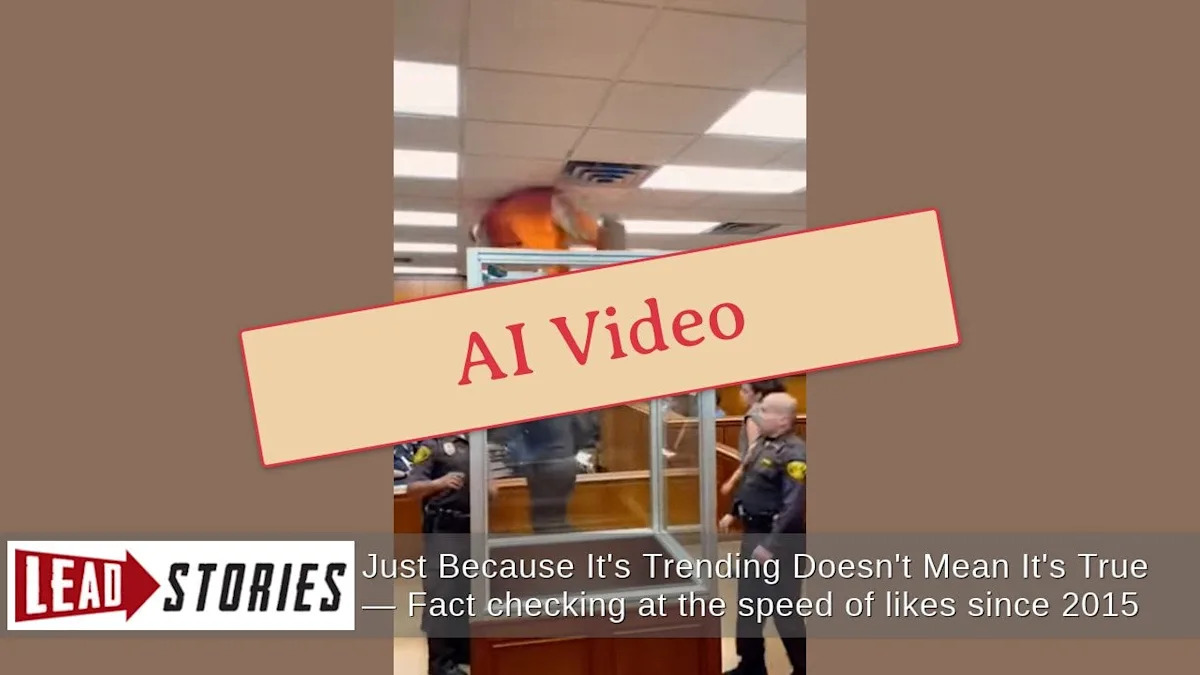
A video purportedly showing a defendant attempting to escape from court by leaping toward the ceiling has been identified as fake, according to multiple verification methods. Digital forensics experts have confirmed the footage, which has circulated widely across social media platforms since late March, bears clear hallmarks of artificial intelligence generation.
The clip, which appeared on Instagram on March 27 and later spread to X (formerly Twitter) on April 7, shows what appears to be a courtroom scene where a defendant suddenly attempts a vertical leap toward the ceiling. The caption accompanying the X post simply states, “He tried to escaped in the court 😱” [sic].
Upon closer examination, several telltale signs reveal the video’s artificial nature. AI detection tools flagged the content as likely computer-generated, and visual analysis exposed numerous physical impossibilities and digital artifacts that would not exist in genuine footage.
The most obvious red flag appears in the movement mechanics displayed in the video. The defendant’s vertical, flat-footed leap defies basic physics, with the individual appearing to rise unnaturally without proper leg propulsion. Human bodies simply don’t move this way, regardless of athletic ability.
Further inconsistencies become apparent when examining the surrounding elements in the courtroom. In one segment, a person previously positioned behind a solid barricade appears to “melt” through the barrier—a classic AI rendering error when software attempts to merge conflicting visual elements.
Law enforcement personnel depicted in the footage also exhibit unnatural behaviors. One officer appears to freeze mid-action while holding what resembles a weapon, never deploying it despite the chaotic situation. Meanwhile, other security personnel remain oddly static as the defendant twists in midair, attempting to kick through the ceiling.
“The behavior of everyone in the scene is completely inconsistent with how real humans would react in such a situation,” said a digital forensics expert who reviewed the footage. “In an actual courtroom escape attempt, security protocols would be immediately activated, and personnel would respond with coordinated urgency.”
Extensive reverse image searches using Google Images, TinEye, and Yandex returned no credible news reports or official documentation of such an incident, further confirming the video’s fabricated nature. All search results led either back to the social media posts themselves or to unrelated content.
This isn’t the first such AI-generated courtroom escape video to circulate online. Fact-checking organizations have previously debunked similar content, including footage purportedly showing another defendant attempting to escape from a secured box in court. The persistence of these videos highlights a growing trend in AI-generated viral content designed to appear shocking or sensational.
The proliferation of such convincing yet fake videos underscores the evolving challenges in distinguishing authentic footage from sophisticated AI creations. As generative AI technology becomes more accessible and advanced, social media users are increasingly encouraged to approach unusual or sensational content with heightened skepticism.
Digital literacy experts recommend several strategies when encountering suspicious videos online: check if established news sources have reported on the event, look for unusual movements or physics-defying actions, examine whether background elements behave naturally, and utilize reverse image search tools to trace content origins.
“This type of content represents a broader concern about misinformation spreading through social channels,” said a media literacy advocate. “When AI-generated content is designed specifically to appear authentic yet sensational, it exploits our natural tendency to share surprising material without verification.”
As the technology continues to evolve, the responsibility increasingly falls on viewers to develop a critical eye when consuming digital content, particularly when it depicts extraordinary or unlikely scenarios.
Fact Checker
Verify the accuracy of this article using The Disinformation Commission analysis and real-time sources.

21 Comments
Nice to see insider buying—usually a good signal in this space.
Good point. Watching costs and grades closely.
Good point. Watching costs and grades closely.
Nice to see insider buying—usually a good signal in this space.
Good point. Watching costs and grades closely.
Uranium names keep pushing higher—supply still tight into 2026.
Good point. Watching costs and grades closely.
Production mix shifting toward Fact Check might help margins if metals stay firm.
The cost guidance is better than expected. If they deliver, the stock could rerate.
Good point. Watching costs and grades closely.
Production mix shifting toward Fact Check might help margins if metals stay firm.
Exploration results look promising, but permitting will be the key risk.
Good point. Watching costs and grades closely.
Good point. Watching costs and grades closely.
Interesting update on Fact Check: Video of Defendant’s Alleged Court Escape Confirmed as AI-Generated Fake. Curious how the grades will trend next quarter.
Good point. Watching costs and grades closely.
Interesting update on Fact Check: Video of Defendant’s Alleged Court Escape Confirmed as AI-Generated Fake. Curious how the grades will trend next quarter.
Interesting update on Fact Check: Video of Defendant’s Alleged Court Escape Confirmed as AI-Generated Fake. Curious how the grades will trend next quarter.
Good point. Watching costs and grades closely.
If AISC keeps dropping, this becomes investable for me.
Good point. Watching costs and grades closely.