


Listen to the article
Global tensions escalated this week as claims of an Iranian attack on a U.S. Navy warship spread rapidly across social media platforms, further inflaming concerns about the ongoing crisis in the Strait of Hormuz. However, a detailed investigation has revealed these claims to be entirely fabricated.
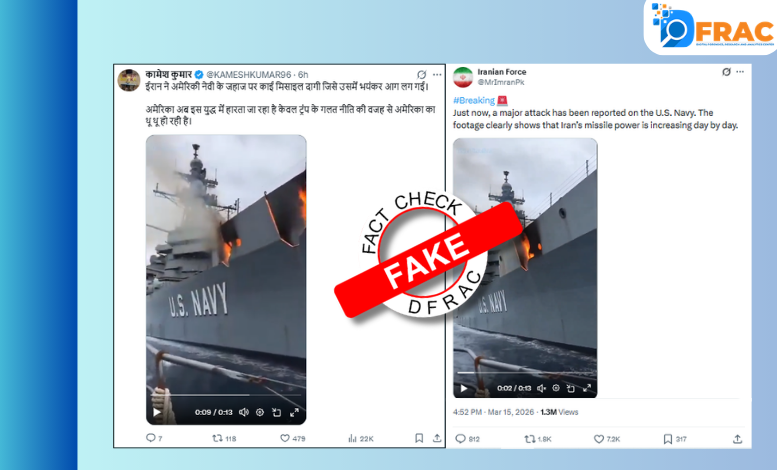
The viral video, which purportedly showed a U.S. Navy vessel in flames following an Iranian missile strike, has been confirmed to be an AI-generated fabrication rather than authentic footage of a military confrontation.
The claims emerged against the backdrop of Iran’s closure of the strategically vital Strait of Hormuz, a maritime chokepoint through which approximately 20% of the world’s petroleum supply passes. The closure has sent shockwaves through global energy markets and placed enormous diplomatic pressure on the United States to secure the reopening of this critical shipping lane.
Social media users, particularly one account named “Iranian Force,” shared the video with inflammatory captions suggesting Iran’s growing missile capabilities had successfully targeted American naval forces. The post claimed: “#Breaking Just now, a major attack has been reported on the U.S. Navy. The footage clearly shows that Iran’s missile power is increasing day by day.”
The video gained significant traction when users like Kamesh Kumar reshared it with political commentary, stating: “Iran fired a missile at a US Navy ship, causing a massive fire. America is now losing this war, and the country is facing humiliation solely due to Trump’s wrong policies.”
Digital forensic experts at DFRAC conducted a comprehensive investigation into the video’s authenticity. Their initial research found no corroborating reports from any credible media outlets about such an attack, which would represent a major escalation in the ongoing tensions.
Closer technical analysis revealed telltale signs of artificial intelligence generation, including unnatural patterns in the ship’s surface, unrealistic flame behavior, and suspicious smoke movement. The ship’s superstructure, radar equipment, and antennas displayed the blurring and distortion characteristics commonly found in AI-generated imagery.
To confirm these suspicions, the team employed specialized AI-detection tools including Hive Moderation and the University at Buffalo’s Deepfake-o-meter (AVSRDD 2025), both of which conclusively identified the video as artificially generated rather than authentic footage.
AI expert Mayank Sharma, consulted during the investigation, noted specific technical artifacts that betrayed the video’s origins. “The visual artifacts seen around the fire, smoke, and ship’s structure are common in AI-generated content,” Sharma explained. “The texture of the smoke, uneven edges, and sudden changes in detail in some frames indicate that this footage was algorithmically generated rather than recorded with an actual camera.”
Further investigation into the “Iranian Force” account that initially shared the video revealed a pattern of distributing false and misleading information. Despite claiming to represent Iranian military interests and listing a U.S. location, metadata from the account indicates it is actually operated from Pakistan, raising additional questions about the motivations behind spreading such disinformation during a geopolitical crisis.
This fabricated video emerges at a particularly sensitive time, as maritime security in the Persian Gulf region faces its most serious challenge in years. The Strait of Hormuz closure has already caused global oil prices to surge and disrupted supply chains worldwide.
Disinformation of this nature could potentially exacerbate an already volatile situation, potentially influencing market behavior and public opinion through manufactured evidence of military confrontations that never occurred.
The incident highlights the growing sophistication of AI-generated content and the challenges it presents for verifying information during international crises, particularly as tensions between Iran and Western powers continue to simmer over freedom of navigation in vital waterways.
Fact Checker
Verify the accuracy of this article using The Disinformation Commission analysis and real-time sources.

10 Comments
This is a concerning development if true. I hope the situation can be de-escalated before it leads to further conflict. Spreading unverified claims, even if intended to inflame tensions, seems irresponsible and could make the situation worse.
I agree, it’s critical that we rely on authoritative and verified information sources, especially on sensitive geopolitical issues like this. Fabricated footage and misinformation can have serious consequences.
While it’s a relief this video was confirmed as AI-generated rather than a genuine attack, the broader tensions and risks in the region remain deeply concerning. Diplomatic efforts to de-escalate the situation and protect critical shipping lanes should be the top priority.
The Strait of Hormuz is a strategic choke point, so any disruptions there can have significant global impacts. I’m glad the authorities were able to quickly identify and debunk this fabricated video, but the underlying geopolitical risks in the region still require close monitoring and careful management.
Absolutely. Maintaining open communication, de-escalating tensions, and upholding international norms will be crucial to navigating this situation safely and preventing further escalation.
It’s good that the authorities were able to quickly identify and debunk this fabricated video. Maintaining credibility and trust in information sources is critical, especially on matters of national security. Fact-checking and transparency are vital.
Completely agree. Unverified claims and misinformation can have serious real-world consequences, so we must remain vigilant and rely on reputable, well-sourced information. Journalistic integrity is paramount in these situations.
This serves as a reminder of the importance of verifying information, especially around complex geopolitical issues. Spreading unconfirmed claims, even inadvertently, can fan the flames of conflict. Responsible journalism and open dialogue are crucial here.
The Strait of Hormuz is a strategically vital shipping lane, so any disruption there has major global implications. I’m glad this video has been confirmed as fabricated, but the underlying tensions and risks in the region remain worrying.
Absolutely. Even unintentional escalations or miscalculations could have devastating effects. All sides need to exercise maximum restraint and pursue diplomatic resolutions to de-escalate the situation.