


Listen to the article
Vance Tells Michigan Gas Price Spike “Temporary” as Conflict With Iran Continues
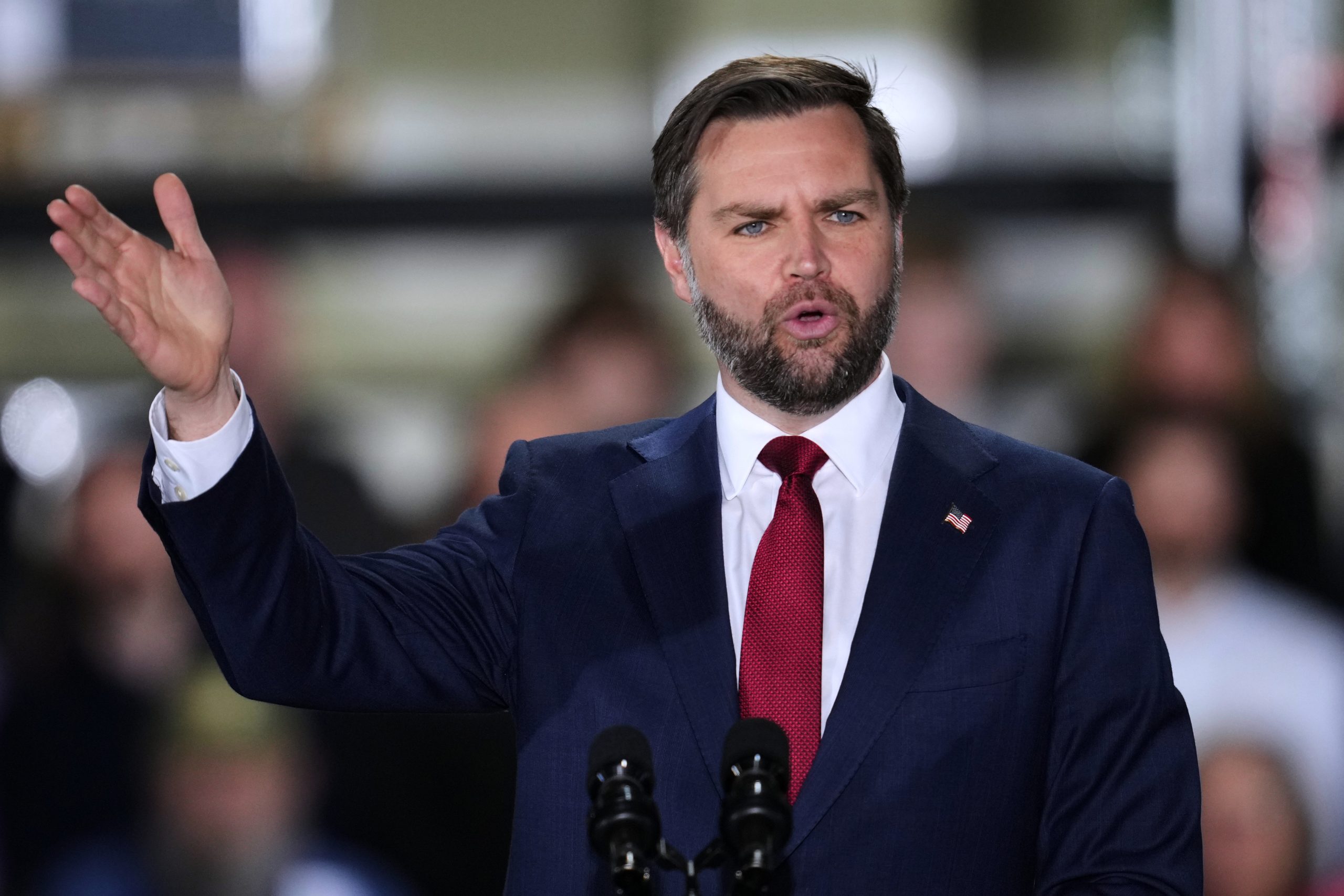
Gas prices may remain elevated in coming weeks due to ongoing conflict in the Middle East, Vice President JD Vance told a Michigan audience Wednesday, characterizing the situation as a “blip” that the Trump administration is actively addressing.
“We’ve got a rough road ahead of us for the next few weeks, but it’s temporary,” Vance said during remarks at the EDSI manufacturing facility in Auburn Hills, where he promoted the administration’s economic policies and tax cuts.
The national surge in gas prices follows recent U.S. and Israeli military strikes against Iran, which responded by restricting access to a crucial strait through which approximately one-fifth of the world’s crude oil passes.
Michigan motorists are feeling the pinch at the pump, with AAA reporting an average cost of $3.87 per gallon on Wednesday—nearly a dollar higher than the $2.92 average just a month ago and well above the $3.02 average from this time last year.
During the roughly hour-long event that included a press conference, Vance acknowledged the financial strain on consumers but predicted a swift resolution to the price surge.
“It’s not going to last forever,” he said. “We’re going to take care of business. We’re going to come back home, and when that happens, you’re going to see energy prices come back down to reality.”
Vance pointed out that gas prices reached even higher levels under former President Biden, hitting a record $5.22 per gallon in Michigan in June 2022 amid post-pandemic economic recovery and Russia’s invasion of Ukraine. However, critics noted that prices had already stabilized well before Trump’s return to office, with Michigan’s average at $3.14 per gallon the day before his inauguration.
Discussing the ongoing military situation, Vance emphasized that President Trump “is not interested in getting us…in the kind of long-term quagmires that we’ve seen in years past.”
Critics Question Administration’s Economic Claims
Democratic leaders and energy policy experts remained skeptical of the administration’s ability to effectively reverse the recent price hikes. Jesse Lee, a senior advisor for the climate advocacy group Climate Power, dismissed Vance’s speech as “damage control,” while Michigan Democratic Party Chair Curtis Hertel argued that “Trump’s agenda is putting lives at risk, hurting Michigan’s manufacturing industry and increasing costs of living.”
“No amount of lip service from Vance will make up for the fact that Republicans have made life less affordable for working families,” Hertel added.
Standing beside a banner reading “Jobs! Jobs! Jobs!,” Vance praised workers at the Auburn Hills facility for supporting what he described as an “American Renaissance in manufacturing.”
“The fact that we added over 2,000 manufacturing jobs in this state since Donald Trump became president is a testament to what you all make possible,” the vice president claimed.
Federal data shows Michigan did add approximately 2,100 manufacturing jobs between February and December of last year. However, almost all of that growth occurred during February, Trump’s first full month in office. From March through December, Michigan actually lost 5,500 manufacturing jobs.
The administration faces significant hurdles to fulfill Trump’s campaign promise that Michigan would “dominate like never before” in manufacturing. The state’s manufacturing sector employed over 800,000 workers throughout much of the 1990s but had declined to roughly 596,600 jobs by the end of 2025.
Uncertainty Over Gordie Howe Bridge Opening
When asked about the scheduled opening of the Gordie Howe International Bridge connecting Detroit to Windsor, Vance avoided directly answering whether the administration supported keeping the original timeline. His response followed Trump’s threat last month to potentially delay the bridge’s opening.
The bridge, jointly owned by Michigan and Canada, is expected to serve as a vital economic connection between the two countries and provide significant economic benefits to the region.
“Our hope with Canada — and I think we’ll get there eventually — is, we’re going to get to a point where Canada treats our workers fairly, we treat their workers fairly, and they’re going to be a true ally and a true friend,” Vance said.
Immigration Enforcement Tensions
During his remarks, Vance also criticized Democratic opposition to the administration’s deportation policies, accusing the party of defending illegal immigration while the administration works to identify and remove people living in the U.S. without legal permission.
When questioned about concerns from local Michigan governments regarding planned Immigration and Customs Enforcement facilities in Romulus and Southfield, Vance emphasized that cooperation between local and federal authorities would prevent the type of conflicts seen recently in Minneapolis.
“So long as we’ve got the cooperation, and so long as we’re working as a team, the chaos that you see in Minneapolis, it’s not going to happen,” he said. “It only happens when we’ve got broken and dysfunctional political leadership that tries to stop us from doing our jobs.”
Deportations have increased significantly in Michigan over the past year, with the state hosting one of the Midwest’s largest immigration detention facilities.
Fact Checker
Verify the accuracy of this article using The Disinformation Commission analysis and real-time sources.

8 Comments
Promoting tax cuts as a solution to rising gas prices seems like an oversimplification. While they may provide some economic stimulus, the core issue is global supply and geopolitical tensions. I hope the administration has a more comprehensive strategy in the works.
Good point. Tax cuts alone are unlikely to be an effective solution for the current gas price crisis. A more holistic approach targeting both supply and demand factors would be needed.
The administration’s focus on tax cuts as a solution to rising gas prices is concerning. While they may provide some economic stimulus, the core issue is global supply and demand factors beyond the control of domestic policy. I hope the administration has a more nuanced strategy in development.
Vance’s characterization of the situation as a “blip” seems overly optimistic. With tensions in the Middle East and other global factors at play, gas prices could remain elevated for some time. I hope the administration is prepared to provide meaningful relief to consumers.
Interesting to hear Vance’s take on the gas price spike. While the situation in the Middle East is certainly a factor, I’m curious to know what other policies the administration plans to enact to help alleviate the strain on consumers in the meantime.
I agree, it will be important to see what concrete steps are taken to address the rising gas prices in the short term. Temporary relief may not be enough for many struggling households.
While it’s encouraging to hear the administration acknowledging the strain on consumers, I’m skeptical of their ability to quickly resolve the gas price surge. Geopolitical issues can be unpredictable, and long-term solutions may be needed to ensure price stability.
Agreed. Vance’s assurances of a swift resolution seem overly optimistic given the complex global dynamics at play. Consumers will likely need more than temporary relief measures to weather this price spike.