


Listen to the article
Trump Touts Economic Wins in Michigan Despite Mixed Reality on Costs
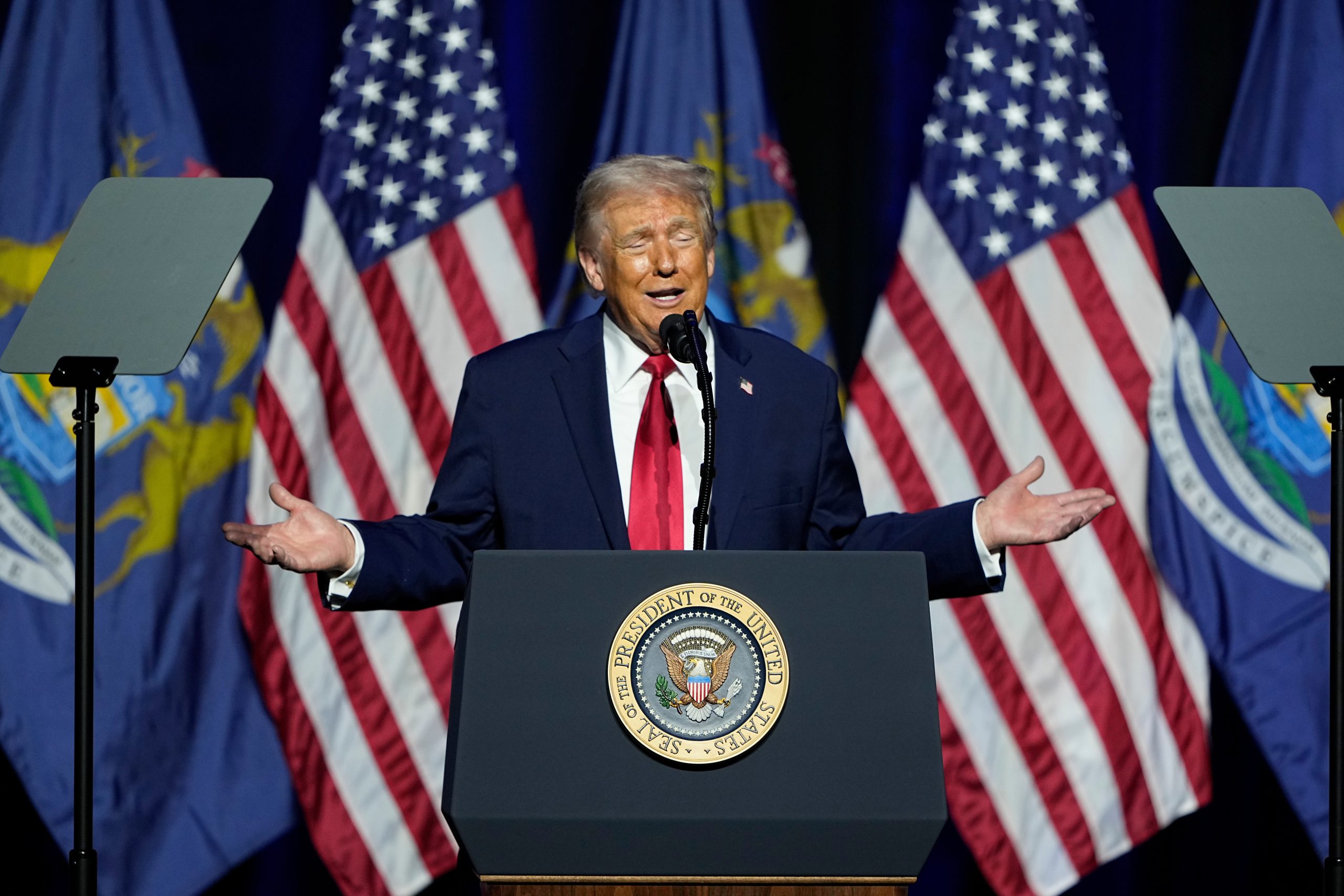
President Donald Trump returned to Michigan Tuesday, declaring a major economic revival under his administration while downplaying persistent inflation concerns that continue to affect many residents’ daily lives.
“Investment is booming, incomes are rising, inflation is defeated, America is respected again,” Trump told members of the Detroit Economic Club at the MotorCity Casino Sound Board theater. He characterized his policies as creating the “strongest and fastest economic turnaround in our country’s history.”
During his address, Trump claimed grocery prices are “starting to go rapidly down,” along with rent, airfares, hotel rates, and cell phone prices. However, federal data released just hours before his speech painted a more nuanced picture.
The U.S. Bureau of Labor Statistics reported grocery prices rose 2.7% nationally in 2025, including a 0.7% increase in December alone. “Five of the six major grocery store food group indexes increased in December,” the report stated. Similarly, rent growth has slowed but continues to rise according to Zillow data, while the American Hotel and Lodging Association reports average hotel rates increased slightly in 2025.
Trump did correctly note some positive economic indicators. Airfares have decreased during his second term, and he highlighted that motorists can currently fill up for as low as $2.30 at some Detroit-area stations.
Before his speech, the president toured Ford Motor Company’s Dearborn assembly plant with Executive Chairman Bill Ford and CEO Jim Farley, where F-150 models are manufactured. Both executives praised Trump during a brief exchange with reporters.
“Business is better than ever” for Ford and other Big Three automakers, Trump claimed. His administration pointed to domestic sales data showing Ford and GM both made gains in 2025, though Stellantis saw U.S. sales decrease.
Tariffs and Trade Policy
A cornerstone of Trump’s economic strategy has been his aggressive use of tariffs on imported cars, vehicle parts, steel, and aluminum. During his Detroit address, he credited these policies with driving economic success.
“Every prediction the critics made about our tariff policy has failed to materialize,” Trump claimed. “The evidence shows overwhelmingly that the tariffs are not paid by American consumers, they’re paid by foreign nations.”
Economic research tells a more complex story. A December 2025 analysis from economists at Harvard and the University of Chicago determined prices have increased and U.S. businesses have absorbed much of the added costs. However, tariff exemptions, shipping lags, and enforcement gaps have moderated the overall economic impact.
Michigan’s strong trading relationship with Canada and its robust auto manufacturing sector initially raised concerns about potential negative impacts from steep tariffs. University of Michigan economists had initially predicted the state could lose 13,000 jobs due to higher tariffs, but an updated report in late 2025 found the measures would ultimately result in a “small positive” for domestic auto production.
“We still expect the tariffs to add over $3,000 on average, to the price of a car,” said U-M economist Gabe Ehrlich on Tuesday. The U.S. Supreme Court is expected to rule soon on whether Trump had the authority to unilaterally impose these tariffs.
Mixed Economic Indicators
Trump’s visit comes as Michigan shows mixed economic signals. Through September, the state added approximately 20,000 jobs in 2025, according to federal data. While Michigan’s unemployment rate dropped 0.2 percentage points in November to 5%, it remains among the highest jobless rates nationwide.
Real average hourly earnings increased 1.1% nationally in 2025, meaning wage growth slightly outpaced inflation. However, Michiganders earn about 4% less than the national average, even when accounting for the state’s lower cost of living, according to Ehrlich.
For Michigan renters, the situation is particularly challenging. Data from Zillow shows average rents have increased nearly 45% in the Grand Rapids area since 2015 and 35% in metro Detroit, outpacing the national average.
Consumer confidence did lift slightly in December, according to a University of Michigan survey, but remains nearly 30% below the same time in 2024.
Protests and Opposition
While Trump spoke inside, hundreds of protesters gathered outside in Detroit’s Corktown neighborhood, many holding signs opposing his immigration policies with messages like “ICE out of Detroit” and “Fight Trump’s agenda.”
“Deportation, we say no! Donald Trump has got to go!” chanted demonstrators in the rain, protesting the administration’s aggressive crackdown on illegal immigration.
Some protesters expressed skepticism about Trump’s promised “Michigan miracle.” Debbie Rosenman, 69, of Bloomfield Township, said flatly: “He will not do any of that. He doesn’t care about anybody but himself. There will be a Michigan miracle when we turn over our leadership.”
Inside, Trump reiterated his unproven claims of election fraud in 2020 and alleged without evidence that Senate candidate Mike Rogers had “won” his 2024 race against Democrat Elissa Slotkin, despite Rogers having conceded after losing by a narrow margin.
As Trump approaches the one-year mark of his second term, his economic promises remain a work in progress. While he’s made headway on some campaign pledges like tax cut extensions and implementing tariffs, the “Michigan miracle” he promised voters during his campaign remains distant for many residents still grappling with elevated costs of living.
Fact Checker
Verify the accuracy of this article using The Disinformation Commission analysis and real-time sources.

14 Comments
While Trump may tout certain economic gains, the data suggests a more nuanced picture, with persistent inflation and other cost-of-living pressures. It’s important to look beyond the rhetoric and examine the underlying trends and challenges.
The speech seems to highlight Trump’s tendency to prioritize headline-grabbing claims over the more complex realities of the economy. It will be important for voters to look beyond the rhetoric and examine the underlying data.
This speech is a prime example of how politicians can manipulate data and statistics to support their preferred narrative. It’s a good reminder to always cross-reference claims with credible, independent sources.
While Trump may have a point about certain economic indicators, the broader data paints a more complex picture. Voters should be wary of overly simplistic claims and look for a balanced, data-driven analysis.
Well said. Fact-checking and critical analysis are crucial for cutting through political rhetoric and getting to the heart of economic realities.
While Trump may tout certain economic gains, the data suggests inflation and other cost-of-living pressures continue to weigh on many households. A nuanced, fact-based assessment is crucial for understanding the true state of the economy.
Absolutely. Cutting through the political spin to get a clear, unbiased picture of economic conditions is essential for making informed decisions as voters and citizens.
This speech highlights Trump’s tendency to exaggerate economic gains while downplaying the real costs and challenges facing many Americans. While some metrics may have improved, the data suggests a more nuanced picture on inflation and other factors.
Agreed, it’s important to look at the full picture and not just cherry-pick favorable statistics. Fact-checking is crucial to provide a balanced perspective on economic conditions.
The contrast between Trump’s rhetoric and the federal data highlights the importance of approaching economic and political claims with a discerning eye. Objective, evidence-based analysis is key to understanding the true state of affairs.
This speech seems to be a prime example of cherry-picking data to support a particular narrative. It’s a good reminder that voters should always seek out a range of credible sources and perspectives when evaluating economic and political claims.
Absolutely. Relying on a single source or taking claims at face value can lead to a distorted understanding of complex issues. Maintaining a critical and balanced approach is essential.
It’s interesting to see the contrast between Trump’s rosy portrayal of the economy and the more nuanced federal data. Curious to hear perspectives on how this might impact public perceptions and political narratives.
Good point. Selective use of data to support a particular narrative is a common political tactic, but it can distort the reality that many Americans are experiencing in their daily lives.