


Listen to the article
Trump’s State of the Union Address Marred by Numerous False Claims
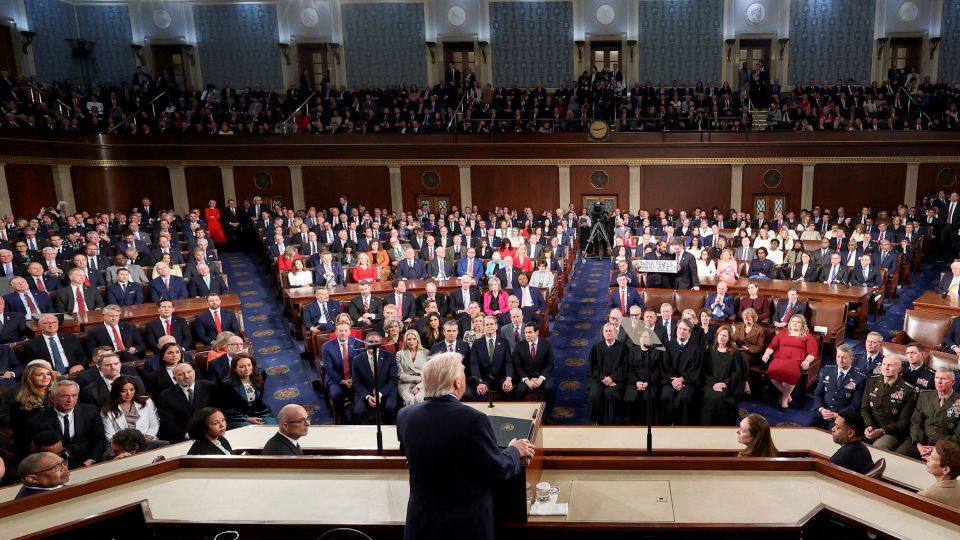
President Donald Trump delivered his State of the Union address to Congress on Tuesday night, but fact-checkers quickly identified numerous false or misleading statements throughout his speech, particularly regarding economic achievements and immigration policies.
The president made a series of claims about the economy that distorted reality. Despite declaring that he inherited a “stagnant economy” that is now “roaring like never before,” economic data tells a different story. The U.S. economy grew just 2.2% in 2025, lower than any year during the Biden presidency, which saw 2.8% growth in 2024. The unemployment rate actually increased from 4.0% when Trump took office in January 2025 to 4.3% in January 2026.
Trump repeatedly asserted that he had secured “$18 trillion in investments” pouring into the United States from around the globe. This figure appears to be entirely fictional. The White House’s own website placed the figure for “major investment announcements” at $9.7 trillion, and even that number has been called into question by detailed analysis showing it includes vague pledges and statements that don’t constitute actual investments.
On gasoline prices, the president claimed prices were “now below $2.30 a gallon in most states, and in some places, $1.99 a gallon.” Data from AAA contradicted this assertion, showing no state with an average below $2.37 per gallon on the day of his speech, with only two states averaging below $2.50. According to GasBuddy, merely four stations nationwide were selling gas below $2 per gallon, representing about 0.003% of all gas stations tracked by the firm.
Trump falsely stated that he inherited “inflation at record levels” and that the Biden administration gave America “the worst inflation in the history of our country.” In reality, inflation was at 2.9% in Biden’s last full month in office, far below the all-time high of 23.7% set in 1920. While inflation did hit a 40-year peak of 9.1% in June 2022, it had declined significantly by the time Trump took office.
The president twice incorrectly claimed that foreign countries are paying for his tariffs. Economic analyses from the Federal Reserve Bank of New York and the Congressional Budget Office have found that nearly 90-95% of tariff costs are being borne by U.S. businesses and consumers, not foreign entities.
On immigration, Trump repeated his false claim that the Biden administration allowed “11,888 murderers” to enter the country. This figure actually represents non-citizens who entered over many decades, including during Trump’s first term, who were convicted of homicide at some point (usually in the U.S. after arrival) and are on Immigration and Customs Enforcement’s “non-detained docket” – many of whom are currently serving prison sentences.
Trump’s assertion that he “ended eight wars” in his first ten months was another exaggeration. Several conflicts he listed weren’t actual wars, including a diplomatic dispute between Egypt and Ethiopia over a dam project. Others, like the conflict in the Democratic Republic of Congo, continue despite peace agreements.
Regarding NATO, Trump overstated U.S. contributions, claiming America was “paying for almost all of NATO” before his intervention. NATO figures show U.S. defense spending constituted about 72% of total NATO defense spending in 2016 and 63% in 2024 – significant portions but not “almost all.” The U.S. contribution to NATO’s organizational budget was around 22% when Trump first took office in 2017 and about 16% when he returned in 2025.
Trump also made misleading claims about his domestic policy achievements, including falsely stating that he eliminated taxes on Social Security. While his “big, beautiful bill” created a temporary additional tax deduction for some individuals aged 65 and older, millions of Social Security recipients will continue paying taxes on their benefits.
His claim that eliminating fraud in federal programs would balance the budget “overnight” is mathematically impossible. The Government Accountability Office estimates annual fraud losses between $233 billion and $521 billion, while the federal budget deficit was nearly $1.8 trillion in the most recent fiscal year – more than triple the highest estimated fraud total.
Throughout his address, Trump continued to promote unfounded claims about U.S. elections being “rampant” with cheating, despite overwhelming evidence that voter fraud is exceedingly rare in American elections.
The president’s tendency to embellish or fabricate statistics was on full display during what should have been a serious policy address to the nation, undermining the credibility of his broader agenda and raising questions about the administration’s commitment to factual governance.
Fact Checker
Verify the accuracy of this article using The Disinformation Commission analysis and real-time sources.

7 Comments
I’m curious to see how Trump’s supporters react to these fact-checks. Will they double down on his claims or acknowledge the discrepancies between his rhetoric and the data?
It’s concerning to see a pattern of false or misleading statements, especially around economic performance and investment. Fact-checking is crucial to hold leaders accountable and inform the public.
As an investor, I pay close attention to economic indicators and trends. Distortions or fabrications around these figures are troubling and can impact market decisions if not properly corrected.
Interesting to see the fact-checking on Trump’s claims. The economy data tells a different story than what he presented. Looks like some cherry-picking and exaggeration going on there.
This is a good reminder that we need to be vigilant and fact-check claims, even from the highest levels of government. Rhetoric doesn’t always match reality, especially when it comes to complex economic data.
Absolutely. Maintaining a critical eye and not taking everything at face value is so important, especially for issues that can impact investments and the broader economy.
The $18 trillion figure seems quite dubious – good to see it called out as likely fictional. Detailed analysis is important to cut through the rhetoric and get the real facts.