


Listen to the article
Trump’s Tariff Claims Fall Short of Economic Reality, Analysis Shows
President Donald Trump’s recent assessment of his economic policies, particularly regarding tariffs, contains numerous inaccuracies and misrepresentations, according to a fact-check of his claims.
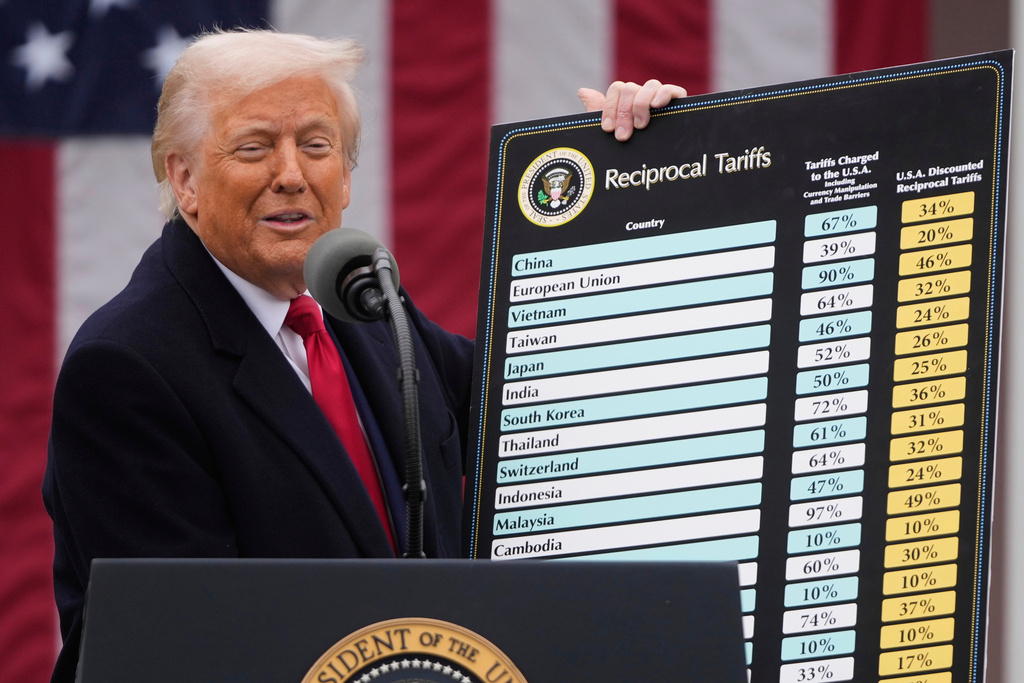
In a Wall Street Journal opinion piece, Trump portrayed his first year back in office as an “American economic miracle,” crediting his aggressive trade policies for transforming what he called a “DEAD” country into the “HOTTEST” economy worldwide.
However, economic data tells a more nuanced story. When Trump returned to office in January 2025, he inherited an economy that was far from moribund. Under the Biden administration, U.S. GDP grew 2.8% in 2024, outpacing nearly all wealthy nations except Spain, with healthy growth rates from 2021 through 2023.
Trump’s tariff policies produced mixed economic results throughout 2025. In the first quarter, GDP actually contracted for the first time in three years, largely due to a surge in imports as companies rushed to purchase foreign goods before new tariffs took effect. Growth rebounded impressively in subsequent quarters – 3.8% from April to June and 4.4% from July to September – partly due to decreased imports reflecting the tariffs’ impact and strong consumer spending.
While Trump highlighted the stock market’s 52 new highs in 2025, he omitted that the S&P 500’s 17% gain trailed several international markets, including South Korea (71%), Hong Kong (29%), Japan (26%), Germany (22%), and the United Kingdom (21%).
The President’s inflation claims also misrepresent reality. His cited 1.4% annual core inflation figure relies on data distorted by the government shutdown in October and November, which disrupted data collection and forced the use of estimates that artificially lowered inflation figures. The more representative six-month core inflation rate stands at 2.6%, showing that inflation has largely leveled off rather than dramatically declined.
Harvard economist Alberto Cavallo, whose research Trump cited, found that the administration’s tariffs actually boosted overall inflation by approximately three-quarters of a percentage point. This contradicts Trump’s claim that “the burden of tariffs has fallen overwhelmingly on foreign producers and middlemen.”
In fact, Cavallo’s study concludes the opposite of what Trump claimed. The research found that “U.S. consumers were bearing roughly 43% of the tariff-induced border cost after seven months, with the remainder absorbed mostly by U.S. firms.” Cavallo noted that import prices hadn’t fallen significantly, suggesting foreign exporters did not reduce their pre-tariff prices enough to absorb a large share of the costs.
The President’s assertion that his administration “slashed our monthly trade deficit by an astonishing 77%” represents selective data use, comparing a particularly high deficit in January 2025 to an unusually low figure in October. The complete picture shows that from January through November 2025, the U.S. accumulated a trade deficit of nearly $840 billion, actually 4% higher than the same period in 2024.
Trump’s claim of securing $18 trillion in international investment commitments remains unsubstantiated. The White House has published a more modest figure of $9.6 trillion, while researchers at the Peterson Institute for International Economics calculated commitments at approximately $5 trillion from various countries and regions. These researchers expressed skepticism about whether these investments would fully materialize, citing vague agreements and questions about affordability.
Nevertheless, these investment figures represent substantial potential inflows compared to the $5.4 trillion annual pace of total private investment in the United States and the $151 billion in foreign direct investment recorded in 2024.
As Trump’s economic policies continue to evolve, the gap between his rhetoric and economic reality remains a subject of intense scrutiny among economists and policy analysts.
Fact Checker
Verify the accuracy of this article using The Disinformation Commission analysis and real-time sources.

9 Comments
This fact check underscores the importance of not oversimplifying complex economic issues. There are often multiple forces at play that can produce unexpected outcomes.
The mixed results highlighted in this piece demonstrate the challenges of using tariffs as an economic tool. Policymakers need to carefully weigh the potential costs and benefits.
The GDP contraction in the first quarter from a tariff-driven surge in imports is an interesting data point. It shows how tariffs can sometimes have counterproductive effects in the short term.
This fact check highlights the need to look beyond simplified narratives when assessing the real-world impacts of economic policies. The data tells a more complex story.
The fact that GDP grew strongly in subsequent quarters despite the tariffs suggests the economy may have other underlying strengths. It would be worth looking into what other factors contributed to that rebound.
It’s good to see a nuanced, data-driven analysis rather than accepting political claims at face value. This type of rigorous fact-checking is essential for informed public discourse.
The nuanced data seems to contradict the claims of an ‘economic miracle’ from tariffs. It’s important to rely on objective economic indicators rather than political rhetoric.
This highlights how economic performance is influenced by many factors, not just trade policy. A balanced, evidence-based approach is needed to assess the true impact of tariffs.
Interesting analysis. Tariffs can have complex and sometimes unintended effects on the economy. It’s important to look at the full picture rather than focus on any single policy or metric.