


Listen to the article
Viral Post Falsely Claims NBA Stars Support Philippine Vice President’s Presidential Bid
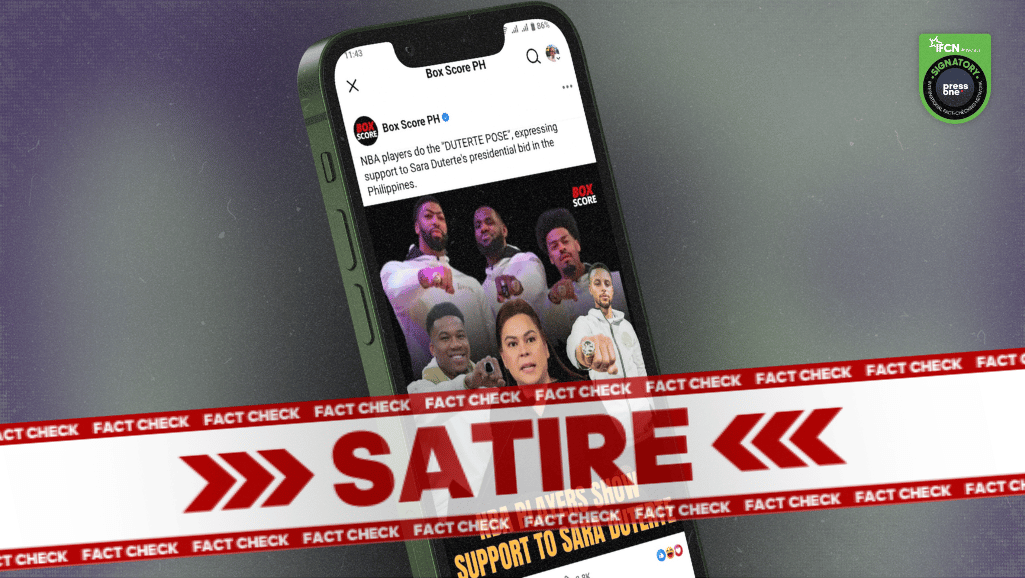
A misleading graphic claiming NBA superstars are supporting Philippine Vice President Sara Duterte’s presidential ambitions has gone viral on social media, spreading disinformation amid heightened political tensions in the Philippines.
The image, shared by verified Facebook page Box Score PH, features basketball stars LeBron James, Anthony Davis, Quinn Cook, Giannis Antetokounmpo, and Stephen Curry, with their fists raised showing off championship rings. The athletes’ poses are juxtaposed with a central image of Duterte, suggesting their gesture mimics the fist-bump symbol associated with the Duterte political brand.
An investigation into the images reveals the complete fabrication of this supposed endorsement. The photos of James, Davis, and Cook were taken in December 2020 during a Los Angeles Lakers championship ring ceremony before their game against the Clippers. Similarly, Antetokounmpo’s image comes from October 2021, when the Milwaukee Bucks star received his first championship ring prior to facing the Brooklyn Nets. Curry’s photo dates back to October 2018, showing the Golden State Warriors guard displaying his third NBA championship ring.
None of these athletes has made any public statement supporting Duterte or commented on Philippine politics. The composite image manipulates legitimate sports photography to create a false narrative of international athlete endorsement.
The misleading content has gained significant traction, accumulating over 5,200 shares, 109,000 reactions, and 7,700 comments. Box Score PH, which commands an audience of more than 156,000 followers, presented the graphic without any satire disclaimer, causing many viewers to believe the fabricated endorsement was legitimate.
More concerning is the migration of this content to other platforms, where it continues to spread without context, further cementing the false impression of international sports figure involvement in Philippine politics.
The timing of this misinformation is particularly sensitive. Duterte announced her intention to run for president in the 2028 election on February 18, a politically calculated move coming amid four pending impeachment complaints against her. The announcement also preceded her father, former President Rodrigo Duterte’s confirmation of charges for crimes against humanity at the International Criminal Court on February 23.
The Duterte family has long used social media as a political tool, with supporters frequently creating and distributing content that portrays the family positively. This latest example demonstrates how sports imagery can be repurposed to suggest international legitimacy for domestic political figures.
Media literacy experts emphasize that verification badges on social media accounts don’t guarantee reliable information. Users should verify the authenticity of images by checking original sources and contexts, especially when photos feature international celebrities seemingly weighing in on local politics.
“This type of content manipulation is designed to generate emotional responses and shares,” says media analyst Maria Santos. “Associating political figures with beloved sports stars creates an immediate positive association, regardless of actual endorsement.”
The incident highlights ongoing challenges with misinformation in Philippine politics, where social media plays an outsized role in shaping public opinion ahead of elections. It also serves as a reminder that verification tools provided by platforms like Facebook don’t necessarily reflect the accuracy of the content being shared.
Fact Checker
Verify the accuracy of this article using The Disinformation Commission analysis and real-time sources.

12 Comments
The use of celebrities to falsely endorse political candidates is a common tactic we’ve seen in many countries. It’s reassuring to see this specific instance being debunked through careful fact-checking. Maintaining integrity in the media is crucial for democracy.
Absolutely right. Disinformation campaigns like this can have serious consequences, so it’s vital that we have reliable sources to separate truth from fiction.
This is a concerning example of how misinformation can spread rapidly online, especially around politically-charged topics. I’m glad the researchers were able to trace the origins of the images and expose the fabrication. Fact-checking is so important these days.
Agreed, the ability to quickly verify the authenticity of viral content is critical. It’s encouraging to see diligent efforts to combat the spread of disinformation.
The use of manipulated images to mislead the public is a troubling trend. While satire can serve a purpose, misrepresenting endorsements from public figures crosses an ethical line. Kudos to the fact-checkers for their thorough investigation.
Exactly, maintaining transparency and credibility in media reporting is vital, especially around sensitive political topics. This incident highlights the need for robust fact-checking protocols.
Interesting fact-check on this misleading graphic. It’s concerning to see disinformation campaigns like this spread, especially around sensitive political topics. Verifying the sources and origins of viral images is so important these days.
Absolutely, fact-checking is crucial to combat the proliferation of fake news online. It’s good to see this disinformation being debunked.
Fabricating endorsements from famous personalities is a deceptive tactic that erodes public trust. I’m glad to see this specific instance of disinformation being debunked through rigorous research. Fact-checking is essential for upholding journalistic integrity.
Agreed, disinformation campaigns like this can have serious consequences for democratic processes. Kudos to the fact-checkers for their efforts to combat the spread of misleading content.
This kind of fabricated content is really troubling. While satire can be a valid form of political commentary, using misleading images to spread falsehoods is irresponsible and undermines public discourse. Kudos to the researchers for uncovering the truth.
I agree, it’s important to maintain transparency and accuracy, especially around political issues that can be so divisive. This serves as a good reminder to always scrutinize viral content.