


Listen to the article
Republican Lawmakers Call for FCC Investigation of Bad Bunny’s Super Bowl Halftime Show
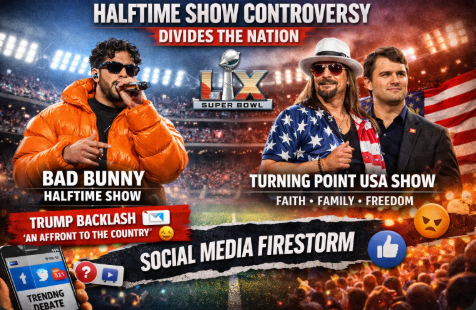
Republican lawmakers have formally requested the Federal Communications Commission investigate Bad Bunny’s recent Super Bowl LX halftime performance, transforming what was meant to be entertainment into a politically charged controversy.
Representative Randy Fine (R-FL) spearheaded the effort by sending a letter to FCC Chairman Brendan Carr on February 10, demanding a “full investigation” into the February 8 broadcast. Fine and several conservative colleagues claim elements of the performance violated broadcast standards and are pushing for significant penalties, including potential fines and the possible revocation of broadcast licenses for both NBC and the NFL.
Despite the political pressure, the FCC has not announced any formal probe or enforcement action as of February 11. Claims circulating on social media suggesting Bad Bunny has been fined $10 million are demonstrably false, as no penalties have been issued.
The performance itself was a showcase of Latin American culture featuring Bad Bunny performing an all-Spanish set with hits including “Tití Me Preguntó,” “Safaera,” “Yo Perreo Sola,” and “Monaco.” The show included guest appearances by Lady Gaga, who joined for “Die with a Smile,” and Ricky Martin, who performed “Lo Que Le Pasó a Hawaii.”
Critics have pointed to potentially explicit lyrical content, though Bad Bunny appeared to self-censor during the live broadcast by altering or mumbling certain portions of songs. Notably, neither the NFL nor NBC provided subtitles for the predominantly Spanish-language performance, which some viewers found puzzling given the global audience.
The halftime show quickly transcended entertainment to become a political flashpoint due to its cultural messaging and symbolism. The most controversial moment came during the finale when Bad Bunny said “God Bless America” before reciting the names of more than 20 countries across North and South America. Supporters viewed this as a celebration of hemispheric unity, while critics interpreted it as challenging American exceptionalism by reframing “America” as the entire continent rather than just the United States.
Adding to the political undertones, Bad Bunny prominently displayed the Puerto Rican flag featuring a light blue triangle—a version historically associated with independence and sovereignty movements on the island. This choice carries significant political weight given ongoing debates about Puerto Rico’s territorial status.
Ricky Martin’s performance of “Lo Que Le Pasó a Hawaii” further fueled controversy with its implied comparison between Hawaii’s colonization and Puerto Rico’s political status. The song addresses themes of gentrification and cultural preservation that resonate with current discussions about Puerto Rico’s relationship with the mainland United States.
During “El Apagón,” dancers climbed electrical pylons that appeared to explode—imagery widely interpreted as referencing Puerto Rico’s persistent power grid problems and criticism of federal responses following Hurricane Maria. This visual storytelling connected the entertainment spectacle to serious infrastructure issues affecting millions of American citizens.
The performance occurred against a backdrop of intense national debate over immigration policy, with Bad Bunny concluding the show by displaying the message: “The only thing more powerful than hate is love” while holding a football inscribed with “Together We Are America.”
This incident reflects the increasingly politicized nature of major cultural events in America, where entertainment spectacles like the Super Bowl halftime show become venues for political expression and subsequent backlash. The controversy highlights deepening cultural divides in how Americans interpret symbols of national identity and unity.
As the debate continues, the FCC faces pressure to determine whether any broadcast standards were actually violated, or if the complaints stem primarily from political and cultural objections to the performance’s messaging.
Fact Checker
Verify the accuracy of this article using The Disinformation Commission analysis and real-time sources.

12 Comments
Interesting to see some Republican lawmakers pushing for an FCC investigation over Bad Bunny’s Super Bowl halftime show. While they may have concerns, it seems like a politically-charged move given the show’s focus on Latin culture and Spanish songs.
I’m curious to see how the FCC responds, if they decide to investigate. The performance itself seemed to be well-received by many fans.
While I can understand concerns over the content of the halftime show, I think investigating it as a potential violation is a bit of a stretch. Bad Bunny is a hugely popular Latin artist, and the performance highlighted that cultural influence.
I’m curious to hear more details on the specific alleged violations the Republican lawmakers are citing. The show seemed fairly tame compared to past Super Bowl halftime acts.
The claims of $10 million in fines being issued are clearly false, as the FCC hasn’t announced any enforcement action yet. Seems like some misinformation is circulating around this issue.
I agree, we should wait and see what the FCC decides before jumping to conclusions. Political pressure doesn’t always lead to concrete action.
It’s interesting to see the political controversy surrounding Bad Bunny’s halftime show performance. While some may have concerns, investigating it as a potential violation seems like an overreaction.
I’m curious to see if the FCC decides to launch a formal investigation based on the pressure from Republican lawmakers. Hopefully they make an objective assessment of the facts.
I’m interested to hear the arguments from the Republican lawmakers on why they think the Bad Bunny performance violated broadcast standards. The show seemed to celebrate Latin culture and music, which many found refreshing.
It will be telling to see if the FCC decides to open an investigation based on the political pressure. Hopefully they make an impartial decision based on the facts.
The claims of $10 million in fines seem completely unfounded given the FCC hasn’t taken any action yet. Spreading misinformation like that is not helpful in understanding this situation.
I agree, we should wait for the FCC to make an official decision before jumping to conclusions about potential penalties. Politics shouldn’t override a fair, impartial review.