


Listen to the article
Recent viral claims about China’s alleged approval of Quranic schools and Islamic education have been debunked as false following a comprehensive fact-check investigation.
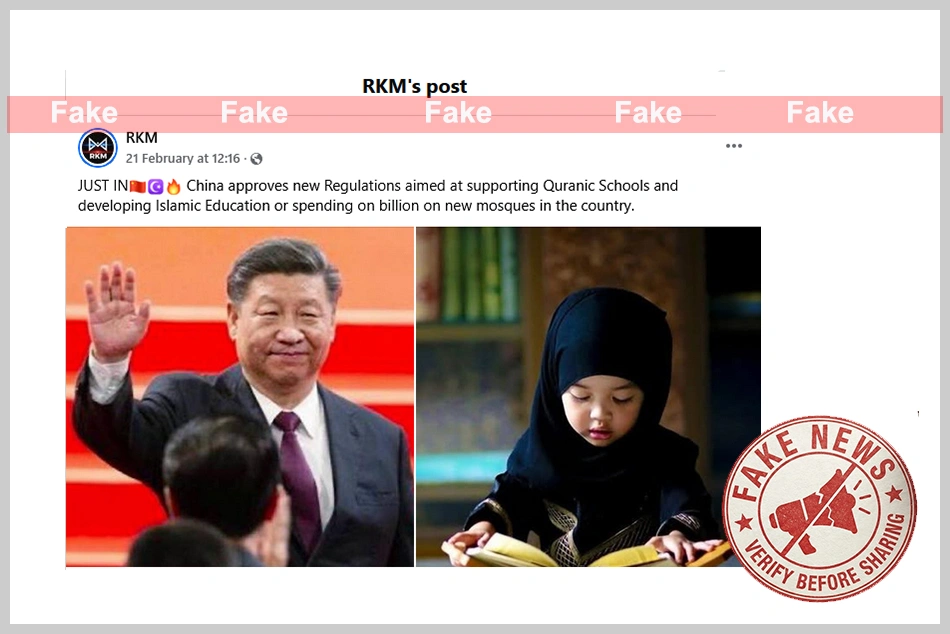
Multiple social media accounts and some news outlets, including US-based RKM Times, had circulated claims that “China has officially approved new regulations to support Quranic schools and develop Islamic education on a national scale.” One post by The Middle East reportedly reached over 1.3 million social media users, spreading the unverified information widely.
The viral posts suggested that the Chinese government under President Xi Jinping had not only endorsed Quranic education but was also “spending billions on new mosques in the country.” These claims gained significant traction online despite lacking credible sources.
However, a thorough fact-check analysis conducted by independent media organization DFRAC, an IFCN-certified fact-checking group, in collaboration with Ummid.com, revealed no evidence supporting these assertions. Researchers found no credible confirmation from official Chinese government sources regarding any new policy supporting Islamic education.
The investigation highlighted that China’s current approach to religion runs contrary to the viral claims. China maintains a strict regulatory framework governing all religious activities, including Islam. The country’s legal system requires registered religious organizations to operate under direct government supervision, with explicit restrictions on religious practices that could “interfere with the educational system of the state.”
Rather than expanding religious education, China’s current policy direction emphasizes what officials call the “Sinicization of religions,” which requires faith communities to align their practices with “Chinese characteristics” and official state ideology. This approach typically involves increasing government oversight of religious institutions rather than promoting independent religious education systems.
The Pew Research Center, cited in the fact-check report, notes that Chinese regulations have historically restricted religious education for minors, particularly in regions like Xinjiang, where authorities have increased state control over Islamic teachings and expressions in recent years.
Researchers also examined the State Council of the People’s Republic of China’s official education blueprint titled “China unveils blueprint for building strong education system by 2035.” This document contains no mention of Quranic education or any planned investment in Islamic schools, further contradicting the viral claims.
China’s policies toward religion, particularly Islam, have faced international scrutiny in recent years. Human rights organizations have documented increased restrictions on religious expression in various regions of the country. The spread of misinformation about China’s religious policies can complicate efforts to accurately assess the situation facing religious minorities there.
Social media platforms continue to struggle with the rapid dissemination of unverified claims, highlighting the importance of fact-checking organizations in providing accurate information. This case illustrates how false information about religious policies can quickly reach millions of people across platforms like Twitter (now X), Instagram, and Facebook.
The fact-checkers concluded their analysis by stating unequivocally that “the statement that China officially approved new regulations to support Qur’anic schools and expand Islamic education nationwide is false and unverified by any news organizations or official sources.”
Fact Checker
Verify the accuracy of this article using The Disinformation Commission analysis and real-time sources.

8 Comments
The lack of official confirmation from the Chinese government is telling. It’s wise to be skeptical of claims that lack credible sources, especially when they seem politically motivated. Fact-checking is crucial for maintaining media integrity.
It’s concerning to see the spread of unverified information, even from seemingly reputable news sources. This fact check highlights the need for vigilance and critical thinking when it comes to consuming media, especially on politically charged topics.
This highlights the need to be cautious about unverified information, especially when it comes to politically charged topics. I’m glad the fact-checkers took the time to thoroughly investigate the claims before drawing conclusions.
Agreed. Fact-checking helps ensure we have accurate, reliable information to form our opinions and understandings. It’s an important safeguard against the proliferation of false narratives.
This fact check reinforces the importance of verifying information, particularly on sensitive geopolitical topics. I appreciate the diligence of the researchers in uncovering the truth behind these viral claims.
Yes, fact-checking is essential for ensuring we have an accurate understanding of complex issues. It’s good to see independent, reputable organizations taking the time to investigate these types of claims thoroughly.
Interesting fact check. It’s important to verify claims, especially those related to sensitive topics like religious education policies. I appreciate the thorough investigation to uncover the truth behind these viral reports.
Yes, fact-checking is crucial to combat the spread of misinformation. It’s good to see an independent, reputable organization like DFRAC conducting a comprehensive analysis on this issue.