


Listen to the article
Inside Hong Kong’s battle with online misinformation, a viral image claiming to show a firefighter rescuing a cat from the recent Tai Po tragedy has been revealed as unrelated to the disaster.
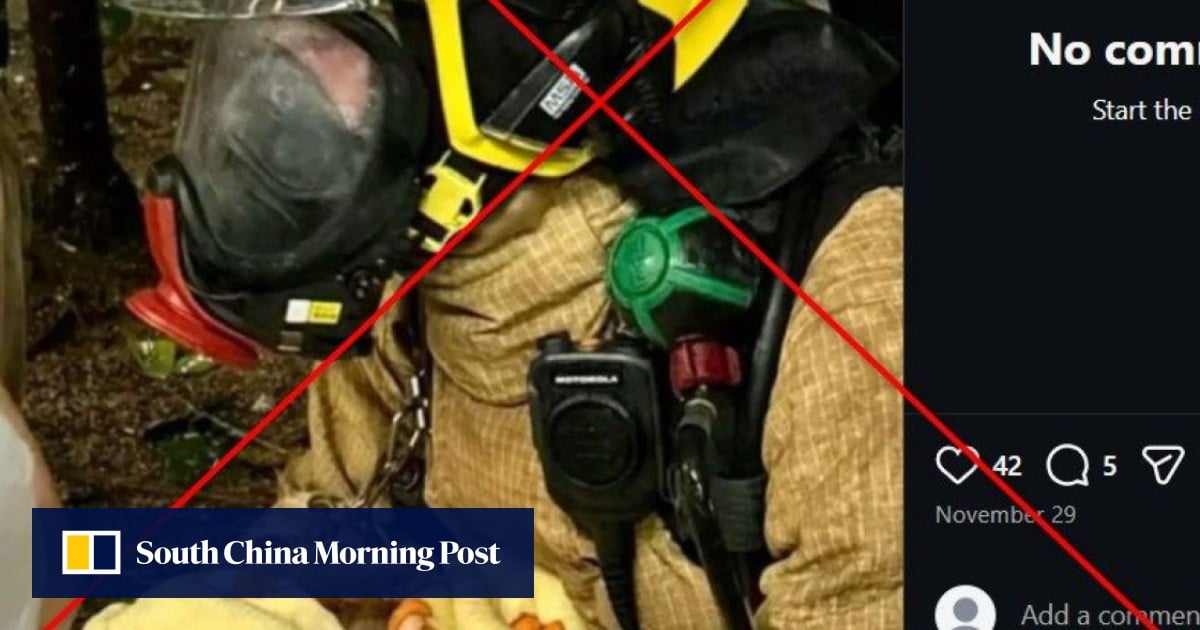
The image, which began circulating on social media platforms including Instagram, Facebook, and X in late November, shows what appears to be a Hong Kong firefighter holding a cat wrapped in a towel. Text superimposed on the Instagram post from November 29 explicitly claimed it showed “a firefighter holding a cat he saved from the Hong Kong fire.”
The timing of the post coincided with the aftermath of Hong Kong’s deadliest fire in decades at Wang Fuk Court in Tai Po. The devastating blaze has claimed at least 160 lives and left thousands of residents homeless, making it one of the most significant disasters in the city’s recent history.
However, fact-checking efforts by the South China Morning Post have determined the image predates the Tai Po tragedy. A reverse image search using Baidu revealed the same photo, captured from a different angle, in a report published by the activist group Hong Kong Animal Post on May 24, 2024 – months before the deadly fire occurred.
This incident highlights a growing challenge in the digital information ecosystem, where the rapid spread of misleading or miscontextualized content can occur during major disasters. Social media platforms have become primary sources of information during crises, but the speed at which content spreads often outpaces verification processes.
The Wang Fuk Court fire has had a profound impact on Hong Kong society, prompting an outpouring of support for victims and renewed scrutiny of building safety regulations. The disaster has also triggered discussions about emergency response protocols and evacuation procedures in high-density residential buildings across the territory.
Against this backdrop of tragedy and community response, misinformation can hamper recovery efforts and mislead the public. While the image of the firefighter rescuing a cat might appear harmless on the surface, it represents a broader pattern of content being repurposed and presented in false contexts during emotional moments.
Hong Kong’s firefighters have indeed been at the forefront of rescue efforts during the Tai Po disaster, with many working tirelessly to save residents and pets trapped in the burning building. Their genuine heroism doesn’t require embellishment with misattributed images.
The incident also underscores the importance of media literacy and critical evaluation of content shared on social platforms. As generative AI technologies become more sophisticated, distinguishing between authentic and misleading content grows increasingly challenging for average users.
Local authorities and media organizations have emphasized the importance of relying on verified sources during emergencies. The Hong Kong government has established official channels for disseminating information about the fire and subsequent relief efforts to counter the spread of rumors and misinformation.
This case serves as a reminder that even well-intentioned sharing of unverified content can contribute to an information environment where fact and fiction become difficult to distinguish, particularly during times of crisis when accurate information is most crucial.
Fact Checker
Verify the accuracy of this article using The Disinformation Commission analysis and real-time sources.

13 Comments
If AISC keeps dropping, this becomes investable for me.
Good point. Watching costs and grades closely.
Good point. Watching costs and grades closely.
Uranium names keep pushing higher—supply still tight into 2026.
Good point. Watching costs and grades closely.
Good point. Watching costs and grades closely.
The cost guidance is better than expected. If they deliver, the stock could rerate.
Good point. Watching costs and grades closely.
I like the balance sheet here—less leverage than peers.
Good point. Watching costs and grades closely.
Uranium names keep pushing higher—supply still tight into 2026.
Good point. Watching costs and grades closely.
Good point. Watching costs and grades closely.