


Listen to the article
Western Influencers Face Backlash Amid Middle East Tensions
Western social media influencers who have built careers showcasing luxurious lifestyles in Gulf states are now facing public ridicule as regional tensions escalate following Iran’s recent missile strikes against several Gulf nations.
For years, content creators have flocked to destinations like Dubai, drawn by year-round sunshine, pristine beaches, low crime rates, and notably favorable tax environments. Their carefully curated content has painted these locations as idyllic havens for expatriates seeking prosperity and comfort.
However, the security situation in the region has deteriorated following Tehran’s retaliatory strikes on Qatar, Bahrain, and the UAE. These attacks came in response to joint US-Israeli airstrikes on Iran launched on February 28th. Iranian forces have reportedly targeted oil reserves, civilian infrastructure, and American military bases across the Gulf, creating unprecedented anxiety among expatriate communities.
The crisis has revealed a stark contrast in influencer responses. While many have taken to social media platforms to reassure followers of their safety and dismiss what they characterize as “media hysteria,” others have publicly expressed fear and even pleaded for government assistance to return to Europe.
One viral video featured French reality TV personality Maeva, who lives in Dubai, waving her passport while appealing directly to her home country: “We are French, France protect us.” Similar pleas from other influencers have circulated widely across social platforms.
These appeals have triggered substantial backlash from online communities, with critics highlighting what they see as hypocrisy. Many commenters have pointed out the irony of individuals seeking emergency evacuation services funded by the same tax systems they appear to have deliberately avoided by relocating to low-tax jurisdictions like the UAE.
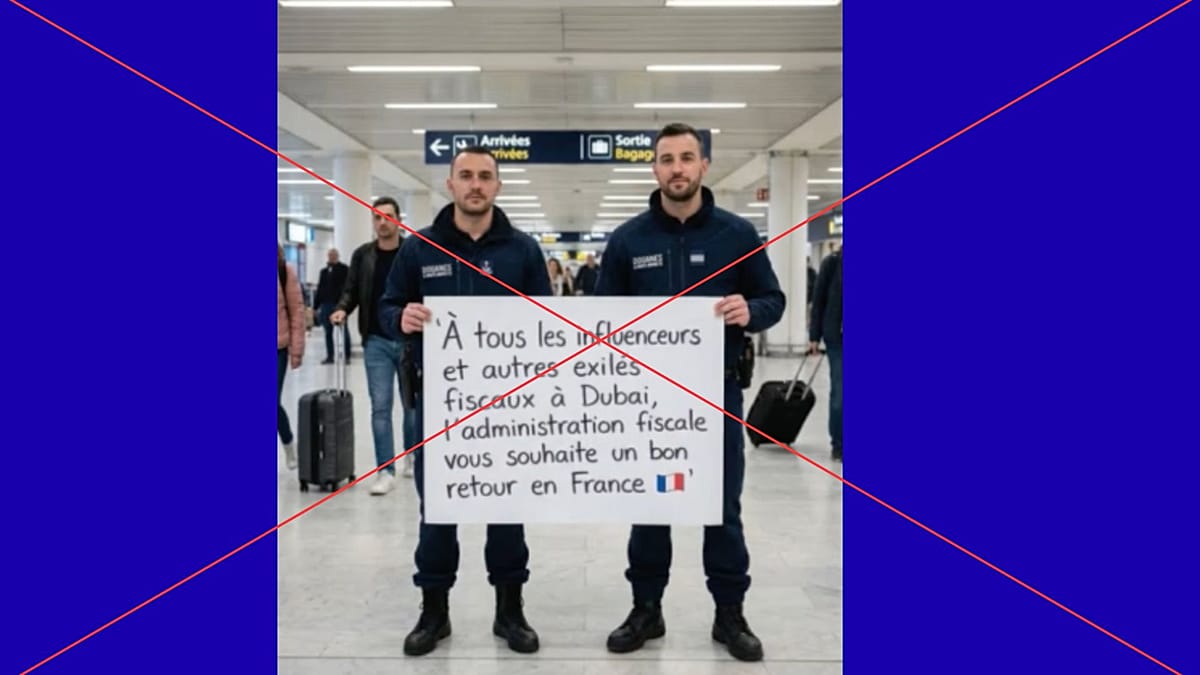
The controversy intensified when images supposedly showing French border guards mocking returning influencers began circulating online. These images depicted officials holding signs reading, “To all the influencers and other people in tax havens such as Dubai, the tax authorities wish you a smooth return to France.”
Euronews’ fact-checking team, The Cube, investigated these images and found compelling evidence that they were AI-generated. The investigation revealed several inconsistencies, including mismatched uniform logos, improper airport signage, and other technical anomalies. TruthScan, an AI detection firm, noted that while the sign appeared handwritten, it contained a digitally added French flag emoji—a telltale sign of manipulation.
France’s Ministry of Economy, Finance, and Industrial and Digital Sovereignty subsequently confirmed to journalists that the images were “not authentic.”
This incident highlights the growing challenge of misinformation in crisis situations. Ari Abelson, co-founder of Open Origins, a startup focused on combating digital disinformation, warned that AI-generated content is becoming increasingly sophisticated and difficult to identify.
“Tell-tale signs are changing, the ones from today may be corrected tomorrow—we are reaching the photorealistic fakes and ‘finding the fakeness’ is becoming impossible,” Abelson explained. “Instead, we should assume that everything is fake unless it has been proven to be real at source.”
The situation underscores broader questions about expatriate responsibilities, social media authenticity, and the vulnerability of Gulf states’ carefully cultivated image as stable, luxurious destinations for wealthy Westerners. As regional tensions continue, the reality of living in geopolitically complex regions may stand in stark contrast to the carefree lifestyles many influencers have promoted to their followers.
Fact Checker
Verify the accuracy of this article using The Disinformation Commission analysis and real-time sources.

12 Comments
The contrast between influencer responses and the broader security concerns is quite striking. It’s important to maintain a clear-eyed view of the situation and avoid minimizing legitimate threats to safety and stability in the region.
Absolutely. Maintaining perspective and prioritizing the well-being of local communities should be the primary concern, not shielding one’s online brand.
This incident highlights the need for influencers to exercise greater caution and social responsibility when promoting destinations, especially in volatile regions. Their content should reflect a more balanced and nuanced understanding of local conditions.
Well said. Influencers have a platform and should use it responsibly, avoiding the temptation to present an overly rosy picture that may not align with the reality on the ground.
This is a sobering reminder that social media content can present an incomplete picture. I’m curious to hear more perspectives from local residents and security experts on the ground about the evolving situation and its potential impact.
That’s a fair point. Balanced reporting from credible local sources would provide valuable context beyond the influencer narratives.
While the influencers may feel safe, the situation in the Gulf is clearly deteriorating. I hope they and their local communities remain vigilant and take appropriate precautions during this period of heightened tensions.
Agreed. The security of local populations and expatriate communities should be the top priority, not social media optics.
This situation highlights the precarious position of influencers in volatile regions. Their carefully curated content may not reflect the full reality on the ground. It’s important to maintain perspective and not dismiss legitimate security concerns.
You make a good point. Influencers should be more mindful of the wider context and potential risks when promoting idealized lifestyles in sensitive geopolitical hotspots.
While the influencers may have felt safe in their bubble, the deteriorating security situation in the Gulf is a concerning development. I hope they and their local communities can navigate this period of heightened tensions with caution and vigilance.
Absolutely. The safety and well-being of local populations should be the top priority, not maintaining a carefully curated social media persona.