


Listen to the article
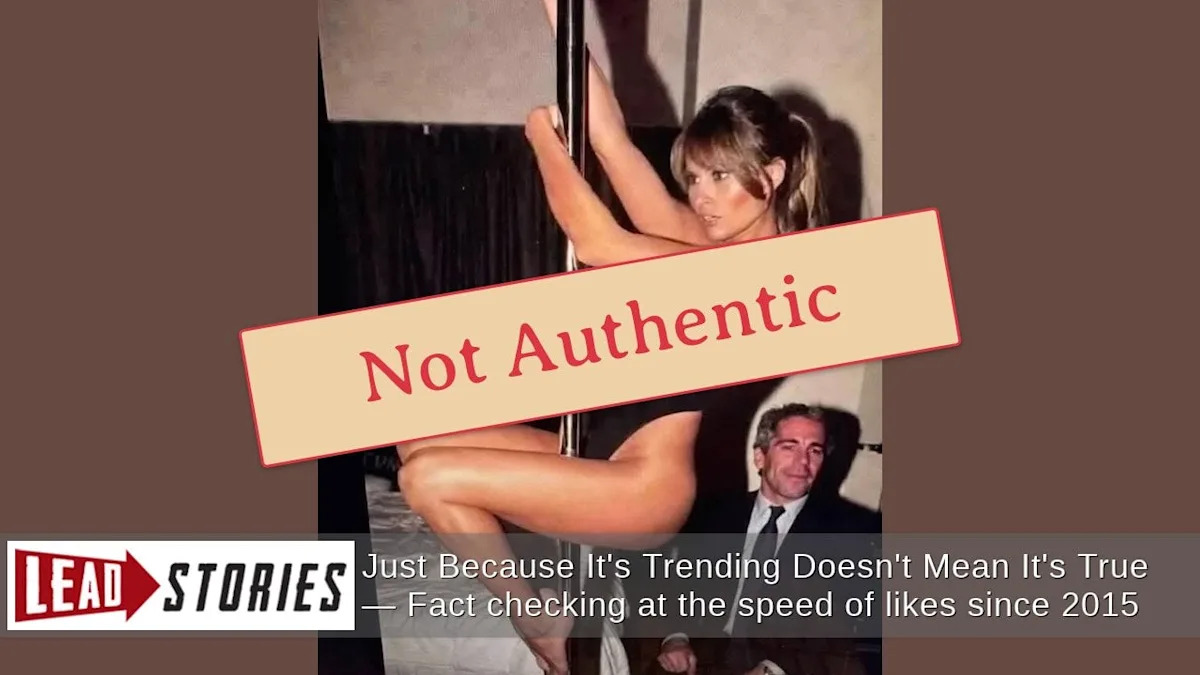
In a swift response to viral misinformation, fact-checkers have debunked an image allegedly showing former First Lady Melania Trump pole dancing in front of convicted sex offender Jeffrey Epstein. The widely shared image, which resurfaced on social media platforms this week, has been confirmed as an artistic fabrication rather than an authentic photograph.
The manipulated image gained renewed attention following Melania Trump’s April 9 statement denying any friendship with or victimization by Epstein. Social media users quickly circulated the pole dancing image with captions like “I don’t know him. But he bought me this pole,” implying a connection between the former First Lady and the disgraced financier.
Digital forensic analysis reveals the image originated from artist Alison Jackson, who posted it on Instagram on February 9 with an explicit disclaimer: “Fictional image. No factual claims implied.” Jackson’s professional work is well-known for creating “convincingly realistic photographs, films and sculpture depicting celebrities doing things in private,” according to her Instagram biography.
Multiple artificial intelligence detection tools have confirmed the fabricated nature of the image. When analyzed by four different AI detectors, the probability of the image being AI-generated ranged from 76% to 99.9%. The InVID-WeVerify plugin assessed a 76% likelihood of AI generation, while Hive Moderation placed the probability at a near-certain 99.9%.
The Epstein case has remained a lightning rod for conspiracy theories and misinformation since his 2019 death in federal custody while awaiting trial on sex trafficking charges. Documents from the Epstein investigation, available on the Department of Justice website, mention pole dancing at least 37 times in various contexts, but contain no evidence supporting the authenticity of the image in question or linking Melania Trump to such activities.
This incident highlights the growing challenge of distinguishing between real and fabricated images in today’s digital landscape. As AI-generated content becomes increasingly sophisticated, doctored images can spread rapidly across social platforms, often stripped of their original context or disclaimers that would identify them as artistic creations rather than documentary evidence.
The timing of the image’s resurgence appears calculated to coincide with renewed public interest in the Epstein case and specifically with Melania Trump’s recent public statement distancing herself from him. This pattern demonstrates how misinformation often exploits current news cycles and public figures’ statements to gain traction and credibility.
Social media platforms continue to struggle with the rapid proliferation of such content. While the original post by Jackson clearly labeled the image as fictional, subsequent shares frequently omitted this crucial context, allowing viewers to interpret the image as authentic documentary evidence.
Media literacy experts emphasize the importance of verifying images before sharing them, particularly those depicting public figures in compromising situations. Basic verification steps include reverse image searches to find the original source, checking for digital manipulation indicators, and considering whether the image aligns with known facts and timelines.
The incident serves as a reminder that visual misinformation poses unique challenges in the digital age, as people tend to process and trust images more readily than text. As AI-generated and manipulated content becomes increasingly common, the boundary between artistic expression and deceptive misinformation continues to blur, requiring heightened vigilance from both platforms and users.
Fact Checker
Verify the accuracy of this article using The Disinformation Commission analysis and real-time sources.

9 Comments
This ‘pole dancing’ image seems to be a clear fabrication, as the fact-checkers confirmed. It’s important to be wary of such manipulated photos and not spread misinformation, even if it seems juicy. Reliable sources are key when evaluating claims about public figures.
Interesting that this doctored image originated from an artist known for creating ‘convincingly realistic’ fake photos of celebrities. It’s a good reminder to always verify the source and authenticity of controversial online content before sharing.
Absolutely. Fact-checking is crucial, especially when it comes to sensitive political topics. Spreading unverified claims, even inadvertently, can do real harm.
It’s good to see the fact-checkers swiftly addressing this manipulated image of Melania Trump. Fabricated content like this, whether intended as ‘art’ or not, can still have real-world consequences if left unchallenged. Reliable sources are essential for the truth to prevail.
While salacious stories about public figures can be tempting, it’s important to maintain a critical eye and rely on trusted, reputable sources. This ‘pole dancing’ image appears to be nothing more than an artistic fabrication, not an authentic photograph.
Given the artist’s disclaimer that this is a ‘fictional image’ with ‘no factual claims implied,’ it’s clear this manipulated photo of Melania Trump should not be taken seriously. Fact-checking is essential to avoid perpetuating misinformation, even unintentionally.
While the ‘pole dancing’ photo of Melania Trump may seem sensational, the fact-checkers have clearly demonstrated it’s nothing more than a fabrication. We must be vigilant about verifying information, especially when it comes to public figures, to avoid spreading misinformation.
Kudos to the fact-checkers for quickly debunking this fabricated ‘pole dancing’ image of Melania Trump. In the age of digital manipulation, we must be vigilant about verifying the authenticity of controversial online content before sharing or believing it.
Absolutely. Spreading unverified claims, even innocently, can contribute to the proliferation of misinformation. Fact-checking is a crucial step we all need to take before engaging with sensitive political content online.