


Listen to the article
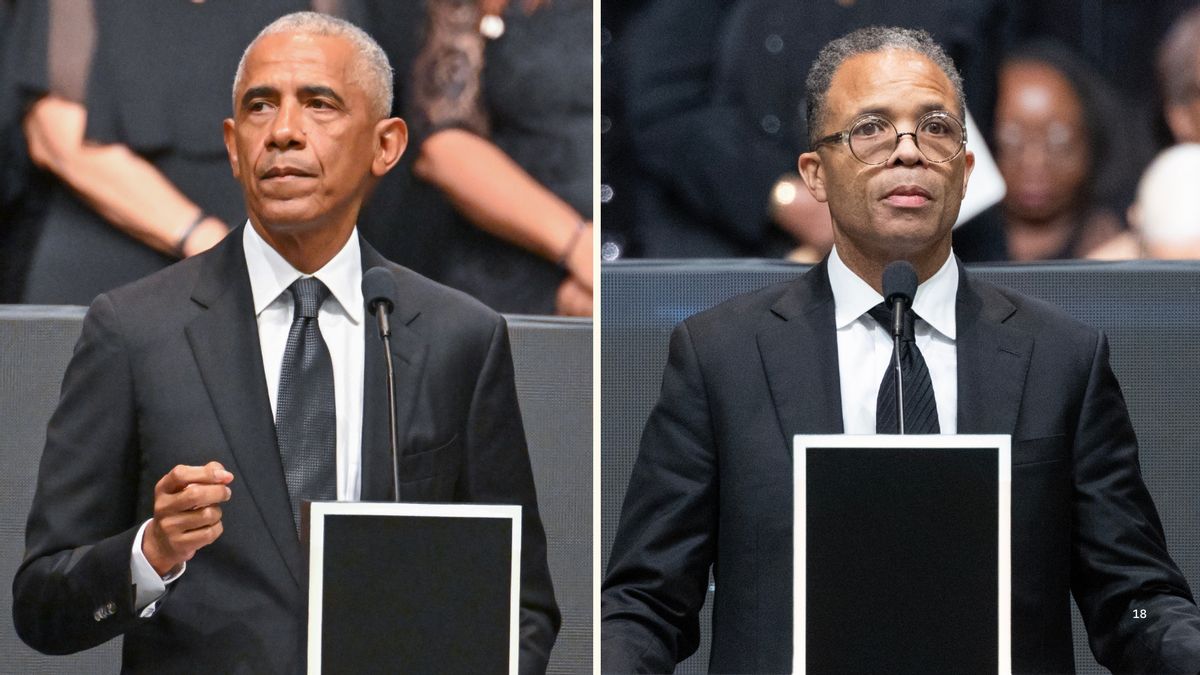
Following the public memorial service for the late civil rights leader Rev. Jesse Jackson, his son Jesse Jackson Jr. made headlines with pointed remarks about the three former U.S. presidents who eulogized his father.
“Yesterday I listened for several hours of three United States presidents who do not know Jesse Jackson,” the younger Jackson said during a private memorial service on March 7, 2026, just a day after former presidents Bill Clinton, Barack Obama, and Joe Biden spoke at the public celebration of his father’s life.
His comment came as a surprise to many, especially given the lengthy and seemingly heartfelt tributes delivered by the three Democratic former presidents. The remark gained significant traction on social media, with some conservative accounts characterizing it as Jackson Jr. “calling out” the former presidents for “hijacking the funeral.”
The context surrounding Jackson Jr.’s statement is important. Just after his father’s death on February 17, he had specifically requested that attendees not bring politics into the memorial services, known in some Black communities as “homegoing” ceremonies.
“Do not bring your politics, out of respect to Rev. Jesse Jackson and the life that he lived, to these homegoing services,” Jackson Jr. stated clearly. “Come respectful and come to say thank you. But these homegoing services are welcome to all. Democrat, Republican, liberal and conservative, right-wing, left-wing, because his life is broad enough to cover the full spectrum of what it means to be an American.”
Despite this request, both Obama and Biden used portions of their eulogies to deliver what many interpreted as critiques of Republican President Donald Trump’s administration. Obama spoke for nearly half an hour, referencing “some new assault on our democratic institutions” and how “we’re told by those in high office to fear each other and to turn on each other.” While not mentioning Trump by name, his comments were widely seen as directed at the current administration.
Biden was more direct in his 21-minute address, stating, “We’re in a tough spot, folks, we’ve got an administration that doesn’t share any of the values that we have. I don’t think I’m exaggerating a little bit.”
Clinton, who spoke for about 17 minutes, notably did not include any political commentary in his remembrance, focusing instead on his personal recollections of the civil rights icon.
Following these eulogies, Jackson Jr.’s statement at the private service expanded on his criticism: “The demands of speaking for the least of these, those who were disinherited, the damned, the dispossessed, the disrespected — demanded not Democratic or Republican solutions, but demanded a consistent prophetic voice that at no point in time ever sold us out as a people.”
Rev. Jesse Jackson, who died at 84, left behind a powerful legacy as a civil rights activist, two-time presidential candidate, and advocate for marginalized communities. He served as a shadow senator for Washington, D.C. in the 1990s, a non-voting, unpaid position that allowed him to advocate for D.C. statehood.
The controversy surrounding the memorial service highlights the delicate balance between honoring a political figure’s legacy and respecting a family’s wishes during times of mourning. It also underscores the deeply polarized nature of American politics, where even funeral services for respected national figures can become stages for political messaging.
Jackson Jr.’s comments have sparked debate about the appropriate role of political discourse at memorial services and raised questions about how public figures’ legacies are interpreted after their death — and by whom.
Fact Checker
Verify the accuracy of this article using The Disinformation Commission analysis and real-time sources.

6 Comments
This is a sensitive topic given the civil rights legacy of Jesse Jackson Sr. Jackson Jr.’s comments raise valid questions about the authenticity of the former presidents’ connections to his father. It would be interesting to get their perspectives on this as well.
While the public tributes may have seemed heartfelt, Jackson Jr.’s remarks suggest there could be more to the story. I hope more details emerge to provide a clearer picture of the relationships between the key figures involved.
The former presidents’ eulogies struck me as sincere, but Jackson Jr.’s remarks suggest there may have been political motivations at play. It’s a complex issue that deserves further examination to understand the nuances of the relationships involved.
I’m curious to hear more from Jackson Jr. about what led him to make those claims. Were there specific instances that made him feel the former presidents did not truly know his father?
This is an interesting perspective from Jesse Jackson Jr. It raises questions about the depth of the former presidents’ relationships with his father, the renowned civil rights leader. While the tributes seemed heartfelt, the younger Jackson’s comments suggest there may be more to the story.
It would be helpful to get more context on the private memorial service and Jackson Jr.’s specific concerns. Were the former presidents truly unaware of the elder Jackson’s work and legacy?