


Listen to the article
AI-Generated Image of Trump Using Walker Debunked as Fake
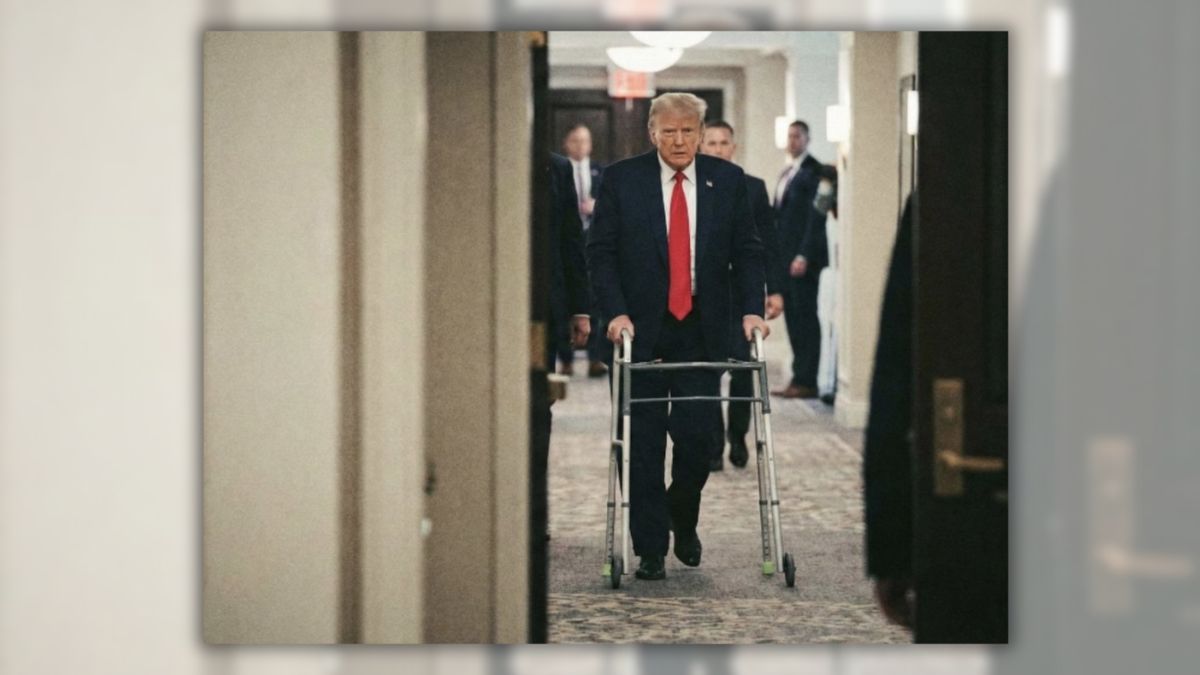
A widely circulated image supposedly showing President Donald Trump using a walker has been conclusively identified as a fake, according to multiple AI detection tools and fact-checkers.
The image began spreading in mid-December 2025 when Keith Edwards, a Democratic political strategist who previously led communications for The Lincoln Project, posted it on X (formerly Twitter). His caption read: “BREAKING: an image has leaked showing Trump using a walker moments after he signed an executive order banning states from regulating AI.”
The timing of the fake image coincided with President Trump’s signing of a controversial executive order establishing a “minimally burdensome national standard” for AI regulation. The order effectively prevents individual states from creating their own AI legislation, which the administration argued would create “a patchwork of 50 different regulatory regimes” making compliance difficult for companies, particularly startups.
Multiple AI detection systems have confirmed the image is synthetic. Google’s AI assistant Gemini identified the presence of SynthID, a digital watermark Google embeds into AI-generated images that’s invisible to the human eye but detectable by specialized tools. When queried about the image, Gemini responded: “Based on the detection, it appears that most or all of this image was edited or generated with Google AI.”
Additional verification from independent AI detection services Sightengine and Hive Moderation both indicated a high probability the image was artificially created. A second version of the fake showing Trump with a gold-colored walker even contained a visible Gemini watermark in the corner.
No reputable news organizations have reported the image as authentic, and numerous media outlets have published their own debunking articles. There is no evidence that President Trump has been using any mobility assistance devices.
The image’s spread highlights growing concerns about AI-generated content in political discourse. As artificial intelligence tools become more sophisticated and accessible, distinguishing between authentic and fabricated content becomes increasingly challenging for the average social media user.
Some social media users appeared to interpret Edwards’ post as satire, though at the time of reporting, he had not responded to inquiries asking whether the post was intended as a joke. The Lincoln Project, where Edwards previously worked, is well-known for its aggressive anti-Trump messaging and campaigns.
This isn’t the first time AI-generated content purporting to show the president in compromising situations has gone viral. Previous investigations have debunked fake images allegedly showing Trump sitting next to his daughter Ivanka with his tongue out and fabricated videos of him falling asleep during White House Cabinet meetings.
The White House has not yet issued a formal comment on the fabricated walker image. As AI technology continues to advance, incidents like this underscore the importance of media literacy and the need for reliable fact-checking resources in the digital information ecosystem.
The circulation of this fake image comes at a politically sensitive time, as President Trump’s executive order on AI regulation has drawn criticism from state officials and tech industry experts concerned about centralized federal control over emerging technologies. Major technology companies, however, have generally supported standardized national regulations over varying state-by-state requirements.
Fact Checker
Verify the accuracy of this article using The Disinformation Commission analysis and real-time sources.

16 Comments
It’s concerning to see how easily AI-generated content can be used to spread misinformation. Kudos to the fact-checkers for catching this one.
Absolutely, the proliferation of synthetic media is a growing challenge that requires vigilance and robust verification tools.
Clearly this image was fabricated to undermine the President. I’m glad the fact-checkers were able to conclusively prove it’s a fake.
Yes, it’s reassuring to see the use of AI detection tools to combat the spread of disinformation online.
The timing of this fake image is suspicious, coinciding with the President’s executive order on AI regulation. Glad to see it was quickly identified as synthetic.
Agreed, it’s important to be vigilant about the potential misuse of AI-generated media for political purposes.
While I’m no fan of the President, I don’t condone the use of fake images to try and discredit him. Fact-checking is important for maintaining integrity.
Agreed, political discourse should be based on facts and evidence, not fabricated media.
This fake image seems like a clumsy attempt at political mudslinging. I appreciate the diligence in debunking it through technical analysis.
Yes, fact-checking is crucial to maintaining trust in online information, especially around sensitive political topics.
Interesting, it’s good to see fact-checking on AI-generated content like this. Curious if the same tools could be used to verify other political images and claims online.
Absolutely, using AI detection to fact-check digital media is becoming increasingly important to combat misinformation.
This fake image is a reminder of the importance of critical thinking and fact-checking, especially when it comes to politically charged content online.
Agreed, we need to be cautious about blindly believing or sharing digital media, regardless of the source.
This is a prime example of how AI-generated content can be weaponized for political gain. I applaud the diligence in debunking this particular hoax.
Absolutely, the ability to quickly identify synthetic media is crucial in an era of increasing digital manipulation.