


Listen to the article
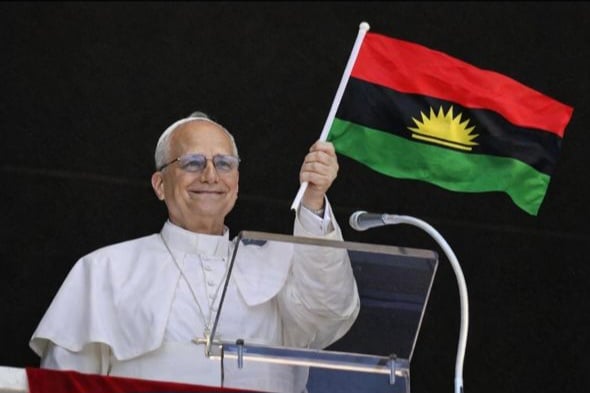
In a significant case of misinformation, a fabricated image purporting to show Pope Francis raising the Biafran flag at the Vatican has been identified as an AI-generated fake. The manipulated image has been circulating on social media, gaining traction among supporters of the Indigenous People of Biafra (IPOB) movement.
The false claim originated from a Facebook post by user @Ofoegbu Ejike, which has accumulated over 20 shares and nine likes. The post declared: “JUST IN: Pope Raises Biafra Flag for First Time — Supporters Say It’s a Call to Free Nnamdi Kanu and End Killing of Christians.”
According to the post, the alleged gesture represented a moral statement rather than political posturing, supposedly calling for the release of IPOB leader Nnamdi Kanu and addressing violence against Christians in Nigeria.
Fact-checking organization CableCheck conducted a thorough investigation into the claim. Researchers searched through the Pope’s official social media channels but found no evidence of such an event or image. When subjected to analysis using Hive AI, an artificial intelligence detection tool, the image was conclusively identified as AI-generated, with specific markers indicating it was likely created using ChatGPT.
The Vatican News website, which regularly documents the Pope’s official activities and statements, contained no reporting on any such gesture or meeting related to Biafra or IPOB. Additionally, no credible international or Nigerian news organizations covered such an event, which would have been significant diplomatic news had it actually occurred.
This instance follows a pattern of IPOB supporters digitally manipulating images of world leaders and prominent figures to create an illusion of international support for their separatist cause. The Biafran movement advocates for the secession of southeastern Nigeria to form an independent state, a contentious political issue with historical roots in the Nigerian Civil War of 1967-1970.
It’s worth noting that the post incorrectly refers to “Pope Leo XIV,” when the current pontiff is Pope Francis. There has never been a Pope Leo XIV in Catholic history, with Pope Leo XIII being the last pontiff with that papal name, serving from 1878 to 1903.
The circulation of such fabricated content highlights the growing challenge of AI-generated disinformation on social media platforms. As artificial intelligence tools become more sophisticated and accessible, the potential for creating convincing false narratives increases, particularly around politically sensitive issues.
This incident also underscores the importance of critical media literacy and verification in the digital age. Social media users are encouraged to verify information through official channels and trusted news sources before sharing content, especially when it involves major religious or political figures making seemingly unprecedented gestures.
For IPOB and its detained leader Nnamdi Kanu, international recognition remains a significant objective, but falsifying support from global figures like the Pope ultimately undermines the credibility of legitimate advocacy efforts. Kanu has been in detention since 2021 on charges including terrorism and treason, with his incarceration remaining a flashpoint for tensions in Nigeria’s southeast region.
Nigerian authorities continue to designate IPOB as a terrorist organization, while supporters maintain it is a legitimate self-determination movement advocating for the rights of the Igbo people.
Fact Checker
Verify the accuracy of this article using The Disinformation Commission analysis and real-time sources.

15 Comments
This is a concerning case of misinformation, but I’m glad the researchers were able to definitively identify the image as AI-generated. It’s a sobering reminder of the importance of verifying claims, especially those related to sensitive topics. Fact-checking is crucial in the digital age.
The proliferation of AI-generated fakes is a growing problem that requires vigilance and critical thinking from all of us. I’m glad to see the researchers took the time to thoroughly investigate this claim and expose it as a fabrication. It’s a valuable lesson in the need for media literacy and responsible information sharing.
Interesting to see the details around how this false claim originated and spread on social media. It’s a good reminder to be cautious about unverified images and claims, especially those related to sensitive political or religious topics. Fact-checking is crucial in the digital age.
This is a good example of how quickly misinformation can spread online. I’m glad the fact-checkers were able to identify this as an AI-generated fake. It’s a sobering reminder of the need for critical thinking and careful verification of digital content.
The proliferation of AI-generated fakes is a major challenge for media literacy and trust in information. This case highlights the need for robust fact-checking processes and increased public awareness of the dangers of misinformation. We all have a role to play in combating the spread of false claims.
Interesting to see the details around how this false claim originated and gained traction on social media. It’s a good example of the need for critical thinking and fact-checking when encountering claims or images online. We all have a responsibility to avoid contributing to the spread of misinformation.
The Pope raising the Biafran flag would be a significant event, so I’m glad the researchers investigated this claim thoroughly. Identifying AI-generated fakes is an important part of combating misinformation. We need to be vigilant about verifying claims, no matter how compelling they may seem.
This is a concerning case that highlights the growing challenge of combating deepfakes and other manipulated media. I’m glad the researchers were able to definitively identify the image as AI-generated. It’s a sobering reminder of the importance of verifying claims and being cautious about unverified information, no matter how compelling it may seem.
This is a concerning example of how misinformation can quickly gain traction online. I’m glad the researchers were able to definitively identify the image as AI-generated. It’s a good reminder to be vigilant about verifying claims, especially those related to sensitive topics like religion and politics.
Kudos to the fact-checking organization for their diligent work on this case. Identifying AI-generated fakes is a crucial skill in the fight against misinformation. This serves as a valuable lesson in the need for vigilance and responsible information sharing, especially when it comes to sensitive topics like religion and politics.
The researchers’ ability to conclusively identify this image as AI-generated is impressive. It underscores the importance of robust fact-checking processes in the digital age. We all have a role to play in combating the spread of misinformation, and this case highlights the need for critical thinking and media literacy.
This is clearly a case of misinformation. It’s important that we verify claims like this before spreading them further. The analysis showing this image is AI-generated is concerning, as it points to the growing challenge of combating deepfakes and other manipulated media.
The rise of deepfakes and AI-generated fakes is a growing threat to the integrity of information. This case shows the importance of having reliable fact-checking processes in place to identify and debunk false claims before they can spread further. It’s a complex challenge, but one we must continue to address.
This is a concerning example of how misinformation can spread rapidly online. I’m glad the fact-checkers were able to identify the image as AI-generated. It’s a good reminder that we need to be cautious about unverified claims, even if they align with our own beliefs or desires. Responsible information sharing is crucial.
Kudos to the fact-checking organization for their diligent work on this case. Identifying AI-generated fakes is a crucial skill in the digital age. This underscores the importance of not blindly believing or sharing unverified claims, even if they align with our own beliefs or desires.