


Listen to the article
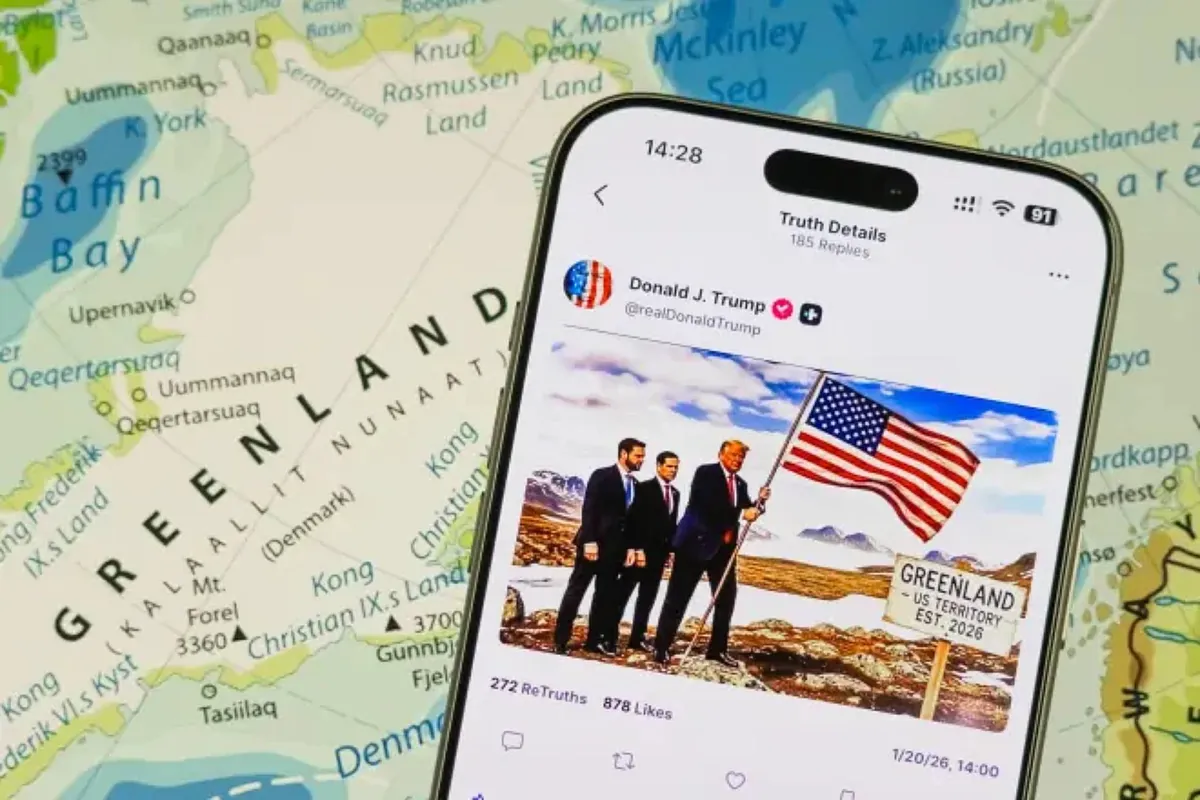
President Trump’s recent comments suggesting the United States once owned Greenland have sparked confusion and prompted historians to clarify the record on the world’s largest island and its territorial status.
During a campaign rally in Michigan last week, Trump claimed that the United States previously owned Greenland but “let it go,” adding that he had attempted to purchase the territory during his administration. These assertions, however, do not align with historical facts.
Greenland, which covers over 836,000 square miles of primarily ice-covered land in the North Atlantic, has never been under American ownership or control. The territory has a complex colonial history, but the United States has never featured as a sovereign power over the island.
Historical records show that Greenland was first settled by Inuit peoples thousands of years ago. European contact began when Norse explorers arrived around 980 CE, establishing settlements that lasted several centuries before disappearing. In 1721, Denmark-Norway began colonizing the island, establishing a permanent European presence.
Following the dissolution of the union between Denmark and Norway in 1814, Greenland remained under Danish control. The island officially became a Danish colony and remained so until 1953, when Denmark amended its constitution to change Greenland’s status from a colony to an integral part of the Danish kingdom, granting Greenlanders Danish citizenship.
The only period of American involvement in Greenland occurred during World War II, when the United States established military bases on the island after Nazi Germany occupied Denmark in 1940. This arrangement was made through a defense agreement with the Danish ambassador in Washington, not through territorial acquisition.
“The United States has maintained a strategic interest in Greenland due to its geographic position, but at no point did America ever own or govern the territory,” explained Dr. Kristian Nielsen, a historian specializing in Arctic geopolitics at Aarhus University. “These bases were established through agreements that specifically acknowledged continued Danish sovereignty.”
In 1979, Greenland achieved home rule, and in 2009, it gained self-government status following a referendum. Today, Greenland maintains authority over most domestic affairs, while Denmark retains control over foreign policy, defense, and monetary policy. The island’s population of approximately 56,000 people has increasingly discussed the possibility of complete independence, though economic challenges remain a significant hurdle.
Trump’s comments likely refer to his widely reported 2019 interest in purchasing Greenland, which made international headlines when he confirmed he had discussed the possibility with his advisers. The suggestion was promptly rejected by both Greenlandic and Danish officials, with then-Danish Prime Minister Mette Frederiksen calling the idea “absurd.” The diplomatic tension resulted in Trump canceling a planned state visit to Denmark.
“Greenland is not for sale,” Frederiksen stated at the time. “Greenland is not Danish. Greenland belongs to Greenland.”
While the United States has made territorial purchases throughout its history—including the Louisiana Purchase from France in 1803 and Alaska from Russia in 1867—Greenland has never been among them.
The strategic importance of Greenland has increased in recent years amid growing competition for Arctic resources and shipping routes. The island contains substantial mineral deposits, including rare earth elements crucial for modern technology, and its position offers military advantages in the North Atlantic. Climate change has further elevated Greenland’s geopolitical significance as melting ice reveals new opportunities and challenges.
The U.S. currently maintains Thule Air Base in northwestern Greenland, America’s northernmost military installation, which operates under agreements with Denmark that date back to the Cold War era.
Historians and political analysts suggest that while the United States has legitimate strategic interests in Greenland, claims of past ownership represent a fundamental misunderstanding of the historical record and the complex relationship between Greenland, Denmark, and the international community.
Fact Checker
Verify the accuracy of this article using The Disinformation Commission analysis and real-time sources.

8 Comments
As an energy and mining enthusiast, I find the territorial status of resource-rich regions like Greenland fascinating. While the US may have explored acquisition in the past, the historical record is clear – Greenland has never been under American control. It’s an important distinction to make.
It’s important we rely on authoritative historical sources when assessing claims about territorial ownership. This article does a good job of debunking Trump’s assertions about Greenland, which appear to be unfounded. As an energy and mining follower, I find this topic quite relevant.
This is a good reminder to always fact-check political claims, even from high-profile figures. Greenland’s history is more complex than a simple territorial exchange. It’s important we understand the nuances, rather than spreading misinformation.
Greenland’s status as an autonomous territory within the Kingdom of Denmark is well-established. The US has never held sovereignty over the island, despite any past interest. This fact-check helps clarify the record and provides context around the geopolitical dynamics at play.
Greenland’s complex colonial history is an interesting case study. While the US may have considered acquiring the territory at times, the facts clearly show it has never been American-owned. I wonder how this history shapes current geopolitical dynamics in the Arctic region.
Given Greenland’s strategic location and natural resource potential, it’s not surprising the US has eyed the territory over the years. However, the facts show Greenland has never belonged to the US. I’m curious to see how this issue plays out geopolitically going forward.
This article provides a helpful fact-check on Trump’s misleading claims about Greenland. It’s a good example of the importance of verifying political statements, especially when they involve territorial disputes or historical inaccuracies. I appreciate the objective, well-researched approach.
Interesting to see the historical facts around Greenland’s territorial status. It’s clear the US never owned or controlled the island, contrary to Trump’s claims. I wonder what motivated his statement – was it just an attempt to make the US appear more influential on the global stage?