


Listen to the article
Government Claims 82% Implementation Rate of Electoral Manifesto, But Critics Question Progress
Prime Minister Robert Abela’s recent claim that his government has implemented 82% of its electoral manifesto has sparked immediate skepticism across Malta’s political landscape. The statement, made during a press conference marking the government’s fourth year in office, was quickly challenged by journalists who pointed to several high-profile promises that remain unfulfilled.
The 82% implementation rate isn’t the first ambitious figure cited by the administration. In June 2025, Abela reported a 70% completion rate, while former Minister Carmelo Abela claimed a 76% implementation rate in summer 2020. These steadily increasing figures have raised questions about how such metrics are calculated.
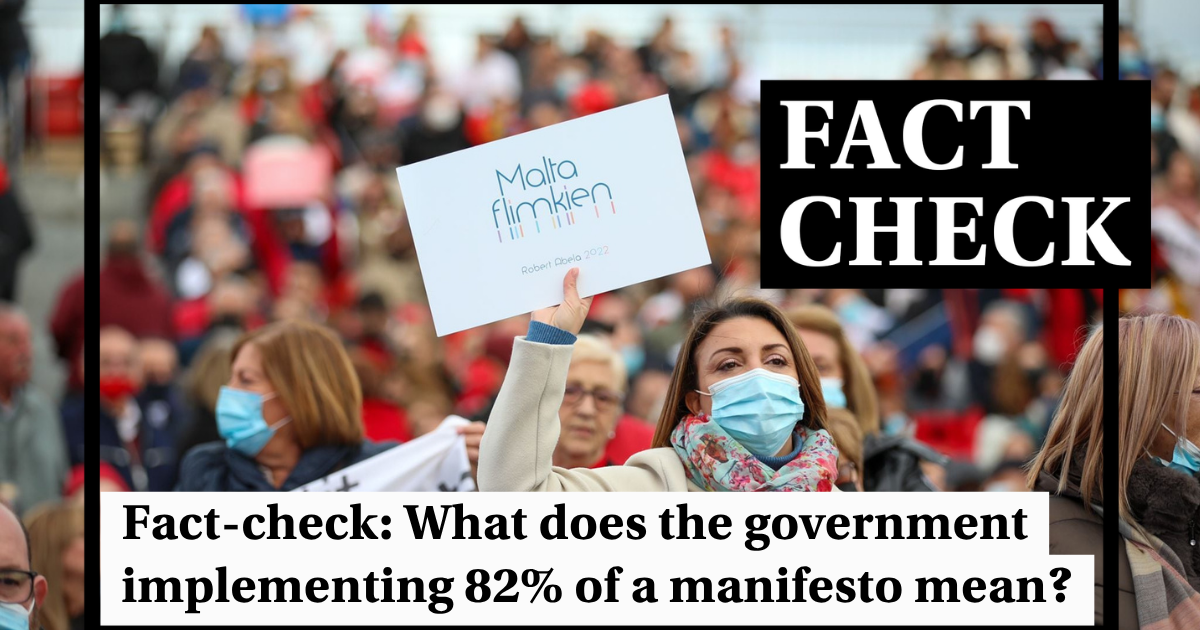
The Labour government won re-election in 2022 on the strength of an exceptionally large manifesto, spanning 288 pages—over 100 pages longer than its 2017 platform. The document contained an ambitious 1,000 distinct measures covering education, economic development, social welfare, and environmental protection.
When Times of Malta investigated how the government arrives at its implementation figures, officials from the Prime Minister’s Office explained that the 82% doesn’t represent completed proposals but rather tracks progress through a specialized online system developed by MITA. This system monitors advancement across all initiatives, including those fully implemented, partially complete, and those barely initiated.
According to government officials, each of the 1,000 proposals is broken down into multiple deliverables, with different weightings assigned based on their importance and complexity. For example, a promise to build a park would involve several steps: identifying a location, obtaining necessary permits, issuing tenders, and completing construction. As each step is accomplished, the overall implementation percentage increases.
The OPM claims that 802 of the 1,000 electoral promises have been fully completed, with the remaining percentage representing partial progress on other initiatives. Officials insist that none of the manifesto proposals have been abandoned, though some may be behind schedule. The online tracking system, which Times of Malta was given access to, appears to support these claims.
Notably, the government’s figures don’t include additional promises made during the current legislature that weren’t part of the original manifesto, such as recently announced parks at Manoel Island, White Rocks, and Fort Campbell.
Critics have focused on several high-profile environmental projects that were prominently featured in the 2022 campaign but show little visible progress. Plans to pedestrianize areas in Floriana, San Ġwann, and Santa Venera appear to remain largely on paper, despite campaign rhetoric suggesting imminent action.
When confronted about these delays, government officials argued that these projects were always intended to span multiple legislative terms. However, the manifesto language contradicts this claim, with pledges that St Anne Street pedestrianization would “become reality,” works on roofing Santa Venera tunnels would “begin,” and San Ġwann’s pedestrianization would be “extended.”
A closer examination of the manifesto reveals numerous vague commitments that are difficult to evaluate. For instance, the document promised that land reclamation would “go ahead” without specifying locations or projects. While some reclamation has occurred at the Freeport, the broader initiative has been folded into the government’s “Vision 2050” framework.
Similarly, the much-discussed metro project was promised “lively discussion” and further studies, yet the public has seen limited concrete developments four years later. Other measurable goals, like increasing research spending to 2% of GDP from 0.6%, show no progress in available data.
Despite these shortcomings, the government has successfully implemented numerous fiscal and social measures, in some cases exceeding original commitments. Income tax cuts initially projected to cost €66 million ultimately reached €140 million, while access to free IVF services has expanded and promised legal amendments allowing under-18s to serve as mayors have been introduced.
As Malta approaches the end of the current legislature, the gap between political rhetoric and tangible results continues to fuel debate over the government’s performance and accountability.
Fact Checker
Verify the accuracy of this article using The Disinformation Commission analysis and real-time sources.

9 Comments
Good to see journalists pushing for more details on the government’s self-reported implementation rates. Consistent, verifiable data is essential for holding elected officials accountable. This will be an important story to follow.
Absolutely. Rigorous fact-checking is the only way to cut through political spin and rhetoric. Looking forward to seeing how this plays out with more investigation and analysis.
This is an important issue to dig into. Voters need clear, factual information to assess the government’s performance. Looking forward to seeing more robust analysis on how they are defining and tracking manifesto implementation.
Agree, transparency and objective metrics are key. Glad to see this being scrutinized – the public deserves an honest accounting of progress made on campaign promises.
I appreciate the government’s commitment to transparency, but the inconsistent implementation figures are concerning. Hopefully the investigation by Times of Malta can shed more light on the true status of their manifesto promises.
It’s great that the government is being held accountable on their manifesto promises. 82% implementation is an ambitious target, so I hope they can back that up with concrete evidence. Voters deserve clear, honest reporting on progress made.
Interesting to see the government’s claims about implementing their manifesto promises. I wonder how they define and measure ‘implementation’ – seems like there could be room for interpretation there. Would be curious to hear more details on their methodology.
Seems like the government is moving the goalposts on their manifesto implementation claims. Curious to see if they can substantiate the 82% figure or if it’s more political spin than substance. Accountability is crucial for voters.
The steadily increasing implementation percentages do raise some eyebrows. Definitely important for the public to have a clear, transparent understanding of how these metrics are calculated. Looking forward to hearing more scrutiny and fact-checking on this issue.