


Listen to the article
UK Government and Opposition Clash Over Cost of Chagos Islands Deal
The UK government and opposition are at odds over the true cost of a treaty that transfers sovereignty of the Chagos Islands to Mauritius while preserving British control of a strategic military base.
At Prime Minister’s Questions on January 21, Opposition leader Kemi Badenoch claimed the Prime Minister is “giving away” the Chagos Islands and “paying £35 billion” to continue administering Diego Garcia, which hosts a vital UK-US military installation.
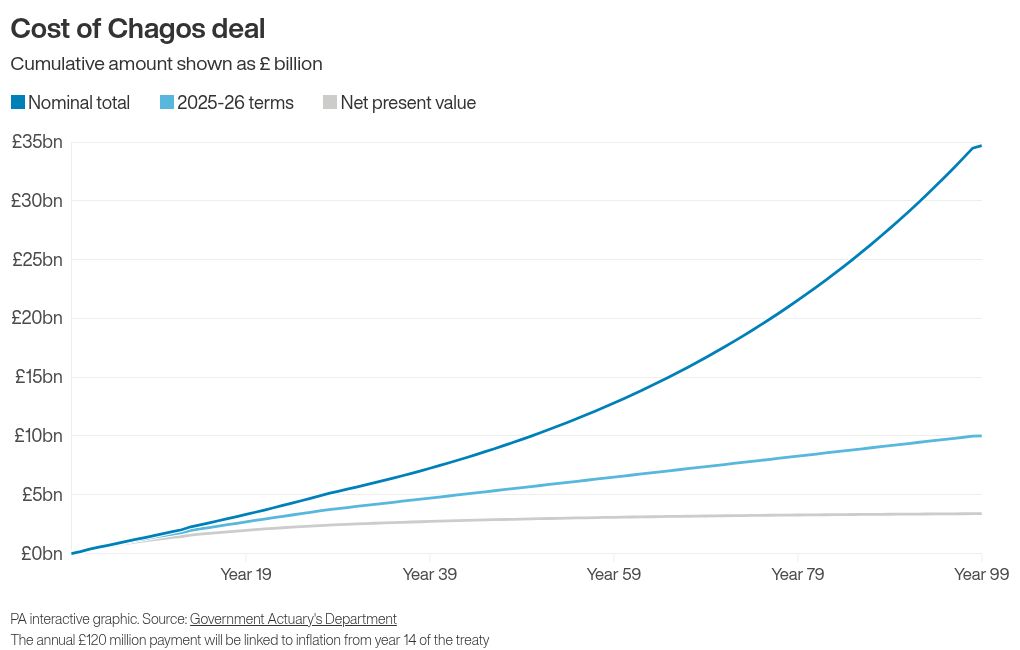
The controversy centers on three different calculations of the deal’s financial impact. Government officials cite a “net present value” estimate of £3.4 billion, while Conservative leader Badenoch references a much higher nominal total of £34.7 billion. A third measurement places the cost at approximately £10 billion over the treaty’s 99-year duration.
The agreement transfers sovereignty of the Chagos Archipelago to Mauritius, ending a long-standing territorial dispute. The islands were originally part of British Mauritius colony but were separated in 1965 to form the British Indian Ocean Territory before Mauritius gained independence in 1968. Mauritius has claimed sovereignty over the archipelago since the 1980s.
The deal follows negotiations that began under the previous Conservative administration after a 2019 International Court of Justice advisory opinion recommended the UK cede control. Under the agreement, Britain maintains authority over Diego Garcia, the archipelago’s largest island and location of the strategic military base, for an initial period of 99 years.
The financial structure of the deal is complex. The UK will pay Mauritius £165 million annually for the first three years, followed by £120 million per year from the fourth year. This amount remains fixed until year 14, when it becomes linked to UK inflation rates. Additionally, there will be a one-time payment of £40 million in the second year for a Chagossian trust fund, plus an annual grant of £45 million for 25 years to support economic development in Mauritius.
The dispute over the total cost stems from different calculation methods. The £34.7 billion figure cited by Badenoch represents the nominal total of all payments across the 99-year treaty, without adjusting for inflation or present value considerations. Under this calculation, the annual £120 million payment, once linked to inflation, could reach approximately £800 million in the final years of the agreement – though this projection depends on unknown future inflation rates.
The £10 billion estimate reflects all payments in 2025-26 terms, accounting for inflation but not time preference. This calculation shows the £120 million annual payment declining to the equivalent of £89.2 million in today’s money by year 14, when it begins tracking with inflation.
The government’s preferred £3.4 billion “net present value” figure follows Treasury Green Book guidance and accounts for both inflation and social time preference (STP). This method considers expected consumption growth per person and the general preference for immediate rather than future value. Applied to the Chagos deal, the £120 million annual payment reduces to a “present value” of just £68.9 million by year 10 and £4.6 million by year 98.
Former UK Statistics Authority chairman Sir Robert Chote has previously stated that the Office for Budget Responsibility confirmed the government’s method is “reasonable” for discounting the value of a lease over time.
The dispute highlights how financial commitments in long-term international agreements can be interpreted differently depending on calculation methodologies, creating opportunities for political debate over their true cost to taxpayers.
Fact Checker
Verify the accuracy of this article using The Disinformation Commission analysis and real-time sources.

5 Comments
This seems like a tricky negotiation, with the UK maintaining control of the strategically important Diego Garcia military base while transferring sovereignty of the broader Chagos Archipelago to Mauritius. Balancing all the interests at play must be challenging.
Agreed, reconciling the different priorities and timelines at stake is no easy feat. I’m curious to see how this evolves and if a consensus can be reached on the final financial terms.
The wide variance in cost estimates is concerning. I hope the government can provide a clear, well-supported rationale for the numbers they are presenting. Transparency will be key to building public trust around this high-profile agreement.
Interesting to see the government’s differing cost estimates for the Chagos Islands deal. It highlights the complexity of these types of territorial agreements. I’m curious to learn more about the rationale behind each number and how they were calculated.
Yes, the range in estimates is quite significant. It will be important for the public to get a clear and transparent breakdown of the costs involved.