


Listen to the article
In an era of viral misinformation, a satirical post about a Florida man refusing to pay taxes has been mistakenly shared as legitimate news across social media platforms, further blurring the line between humor and factual reporting.
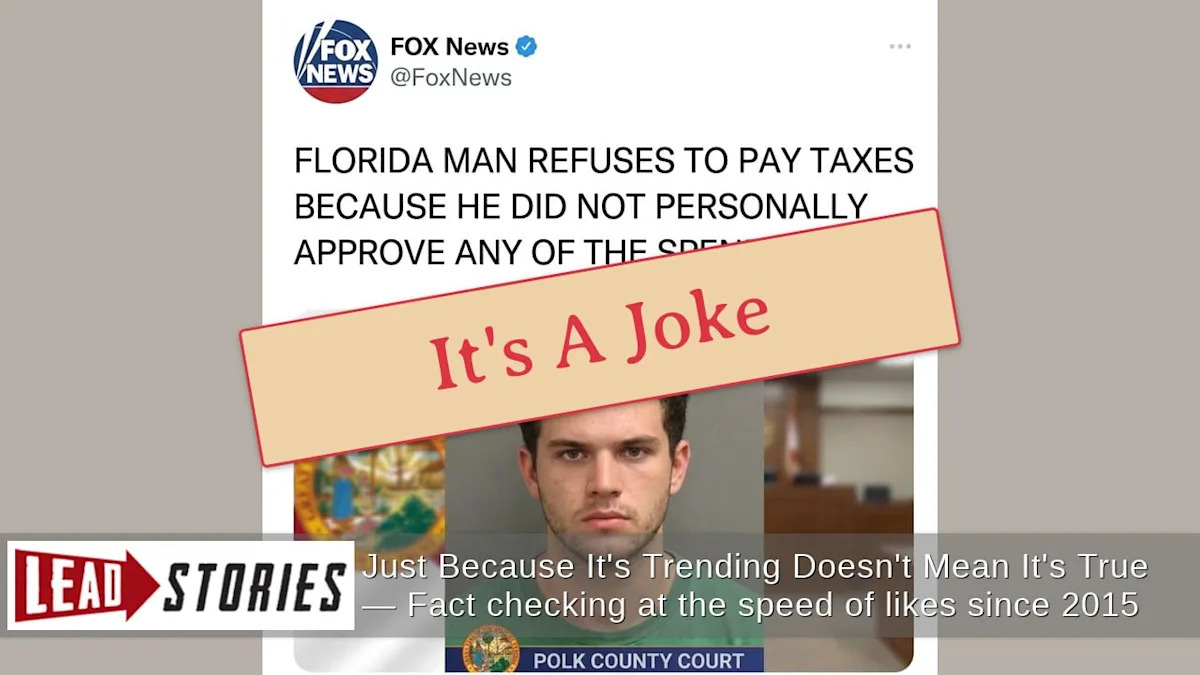
The claim, which featured a headline reading “FLORIDA MAN REFUSES TO PAY TAXES BECAUSE HE DID NOT PERSONALLY APPROVE ANY OF THE SPENDING,” began circulating when X (formerly Twitter) user @DoniTheMisfit shared an image purporting to be a Fox News story on April 6. The post quickly gained traction, with many users believing it to be an authentic news report.
Fact-checking organization Lead Stories conducted an investigation that revealed the original source was not Fox News but rather a Facebook satire account called “The Dude Humor Report.” The original post featured the Fox News logo in the top left corner, which had been cropped out in subsequent shares, removing a key indicator of its dubious origin.
“The Dude Humor Report,” which uses imagery from the cult classic film “The Big Lebowski” as its logo, explicitly identifies itself as a satire page. The account’s bio clearly states that it features “satire and parody stories that are exaggerated, developing fictional — created for entertainment purposes only.” It describes itself as a place “where breaking news meets pure entertainment.”
When researchers conducted searches on Fox News’ official website and across major search engines including Google and Yahoo! News, they found no legitimate news articles with the headline or story in question, further confirming its fabricated nature.
This incident highlights the growing challenge of distinguishing between satire and actual news in today’s digital media landscape. Without proper context or clear labeling, satirical content can easily be stripped of its original disclaimers as it spreads across platforms, potentially misleading audiences who encounter it without the original context.
The “Florida Man” trope has become a particularly popular subject for both legitimate news stories and satirical content. The phrase commonly appears in headlines about unusual or outlandish incidents involving Florida residents, making it especially ripe for parody and, consequently, confusion.
Media literacy experts have increasingly voiced concerns about how easily satirical content can be mistaken for factual reporting when shared on social media platforms. While satire has a long and important tradition in media, the rapid sharing capabilities of social networks can strip away important context clues that help readers identify humorous or fictional content.
This case serves as a reminder for social media users to verify information before sharing and to check the original source of claims that seem unusual or provocative. Many satire websites and accounts do include disclaimers, but these are often missed or removed when content is reshared.
For their part, fact-checking organizations continue to monitor viral claims, with Lead Stories noting that they had previously identified “The Dude Humor Report” as a satire page in separate investigations, suggesting this is not an isolated incident of the page’s content being misinterpreted as factual reporting.
As tax season approaches for many Americans, the fictional Florida man’s tax protest may have resonated with some viewers, perhaps contributing to its viral spread despite its satirical origins.
Fact Checker
Verify the accuracy of this article using The Disinformation Commission analysis and real-time sources.

8 Comments
While the original post may have been intended as satire, the fact that it was widely shared as legitimate news is concerning. It highlights the need for better media education and tools to help people identify credible sources and spot fake news.
This is a classic case of misinformation spreading like wildfire on social media. It’s concerning how easily satirical content can be taken as factual news, blurring the lines between humor and reality. We need to be more vigilant in verifying the sources of information we consume online.
Absolutely. Fact-checking is crucial to combat the proliferation of fake news. It’s a good thing organizations like Lead Stories are on the case to investigate the origins of these misleading claims.
Interesting to see how a satirical post can gain so much traction and be mistaken for real news. This speaks to the power of social media and the need for improved digital literacy to help people navigate the online information landscape more effectively.
I’m not surprised to see this kind of misinformation spreading, especially when it plays into political narratives. It’s a reminder of the importance of critical thinking and media literacy, rather than just blindly sharing content without verifying it first.
Agreed. We need to be more discerning consumers of information, particularly when it comes to politically charged topics. Fact-checking should be a reflex, not an afterthought.
The blurring of the line between satire and factual reporting is a worrying trend. It’s a reminder that we all need to be more vigilant in verifying the information we come across, especially when it aligns with our preexisting beliefs or political leanings.
Absolutely. We should always approach viral news stories, especially those that seem too good (or too outrageous) to be true, with a healthy dose of skepticism and fact-checking.