


Listen to the article
Iranian-Israeli Conflict Video Verification Reveals Misleading Claims
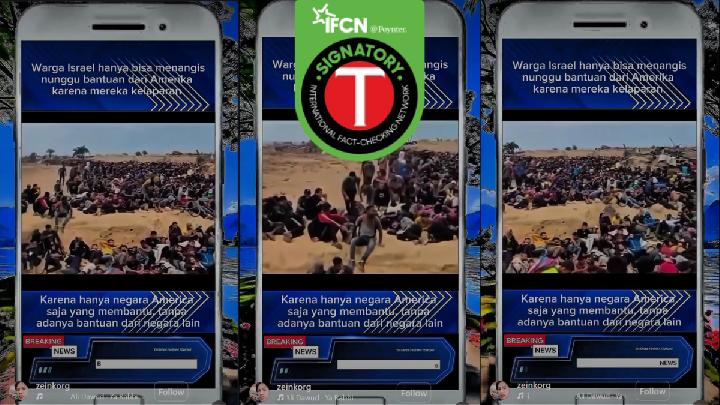
A misleading video falsely depicting Israeli refugees fleeing Iranian attacks has been circulating across multiple social media platforms since early March 2026, according to verification efforts by Tempo’s fact-checking team.
The widely shared footage shows hundreds of people gathered in a desert setting, with captions claiming they are starving Israelis awaiting humanitarian aid from the United States following Iranian attacks. The video has appeared on Instagram, Facebook, and TikTok, gaining significant traction amid the ongoing regional conflict.
Upon thorough investigation using reverse image search technology and cross-referencing with credible news sources, Tempo has determined that the video actually shows Palestinian civilians in Gaza from footage captured in 2025, not Israeli refugees as claimed.
The same imagery appeared on the Yemeni news agency Saba’s website in June 2025, accompanying a report about Doctors Without Borders (MSF) condemning the practice of airdropping aid into Gaza. According to that report, airdrops had resulted in approximately 500 deaths and nearly 4,000 injuries among desperate Palestinian civilians. The dangerous method was implemented after Israel blocked ground access for humanitarian assistance.
Additional verification came from a June 2, 2025 Facebook post by Hasn Shalan, which featured the same footage documenting Gaza residents gathering to collect aid packages dropped from aircraft.
The misrepresentation comes amid escalating regional tensions following Israeli and U.S. military strikes against Iran on February 28, 2026, which prompted retaliatory actions from Iran. The conflict has since expanded to include Lebanon after Hezbollah launched rocket and drone attacks against Israel.
While the video does not show Israeli refugees, the ongoing conflict has created genuine humanitarian crises elsewhere in the region. The Arab Weekly and The New Humanitarian report that approximately 3.2 million Iranians have been displaced due to the conflict. Lebanon has also experienced significant population displacement, with over one million people—representing about 17 percent of the country’s population—forced to flee their homes.
The United Nations Refugee Agency (UNHCR) has reported that this crisis has pushed global refugee numbers to unprecedented levels. The situation has been exacerbated by funding cuts to humanitarian aid organizations by the United States and other Western nations, leaving resources stretched thin across multiple crisis zones.
The closure of the strategically crucial Strait of Hormuz and regional airspace restrictions resulting from the U.S.-Israel operations against Iran have severely disrupted global supply chains, impeding the delivery of humanitarian aid to affected populations throughout the region.
This incident highlights the importance of verifying information during times of conflict, when misinformation can spread rapidly across social media platforms. The misleading contextualization of authentic footage from one crisis to fabricate another underscores the challenges of maintaining accurate information flows during complex regional conflicts.
Tempo continues to encourage readers to submit claims for fact-checking through their verification service and welcomes feedback on their fact-checking process as part of their commitment to combating misinformation.
Fact Checker
Verify the accuracy of this article using The Disinformation Commission analysis and real-time sources.

16 Comments
It’s disappointing to see such blatant attempts to manipulate public opinion by misrepresenting the situation. I’m glad the fact-checkers were able to trace the origins of the footage and set the record straight.
Absolutely. Verifying the sources and context of viral content is essential to maintaining trust in news and information.
This case serves as a reminder of the importance of sourcing information from credible and verified outlets. I’m glad the fact-checkers were able to trace the origins of the footage and provide the accurate context.
Absolutely. Maintaining trust in news and information is crucial, especially during times of heightened tensions and conflict.
The ability to quickly verify the accuracy of online content is crucial in today’s media landscape. I appreciate the diligence of the Tempo team in investigating this case and setting the record straight.
Fact-checking is a vital tool in the fight against the spread of misinformation. Kudos to the team for their efforts in debunking this misleading video.
It’s disheartening to see how easily disinformation can spread, especially on social media. I commend the fact-checkers for their work in debunking this false narrative and providing accurate information.
Absolutely. Maintaining trust in news sources and information is crucial, particularly during times of conflict and instability.
The use of misleading video footage to amplify a particular narrative is concerning. I’m glad the Tempo team took the time to thoroughly investigate the origins of this video and set the record straight.
Fact-checking is essential in today’s media landscape, where information can spread quickly and unchecked. Kudos to the team for their efforts.
This is a timely reminder of the importance of critical thinking and fact-checking, especially when it comes to sensitive geopolitical issues. Kudos to the fact-checking team for their diligence.
Agreed. Fact-checking is a vital tool in the fight against the spread of misinformation, which can have real-world consequences.
This case highlights the importance of media literacy and the need to critically evaluate the information we consume online. I’m glad the fact-checkers were able to uncover the truth behind this misleading video.
Agreed. Fact-checking is an essential skill in the digital age, where misinformation can spread rapidly and have real-world consequences.
This is a concerning case of disinformation being spread online. I appreciate the fact-checking efforts to verify the origin and context of the misleading video footage. It’s important to counter false narratives with accurate information.
Agreed. Fact-checking is crucial to combat the spread of misinformation, especially during times of heightened tensions and conflict.