


Listen to the article
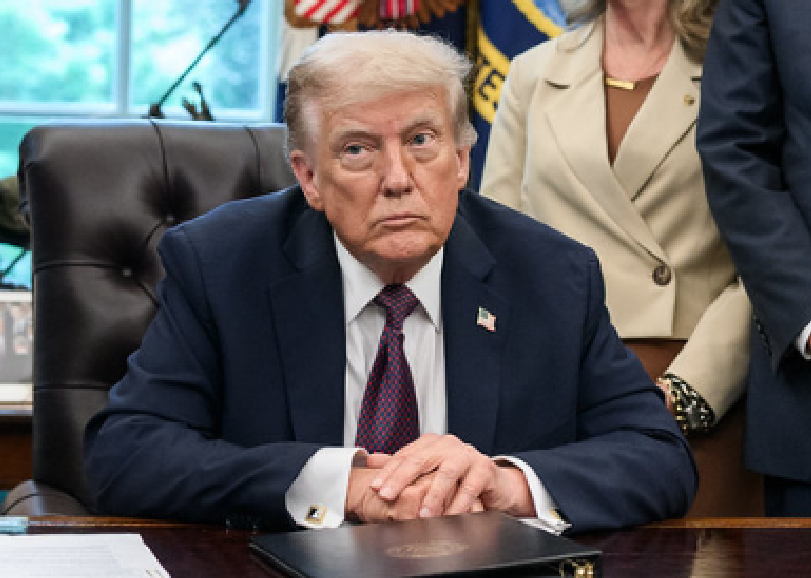
In a rare moment of pushback during a recent interview with President Donald Trump, NBC Nightly News anchor Tom Llamas challenged the president’s claim about his economic polling numbers. When Trump asserted he was “getting great polls on the economy,” Llamas directly contradicted him, noting the numbers were “not great.” Trump quickly retreated, saying his polling “should be great.”
This exchange stood out precisely because it was exceptional. Throughout the rest of the interview, Llamas repeatedly failed to challenge Trump’s false claims, responding with simple acknowledgments like “right” or “yeah” as the president made numerous inaccurate statements about inflation, gas prices, foreign investment, and other critical issues.
While Llamas did ask some probing questions and NBC later published a fact-check article on its website, television viewers and those watching clips on social media received no immediate corrections to Trump’s misstatements. The interview demonstrated the ongoing challenge journalists face when interviewing a president known for rapid-fire inaccuracies, especially given the limited time typically allotted by the White House.
On inflation, Trump falsely claimed he inherited “the worst inflation in the history of our country.” In reality, the year-over-year inflation rate when he took office in January 2025 was 3.0%, only slightly higher than the current 2.7%. While inflation did hit a 40-year high of 9.1% in June 2022 under Biden, it had fallen significantly before Trump took office. Trump also incorrectly stated that inflation over the last three months was 1.2%, a figure that doesn’t align with official data.
The president’s claims about gas prices were similarly misleading. He stated that gasoline was “$1.99 a gallon” last week, when the national average was actually around $2.89, according to AAA. Data from GasBuddy revealed that only about 0.018% of U.S. gas stations—just 28 out of approximately 150,000 tracked stations—were offering gas under $2 during the timeframe Trump referenced.
In discussing economic investment, Trump claimed “$18 trillion being invested into the country,” though the White House’s own website listed $9.6 trillion in “major investment announcements”—a figure CNN had previously found to be greatly exaggerated. He also repeated his long-debunked claim that “China’s paying a lot of tariffs,” when in fact tariff payments are made by U.S. importers and often passed on to American consumers.
The interview contained numerous other falsehoods that went unchallenged. Trump falsely claimed he had “won three times” in presidential elections, despite losing in 2020. He denied saying he wanted to nationalize elections, contradicting his own statement from earlier that week. He made unsubstantiated claims about election corruption in Detroit, Philadelphia, and Atlanta, and repeated debunked assertions about foreign governments “emptying jails” to send migrants to the United States.
When discussing migration under the Biden administration, Trump claimed “25 million people” had been allowed into the country—a significant exaggeration of the actual figure, which was under 11 million encounters, many of which resulted in immediate expulsions. He also mischaracterized data about immigrants with homicide convictions, suggesting they all entered under Biden when the figure spans multiple administrations, including his own first term.
Trump also falsely claimed Russian interference in the 2016 election “turned out to be a hoax,” contradicting the findings of special counsel Robert Mueller, whose investigation concluded that “the Russian government interfered in the 2016 presidential election in sweeping and systematic fashion.”
The NBC interview highlights the ongoing challenge media organizations face when interviewing political figures known for making false claims. While time constraints and the rapid pace of such interviews present real obstacles, the failure to challenge blatant falsehoods in real-time risks leaving viewers misinformed on critical issues.
Fact Checker
Verify the accuracy of this article using The Disinformation Commission analysis and real-time sources.

10 Comments
The challenge of interviewing a politician known for inaccuracies is a tricky one. Kudos to the NBC anchor for pushing back in the moment, even if more comprehensive fact-checking had to come later. Responsible journalism is vital, especially on economic issues.
Agreed. While it may not be possible to fully correct every false statement in the moment, calling them out and following up with detailed analysis is an important step.
As someone interested in the mining and commodities sector, I’m curious to see how Trump’s statements on issues like inflation and foreign investment hold up under scrutiny. Clear, factual reporting is essential for understanding the real state of the economy.
Absolutely. Digging into the details and providing context is key, rather than just repeating unverified claims. I’ll be interested to see the full fact-check analysis.
As an investor in mining and energy equities, I’m always keen to understand the bigger economic picture. Trump’s claims about things like inflation and foreign investment deserve close scrutiny. Looking forward to seeing the full fact-check breakdown.
Absolutely. Fact-based reporting is crucial for making informed decisions, especially in volatile sectors like commodities. I hope the analysis provides a clear, objective assessment of the claims.
It’s refreshing to see a journalist push back on inaccurate statements, even from a high-profile political figure. While it may be challenging, holding leaders accountable is essential for maintaining trust in the media and the political process.
Agreed. Even if it’s not possible to fully correct every false claim in real-time, the willingness to challenge statements and follow up with fact-checking is crucial. Transparency and accuracy should be the top priorities.
Interesting to see Trump’s claims fact-checked during the interview. It’s always important for journalists to push back on inaccuracies, even from high-profile figures. Curious to hear more about the specific economic claims that were contradicted.
Yes, it’s crucial for the media to hold leaders accountable and not simply let false statements go unchallenged. Even brief corrections can make a difference.