


Listen to the article
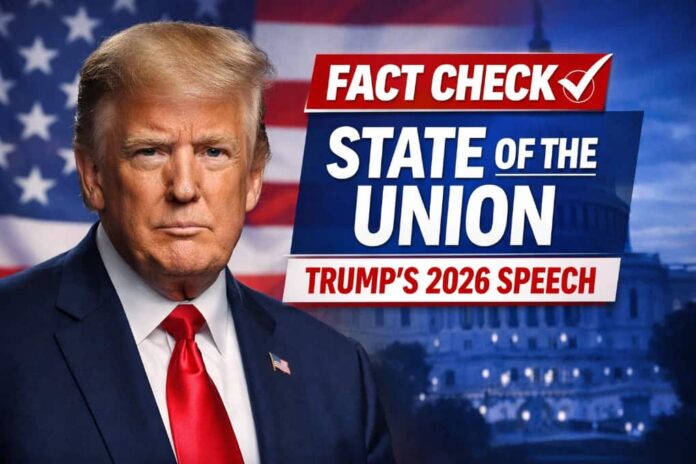
President Trump’s lengthy State of the Union address, which ran for nearly two hours, painted an optimistic picture of his second-term achievements across economic, security, and foreign policy fronts. However, independent fact-checkers have identified numerous inaccuracies, exaggerations, and misleading statements throughout the speech.
On the economic front, Trump’s claim that “inflation is plummeting” was deemed exaggerated by multiple fact-checking organizations. While inflation has indeed decreased from its 2022 peak, this downward trend began during the Biden administration. PolitiFact reported January 2026 year-over-year inflation at approximately 2.4%, close to the Federal Reserve’s 2% target, though household essentials show mixed price patterns.
The president’s statements about gas prices also failed scrutiny. Despite claiming prices below $2.30-$2.36 “in most states” and as low as $1.85 in Iowa, fact-checkers found no state averaging below $2.37 per gallon on the day of his speech. The lowest state average was in Oklahoma, and specific claims about Iowa prices couldn’t be verified at nearby stations.
While technically correct in stating “more Americans are working today than at any time in our country’s history,” the Associated Press noted this raw employment number naturally rises with population growth. The more meaningful metric—the percentage of Americans working—is not at a historic high, and unemployment has actually increased since Trump returned to office.
Investment claims also faced scrutiny. Trump’s assertion of securing “$18 trillion” in commitments lacks supporting evidence, with the White House itself citing a much lower figure of $9.6 trillion. Even this lower number appears to include projects that were already in motion before his election.
On immigration, the president’s claim that “zero illegal aliens have been admitted” in nine months relies on a narrow definition of “admitted.” While border crossings have declined sharply and the Department of Homeland Security reports detaining or removing most migrants, nearly 10,000 border encounters still occurred in January 2026.
Claims about drug interdiction showed similar definitional problems. The 56% reduction in fentanyl cited by Trump refers to seizures rather than total flow, which experts say is impossible to measure accurately. His assertion that drugs entering “by water or sea” have been “virtually stopped” lacks supporting evidence.
In discussing crime, Trump celebrated what he called the “single largest decline” in murder rates, claiming the “lowest number in over 125 years.” While homicides did drop significantly in 2025, fact-checkers noted this downward trend began before Trump took office, and comparisons spanning 125 years face methodological challenges due to changing definitions and data collection practices.
His economic policies were also subject to fact-checking. Trump’s claim of lifting “2.4 million Americans off of food stamps” misleadingly frames regulatory changes that will cause many to lose benefits—not necessarily because their financial situations have improved. Similarly, his statements about eliminating taxes on tips, overtime, and Social Security were deemed overbroad, as these policies have income limits and don’t apply universally.
The president’s assertions about tariffs replacing income taxes and being “paid for by foreign countries” contradict economic evidence. Tariffs currently account for less than 4% of federal revenue, while most economists conclude that American businesses and consumers, not foreign governments, primarily bear tariff costs.
In foreign policy, Trump’s claim that Operation “Midnight Hammer” “obliterated Iran’s nuclear weapons program” contradicts U.S. intelligence assessments, which indicate the strikes likely set back the program by only months, with significant damage at some sites but not a comprehensive elimination of capabilities.
While accurately reporting the capture of Venezuela’s Nicolás Maduro by U.S. forces in January 2026, Trump’s characterization of NATO defense spending commitments was partially misleading. NATO members did agree to a new target of 5% of GDP, but this consists of 3.5% for core defense plus 1.5% for related security investments, with implementation timelines extending into the next decade.
For Canadians in Thunder Bay and Northwestern Ontario, these policy directions have significant implications. Trump’s “America First” trade stance and tariff policies could disrupt cross-border commerce and supply chains vital to the region’s manufacturing and mining sectors. Energy policies affect fuel prices in areas already sensitive to such fluctuations, while NATO spending pressures could force Ottawa to reconsider defense budgets, Arctic security, and NORAD modernization. Additionally, U.S. actions in Iran and Venezuela may introduce volatility in global energy markets that quickly impacts Canadian consumers.
Fact Checker
Verify the accuracy of this article using The Disinformation Commission analysis and real-time sources.

7 Comments
While progress is always welcome, it’s important to ensure the president’s statements are supported by reliable data. Fact-checking helps provide a clearer picture and holds leaders accountable.
Fact-checking is crucial for maintaining trust in our political institutions. I appreciate the efforts to scrutinize the accuracy of the president’s claims, particularly on issues like inflation and energy prices.
Interesting to see fact-checkers scrutinizing the president’s economic claims. While some progress is evident, it’s important to separate rhetoric from reality and ensure the public gets an accurate picture of the current state of affairs.
Curious to see how the president’s statements on job numbers and other metrics hold up under scrutiny. Factual accuracy is crucial, especially for high-profile addresses like the State of the Union.
As someone interested in the mining and energy sectors, I’m keen to understand how the president’s claims about those industries compare to the on-the-ground reality. Fact-checking is an important part of political discourse.
As an investor in mining and commodities, I’m closely following the fact-checking on the president’s economic claims. Reliable information is key for making informed decisions.
Inflation and gas prices are two key economic indicators that can have a big impact on people’s lives. It’s good to see the details being examined closely to provide a more nuanced understanding of the situation.