


Listen to the article
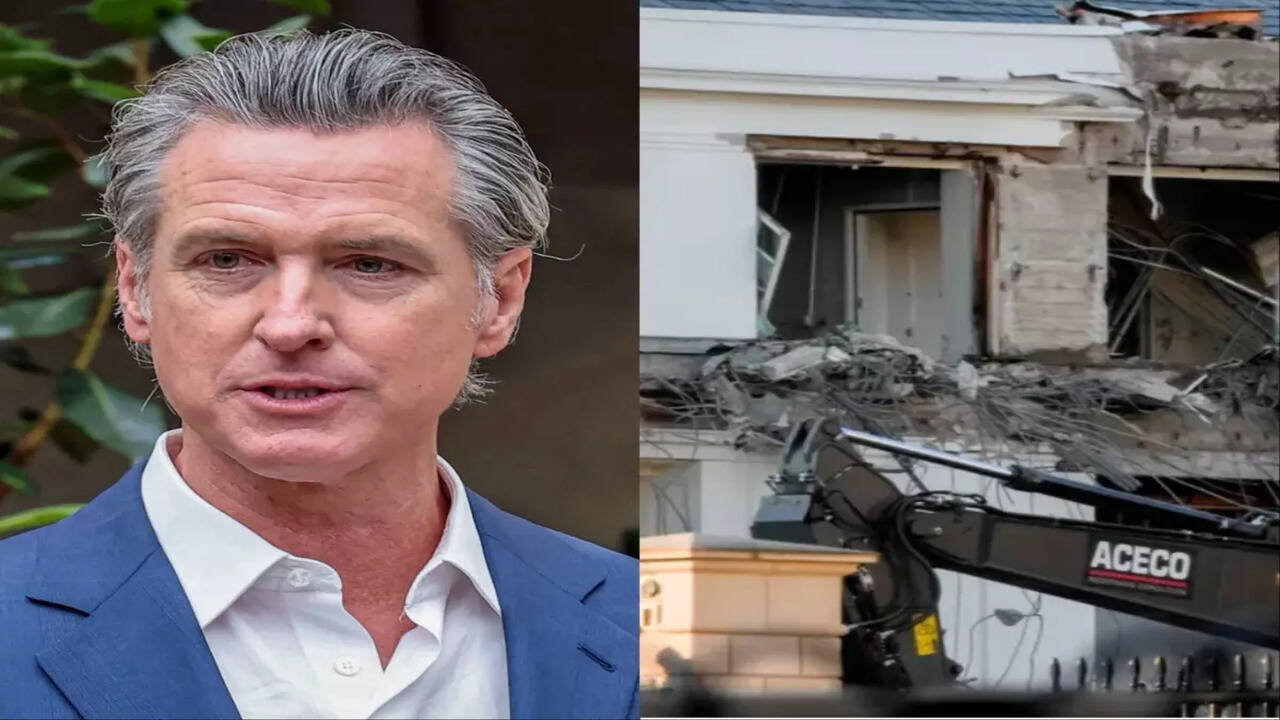
In a move that has ignited political controversy, California Governor Gavin Newsom has accused former President Donald Trump of “destroying the White House,” referring to substantial construction work currently underway at the East Wing. Newsom’s post on social media platform X stated Trump was “ripping apart the White House just like he’s ripping apart the Constitution,” a comment that quickly gained traction online.
The viral statement has drawn mixed reactions and created confusion about the actual scope and purpose of the renovations taking place at America’s most famous residence. While Trump’s renovation plans are indeed in progress, Newsom’s characterization appears to present an incomplete picture of the project’s nature and historical context.
The construction project at the center of the controversy involves the addition of a new 90,000-square-foot ballroom, reportedly conceived by the former president. The expansive hall is designed to accommodate nearly a thousand guests for state dinners and official events, representing a significant expansion of the White House’s entertainment capabilities. To create space for this addition, portions of the East Wing are being removed.
However, experts note that describing this work as “destroying” the White House misrepresents the nature of the renovations. The construction primarily involves modifying sections of a relatively recent addition to the historic structure, not damaging the original 18th-century core of the Executive Mansion. The project is being funded privately and follows a tradition of presidential modifications to the White House throughout American history.
The White House has undergone numerous transformations since its construction, many far more extensive than the current renovations. In 1814, British troops burned the building during the War of 1812, necessitating a near-complete reconstruction. President Theodore Roosevelt significantly altered the structure in 1902 by demolishing older sections to construct the West Wing, creating dedicated office space separate from the residential areas.
The East Wing itself—the very section now being modified—was added in 1942 during Franklin D. Roosevelt’s administration. Perhaps most dramatically, President Harry Truman ordered a comprehensive renovation between 1948 and 1952 that gutted the entire interior while preserving only the exterior walls, reinforcing the structure with a steel frame. By historical standards, Trump’s ballroom expansion represents a relatively modest alteration.
Recent presidents have also left their mark on the White House grounds and facilities. President Barack Obama converted the property’s tennis court into a multi-sport court that accommodated basketball and installed the White House Kitchen Garden, emphasizing healthy eating initiatives championed by First Lady Michelle Obama. More recently, President Joe Biden oversaw the complete reconstruction of the Situation Room complex, a highly secure area beneath the West Wing where critical national security decisions are made.
Architectural historians and preservation experts point out that these ongoing modifications reflect the White House’s dual nature as both a historic landmark and a functioning governmental facility that must adapt to changing needs and technological requirements. Each president has traditionally been afforded some latitude to modify the building to better serve their administration’s functions and preferences.
The White House Historical Association, which helps preserve the building’s heritage, typically works with administrations to ensure renovations respect the property’s historical significance while allowing for necessary updates.
In assessing Governor Newsom’s claim that Trump is “destroying the White House,” a more balanced view suggests the statement contains elements of truth but lacks important context. While significant demolition work is occurring as part of Trump’s renovation project, the goal appears to be expansion and modernization rather than destruction. The Executive Mansion has continuously evolved through changes under numerous presidents, with many modifications more extensive than the current work.
As with many aspects of presidential politics, the interpretation of White House renovations often falls along partisan lines, with supporters viewing them as improvements and critics questioning their necessity or appropriateness.
Fact Checker
Verify the accuracy of this article using The Disinformation Commission analysis and real-time sources.

19 Comments
The cost guidance is better than expected. If they deliver, the stock could rerate.
Nice to see insider buying—usually a good signal in this space.
Good point. Watching costs and grades closely.
Good point. Watching costs and grades closely.
If AISC keeps dropping, this becomes investable for me.
Good point. Watching costs and grades closely.
Production mix shifting toward Fact Check might help margins if metals stay firm.
Good point. Watching costs and grades closely.
Exploration results look promising, but permitting will be the key risk.
Good point. Watching costs and grades closely.
Uranium names keep pushing higher—supply still tight into 2026.
If AISC keeps dropping, this becomes investable for me.
Nice to see insider buying—usually a good signal in this space.
Good point. Watching costs and grades closely.
Good point. Watching costs and grades closely.
The cost guidance is better than expected. If they deliver, the stock could rerate.
Good point. Watching costs and grades closely.
I like the balance sheet here—less leverage than peers.
Good point. Watching costs and grades closely.