


Listen to the article
Religious tensions flared in the aftermath of a deadly bus fire near Jodhpur that claimed 26 lives, as social media posts falsely characterized the tragedy as a religiously motivated attack against Hindus.
The incident occurred on October 14 when a private air-conditioned sleeper bus traveling from Jaisalmer to Jodhpur caught fire just before reaching its destination. In the days following, misleading information circulated online suggesting the disaster was part of a deliberate plot targeting Hindu passengers.
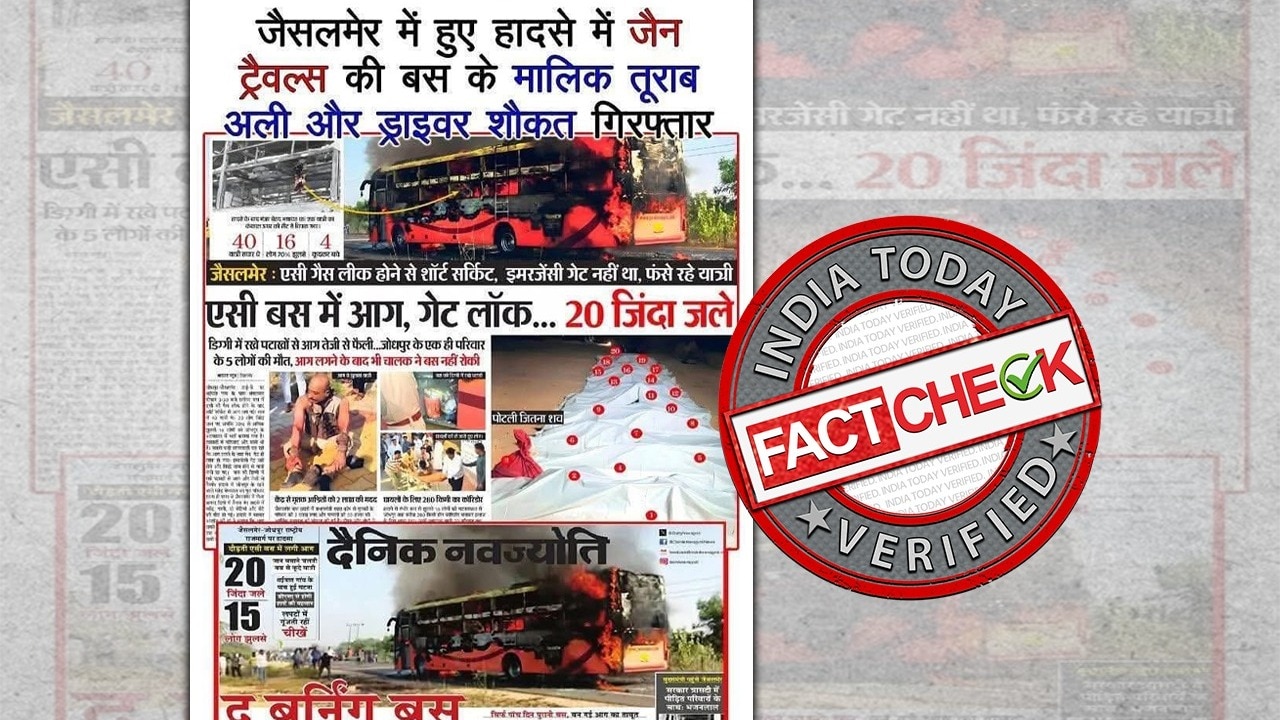
Social media users shared what appeared to be a newspaper clipping from Dainik Navjyoti with text stating: “In the Jaisalmer accident, the owner of Jain Travels’ bus, Turab Ali, and driver Shaukat were arrested.” The posts included inflammatory captions alleging the incident was “a new version of Jihad to kill as many kafirs as possible, disguised under Hindu or Jain named businesses.”
An investigation by India Today Fact Check revealed significant inaccuracies in these claims. The bus was operated by KK Travels, not Jain Travels as suggested. While the owner was indeed Turab Ali and the driver was Shaukat Khan, the connection to Jain Travels was misconstrued. The text overlay on the newspaper clipping was manipulated, with font that didn’t match the publication’s standard typography.
Official records and police statements confirmed these findings. On October 16, Jaisalmer Police issued a press release via their social media accounts clarifying that the AC sleeper bus belonged to KK Travels, with Turab Ali as the owner and Shaukat Khan as the driver.
The investigation did reveal a connection to a person named Manish Jain, but not in the way social media posts suggested. Manish Jain, who owns a company called Jain Travels, also operates Jainam Coach Crafts, the firm responsible for building the bus’s body. According to the Jaisalmer Superintendent of Police Abhishek Shivhare, the bus had “Jain Travels” written on it because its body was manufactured by Jainam Coach Crafts.
Safety violations appear to have played a critical role in the tragedy. Reports indicate that several safety standards were ignored during the bus’s construction, including having only one exit door that became jammed after a short circuit. The bus also had a separately installed air conditioning system. In the aftermath of the incident, the Transport Department seized 66 buses manufactured by Jainam Coach Crafts.
Perhaps most tellingly, the religious conspiracy narrative collapses under demographic scrutiny of the victims. According to a Dainik Bhaskar report from October 18 that listed the names and photos of the deceased, the victims included 14 Hindus and nine Muslims. SP Shivhare confirmed to India Today Fact Check that “a significant number of Muslims, along with Hindus, died in this incident.”
The spread of misinformation following tragedies has become an increasingly common phenomenon in India’s polarized media environment. Such incidents highlight the importance of fact-checking before sharing potentially inflammatory content on social media platforms, where religious tensions can quickly escalate based on false or misleading information.
As the investigation continues, authorities are focusing on safety violations rather than religious motives. Manish Jain has been arrested in Jodhpur for his company’s role in the faulty bus construction, underscoring the actual cause of the tragedy: regulatory failures and safety oversights, not religious targeting.
The Jaisalmer bus fire represents a tragic accident made worse by safety violations, and the subsequent spread of unfounded conspiracy theories demonstrates how disasters can be exploited to inflame communal tensions in an already complex social landscape.
Fact Checker
Verify the accuracy of this article using The Disinformation Commission analysis and real-time sources.

12 Comments
The investigation’s findings are a good reminder to be cautious about accepting social media claims at face value, especially when they involve sensitive topics. It’s important to rely on authoritative and well-researched sources to understand the true facts of an incident.
Yes, the need for reliable information is heightened in situations like this. Fact-checking is essential to counter the proliferation of misinformation and maintain social cohesion.
The detailed investigation and fact-checking in this article are commendable. It’s a good example of how responsible journalism can help counter the spread of misinformation and maintain social stability, even in the face of a tragic incident.
Well said. Fact-based reporting is essential for providing the public with accurate information and preventing the proliferation of harmful narratives, especially around sensitive issues like communal violence.
This article highlights the importance of responsible journalism and fact-based reporting, particularly when it comes to incidents that could inflame religious or communal tensions. Rushing to conclusions without verifying the facts can lead to harmful and divisive narratives.
Absolutely. Spreading unverified claims, especially those with inflammatory undertones, can have damaging societal impacts. Fact-checking is a crucial safeguard against the spread of misinformation.
This fact check highlights the complexities involved in reporting on sensitive issues like communal violence. While it’s understandable that people may feel emotions running high after a tragic incident, it’s crucial that the media and public remain objective and fact-based in their responses.
Absolutely. Emotions can cloud judgment, which is why rigorous fact-checking and impartial reporting are so important, especially when dealing with sensitive topics that have the potential to inflame tensions.
This seems like an important fact check. It’s important to verify claims and not spread misinformation, especially around sensitive issues like religious tensions. I’m glad the investigation was able to clarify the actual details of the tragic bus fire incident.
Yes, it’s good that the media is fact-checking these claims and not letting misinformation spread. Verified information is crucial in these situations.
It’s concerning to see how quickly unsubstantiated claims can spread on social media, especially when they involve sensitive topics like religion and communal violence. Rigorous fact-checking is essential to counter these kinds of false narratives.
Agreed. Fact-checking is vital to prevent the proliferation of misinformation, which can have serious consequences, especially around sensitive issues. Kudos to the investigators for setting the record straight.