


Listen to the article
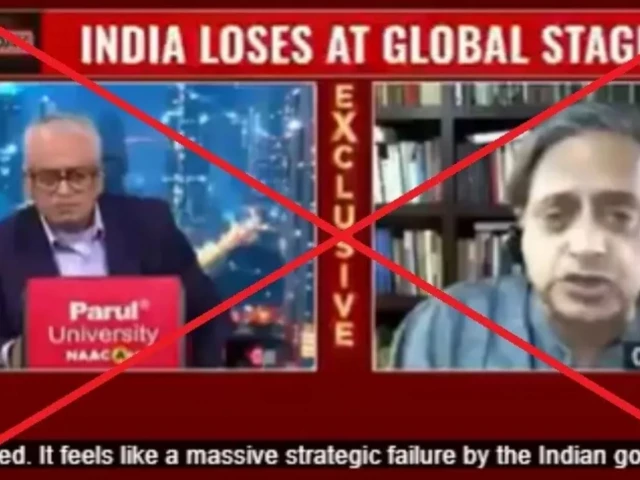
In a concerning development for digital misinformation, a fabricated video falsely depicting Indian politician Shashi Tharoor criticizing Prime Minister Narendra Modi has been widely circulated on social media, highlighting growing concerns about AI-generated deepfakes in political discourse.
The manipulated clip, which began circulating on Wednesday, purportedly showed Tharoor lambasting Modi’s government for its absence in ceasefire negotiations between the United States and Iran, while praising Pakistan’s diplomatic role. The video quickly gained traction, accumulating over 161,000 views on X (formerly Twitter) and was subsequently shared by several high-profile accounts, including Sindh Senior Minister Sharjeel Inam Memon and prominent journalist Kamran Khan.
In the doctored footage, a voice mimicking Tharoor claims: “If you saw Donald Trump’s latest tweet crediting Pakistan with stepping in to end the Iranian war, you know why I am in shock. It feels like a massive strategic failure by the Indian government.” The fabricated monologue goes on to suggest that Pakistan is “rebranding itself as a global net stability provider” while India is “bleeding diplomatic capital.”
Forensic analysis of the video revealed multiple telltale signs of manipulation. The politician’s speech pattern appeared unnatural and robotic, with awkward pacing and emphases inconsistent with Tharoor’s characteristic eloquence. Visual discrepancies were also evident, including a momentary disconnection of his headphone wire and subtle jaw distortions. AI detection tools flagged the content, with Sora AI video detector identifying it as 33.3% AI-generated and Hive Detect labeling the audio as 51% synthetic.
The original footage was traced to an interview published by India Today on December 26, 2025, titled “Shashi Tharoor: ‘No BJP or Congress foreign policy, only Indian national interest.'” The authentic video predated the current events and showed Tharoor discussing entirely different topics, including Bangladesh relations and U.S. tariff impacts on India’s economy.
Tharoor himself addressed the circulation of deepfakes in a statement on his X account, writing: “There are an alarming number of deepfake videos circulating of me, with convincing-sounding AI-generated voice-overs over genuine footage of old interviews, having ‘me’ saying things I have never said.”
The fabricated content emerged against the backdrop of actual diplomatic developments. According to reports, Pakistan has played a significant mediating role in securing a two-week ceasefire between the United States and Iran on April 8, 2026, following escalating hostilities that began with US-Israeli strikes on February 28.
This incident underscores the growing sophistication of AI-generated deepfakes and their potential to inflame regional tensions. The same account responsible for the Tharoor video had previously shared similar fabricated content featuring Indian journalists Ravish Kumar and Palki Sharma purportedly criticizing Modi’s government over Pakistan’s diplomatic initiatives.
Media literacy experts warn that such sophisticated manipulations represent a significant threat to public discourse, particularly in regions with complex geopolitical relationships like South Asia. As AI technology becomes more accessible, the ability to verify authentic content grows increasingly challenging for both media organizations and the general public.
The incident has renewed calls for stronger platform policies regarding synthetic content and greater investment in detection technologies that can help users distinguish between authentic and manipulated media.
Fact Checker
Verify the accuracy of this article using The Disinformation Commission analysis and real-time sources.

9 Comments
The proliferation of manipulated media like this is a concerning trend that undermines democratic processes. We must redouble efforts to combat the spread of misinformation and strengthen our collective resilience against such threats.
This is a troubling example of how easily disinformation can spread online. It’s a reminder of the importance of rigorous verification and responsible journalism, to ensure the public has access to accurate, trustworthy information.
Deepfakes are a concerning development that can be easily weaponized to mislead and influence. We must be vigilant in identifying and debunking fabricated content, and support efforts to combat the rise of digital misinformation.
Fabricated videos like this are extremely worrying, as they can sway public opinion and erode trust in institutions. Fact-checking and media literacy education are essential to counter the threat of AI-generated deepfakes.
Disturbing to see the spread of such blatantly fabricated videos. Deepfakes pose a serious threat to truth and democratic discourse. We must stay vigilant and fact-check claims, no matter the source or their apparent credibility.
This incident highlights the urgent need for robust policies and technological solutions to address the rise of deepfakes. Protecting the integrity of information should be a priority for governments, tech companies, and civil society.
Absolutely. Effective regulation, industry standards, and user education will be crucial in mitigating the risks posed by AI-generated disinformation. Maintaining public trust in the digital space is paramount.
I’m concerned about the growing prevalence of AI-generated misinformation. While technology advances, we must ensure robust safeguards are in place to protect the integrity of information, especially around sensitive political issues.
Agreed. Fact-checking and media literacy are crucial in this environment. We need to empower citizens to critically evaluate online content and call out manipulated media when they see it.