


Listen to the article
In a development that underscores the ongoing information warfare surrounding Myanmar’s civil conflict, a pro-junta Telegram channel has been caught fabricating a quote from a senior Karen National Union (KNU) official regarding alleged casualties from military airstrikes.
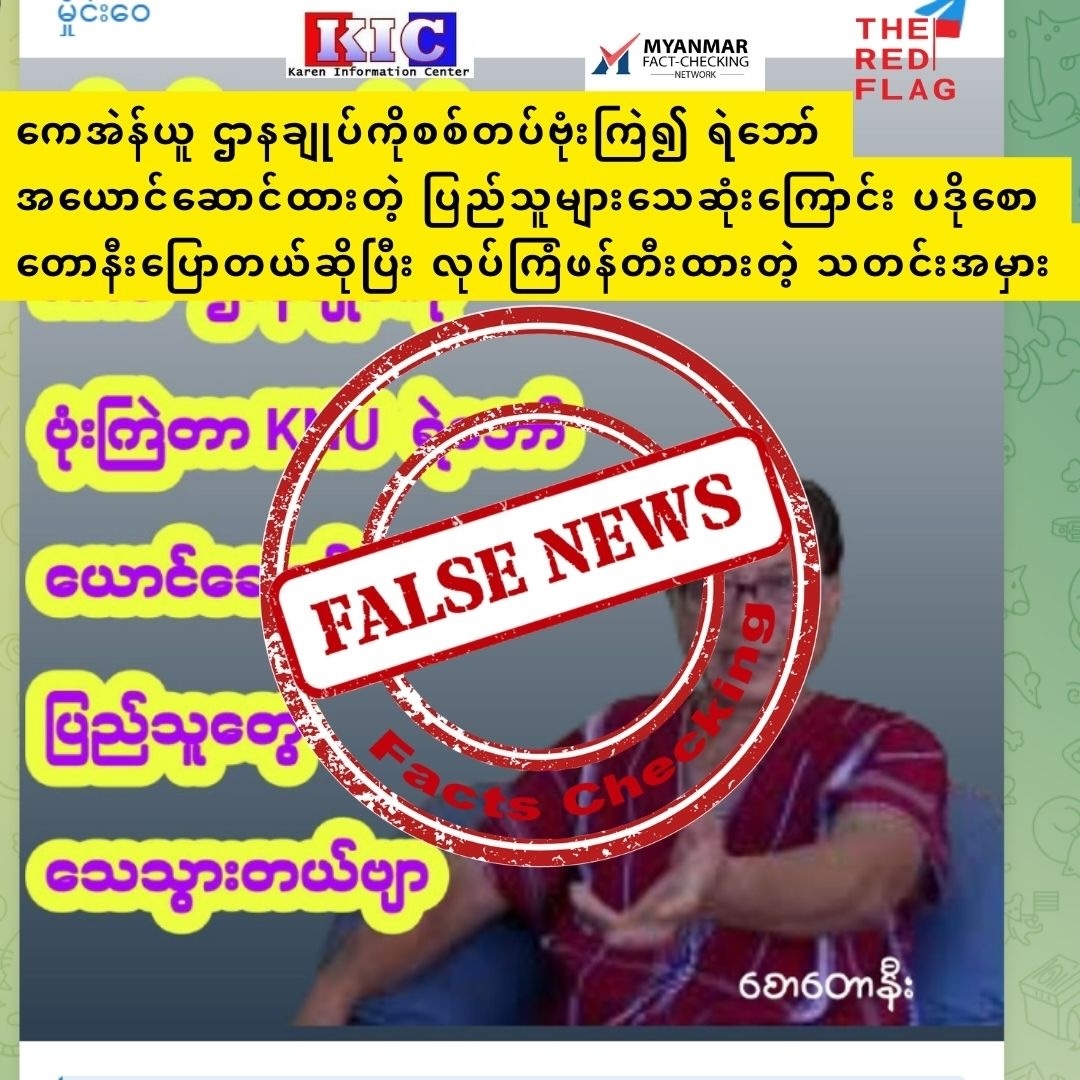
On March 13, the prominent pro-military Telegram channel “Hmine Wai” published a post claiming to quote KNU spokesperson Padoh Saw Taw Nee as saying, “The junta bombed the KNU headquarters, and people posing as our comrades were killed.” The post, which accumulated more than 20,000 views and 600 reactions within a week, was accompanied by a photo of Padoh Saw Taw Nee.
However, an investigation by Karen Information Center (KIC), a member of the Myanmar Fact-Checking Network (MFCN), has determined the quote to be entirely fabricated, marking yet another instance of disinformation in Myanmar’s increasingly complex media landscape.
Independent verification of military actions in the region shows a pattern of airstrikes against KNU territory, though with significantly different outcomes than those claimed by pro-junta sources. Between October 2024 and March 2026, several aerial attacks, including kamikaze drone strikes, were documented by credible media outlets.
Myanmar Now reported the earliest kamikaze drone attack caused property damage but no casualties. A subsequent drone strike on January 31, 2025, documented by KIC, resulted in building damage and one civilian suffering a leg injury.
The first conventional bombing, conducted by a Y-12 aircraft on August 10, injured one young man. At the time, pro-junta channels falsely claimed more than 70 people had been killed, including the commander-in-chief of the Karen National Liberation Army (KNLA), the armed wing of the KNU. This misinformation was previously debunked by KIC on August 17.
Most recently, on March 13, Khit Thit Media reported that the KNU successfully shot down a junta drone, with no casualties or damage resulting from the incident.
To verify the authenticity of the alleged quote, KIC employed Google Advanced Search tools using relevant keywords including “Padoh Saw Taw Nee,” “airstrike on KNU headquarters,” and “bombing on KNU headquarters.” Their investigation found no credible reports containing the statement attributed to the KNU spokesperson by the pro-junta channel.
The KNU, one of Myanmar’s oldest and most established ethnic armed organizations, has been a significant force opposing the military junta that seized power in February 2021. The organization controls territory primarily in eastern Myanmar along the Thai border and has faced increased military pressure since the coup.
This incident highlights the junta’s continued efforts to shape public perception through false narratives. The fabricated quote appears designed to promote the notion that the KNU is forcing civilians to pose as fighters, potentially to justify civilian casualties in military operations against the group.
Media analysts note that such disinformation campaigns have become increasingly sophisticated since the coup, with pro-junta channels frequently sharing manipulated information aimed at undermining the credibility of resistance forces and ethnic armed organizations.
The Myanmar Fact-Checking Network recommends that social media users verify information through reliable fact-checking organizations before accepting or sharing potentially misleading content, especially regarding conflict-related events where accurate information is critical but often difficult to obtain.
As Myanmar’s civil conflict intensifies, with resistance forces making significant gains in some regions, the battle for information control remains a crucial aspect of both sides’ strategies, underscoring the importance of independent fact-checking initiatives in the country’s fragmented media environment.
Fact Checker
Verify the accuracy of this article using The Disinformation Commission analysis and real-time sources.

9 Comments
It’s troubling to see the ongoing disinformation campaign surrounding the conflict in Myanmar. Fabricating quotes from KNU officials to spread false narratives is deeply concerning. Fact-checking efforts are crucial to countering these malicious tactics.
The proliferation of disinformation in Myanmar’s media landscape is deeply concerning. Rigorous fact-checking and a commitment to journalistic integrity are necessary to counter these malicious tactics and shed light on the realities of the conflict.
Kudos to the Myanmar Fact-Checking Network for investigating this false claim and exposing the fabricated quote. Diligent fact-checking is a vital tool in the fight against misinformation, especially in conflict zones where the truth is often obscured.
This story highlights the complex and volatile media landscape in Myanmar. While military airstrikes against KNU territory are documented, the details and outcomes seem to be heavily distorted by pro-junta sources. Rigorous verification of information is essential.
While the details of military operations in KNU territory remain murky, it’s clear that disinformation is being used as a weapon in this conflict. Fact-checking organizations play a crucial role in cutting through the fog of war and exposing the truth.
Fabricating quotes and distorting information only serves to further inflame tensions and undermine efforts towards a peaceful resolution in Myanmar. Responsible media practices and a commitment to truth-telling are vital during such turbulent times.
The use of social media platforms like Telegram to rapidly spread disinformation is a growing concern. It’s crucial that media consumers remain vigilant and cross-reference claims with reliable sources to separate fact from fiction.
This case highlights the importance of maintaining a critical eye and verifying information, especially when it comes to sensitive geopolitical issues. Fact-based reporting is essential for informed public discourse and decision-making.
This incident underscores the need for greater transparency and accountability when it comes to reporting on the military’s actions in Myanmar. Unbiased, fact-based journalism is essential for understanding the complex realities on the ground.