


Listen to the article
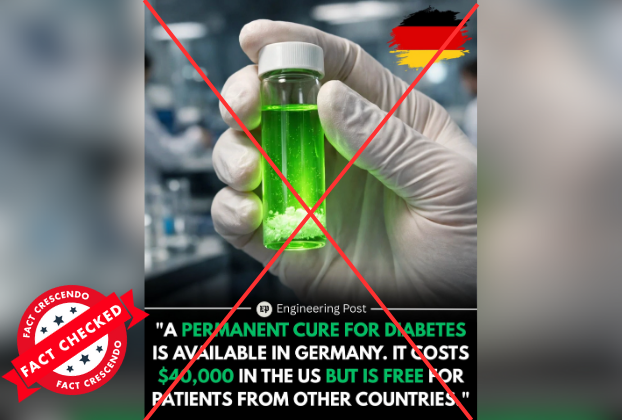
International researchers have debunked viral claims that Germany offers a free cure for diabetes that supposedly costs $40,000 in the United States. The investigation reveals these widely shared social media posts misrepresent ongoing research and experimental treatments that remain years away from clinical application.
Germany does stand at the forefront of diabetes research, particularly for Type 1 diabetes. Helmholtz Munich, working with LMU Munich, is developing insulin-producing cells from stem cells with protective features to prevent immune rejection. This project has secured international funding, including support from JDRF, a major diabetes research organization. However, Helmholtz Munich explicitly describes this work as being in early experimental stages—not an available treatment and certainly not a cure.
Several German research institutions participate in promising international clinical trials, such as Vertex Pharmaceuticals’ VX-880 therapy. While early results show some participants were able to reduce insulin dependence temporarily, these outcomes occurred in small test groups, required lifelong immunosuppression drugs, and lack data on long-term effectiveness.
“Even in the most promising trials, these therapies don’t eliminate the underlying autoimmune process in Type 1 diabetes,” explains Dr. Martin Heni, an endocrinologist at the German Center for Diabetes Research. “Most recipients require immunosuppressive drugs indefinitely to prevent rejection or renewed immune attacks on beta cells.”
The World Health Organization, Diabetes UK, and German medical authorities all confirm that no permanent cure exists for either Type 1 or Type 2 diabetes anywhere in the world. Diabetes remains a chronic condition managed through medication, monitoring, and lifestyle interventions, even as researchers explore disease-modifying approaches.
The German Center for Diabetes Research describes stem cell therapies, immune modulation, and islet replacement as promising future approaches but explicitly states these strategies remain investigational and not curative at present.
Some private German clinics, including the ANOVA Institute for Regenerative Medicine, do offer experimental stem cell treatments for diabetes. However, these programs are neither free nor presented as standard care. ANOVA and similar facilities note that patients must continue conventional diabetes management alongside these treatments, with results varying significantly between individuals.
These experimental treatments typically cost between €20,000 and €35,000, according to BookingHealth, a medical tourism facilitator. Patients must pay out of pocket, as Germany’s statutory health insurance system covers only routine diabetes care for residents and insured individuals. There is no national program providing free experimental diabetes treatments to foreigners.
“The situation is similar in the United States,” notes endocrinologist Dr. Sarah Richardson from the University of Miami’s Diabetes Research Institute. “Investigational cell-based or regenerative diabetes therapies are classified as experimental and not covered by standard health insurance. Patients choosing these treatments typically pay out of pocket, with costs often reaching tens of thousands of dollars.”
One procedure frequently mentioned in viral posts is duodenal mucosal resurfacing, marketed as Revita by Fractyl Health. While available in Germany for certain Type 2 diabetes patients, clinical studies indicate it improves blood sugar control for 12-24 months but doesn’t cure diabetes or eliminate the disease permanently.
Germany’s medical regulator, BfArM, operates under European Medicines Agency frameworks that prohibit marketing unproven treatments as “cures.” As of 2023, no stem cell, regenerative, or metabolic therapy has received EMA authorization as a curative treatment for diabetes.
The viral claims appear designed to exploit the hopes of diabetes patients seeking alternatives to lifelong treatment regimens and financial concerns about healthcare costs. Medical authorities urge patients to consult licensed healthcare providers rather than relying on unverified social media claims about miracle cures.
Fact Checker
Verify the accuracy of this article using The Disinformation Commission analysis and real-time sources.

9 Comments
It’s encouraging to see the promising early results from the Vertex Pharmaceuticals trial, even if long-term effectiveness is still unknown. Developing therapies that can reduce insulin dependence, even temporarily, could be a significant advancement. I’ll be interested to follow the progress of this and other German research.
It’s always important to be cautious about sensational claims, especially related to medical breakthroughs. I’m glad this article provided a balanced and well-researched perspective on the current state of diabetes research in Germany. Slow and steady progress is often the reality, even with promising developments.
The article does a good job of highlighting the important work being done in Germany on diabetes, while also tempering expectations around claims of a ‘free cure.’ Incremental progress is still valuable, and it’s encouraging to see international collaboration on clinical trials. I’ll be following this space with interest.
It’s good to see this level of scrutiny applied to viral claims, even when they seem appealing. The details provided here give a much more accurate picture of the diabetes research landscape in Germany. I’ll be keeping an eye on these developments, but with realistic expectations.
While the claims of a free diabetes cure in Germany seem to be exaggerated, it’s clear they are making important strides in this field. The work on insulin-producing cells and therapies like VX-880 show real potential, even if a true cure remains elusive for now. I appreciate the fact-checking on these viral claims.
This is a great example of the value of fact-checking viral claims, even when they seem appealing. While Germany may be at the forefront of certain diabetes research, the reality is more nuanced than the social media hype. I appreciate the detailed investigation into the actual status of these experimental treatments.
This is a great example of the importance of fact-checking, especially around topics like medical treatments. While the work being done in Germany is certainly notable, the reality is more complex than the viral claims. I appreciate the nuanced look at the current state of diabetes research.
Interesting to see the latest on diabetes research in Germany. It’s good to see they are at the forefront of developing innovative treatments, even if a true cure remains elusive for now. I’m curious to learn more about the protective insulin-producing cell research at Helmholtz Munich.
The fact that several German research institutions are participating in international clinical trials for diabetes treatments is a positive sign. It’s good to see collaborative efforts to advance the science and explore new therapeutic approaches. Even if a complete cure isn’t available yet, incremental progress is still important.