


Listen to the article
Artificial Intelligence-Generated Images Fuel False Claims of Ethnic Protests in Shan State
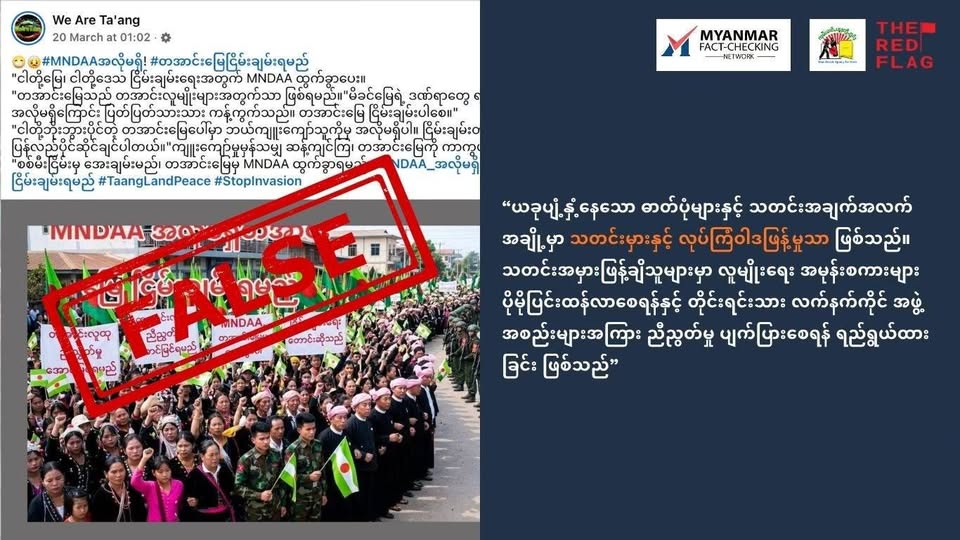
Manipulated photos claiming to show mass protests by Palaung ethnic people against the Myanmar National Democratic Alliance Army (MNDAA) have been circulating on social media, according to an investigation by Shan Herald.
The images, which first appeared on March 20 on a Facebook page called “We Are Ta’ang,” have gained significant traction, collecting more than 1,500 reactions and over 100 shares. The posts allege that Palaung communities organized rallies demanding the Kokang armed group leave their territory.
However, careful examination by fact-checkers has revealed telltale signs of artificial intelligence manipulation in these images. The placards shown in the supposed protest photos display text in suspiciously uniform sizes and fonts, some containing spelling errors. More revealing are the anatomical irregularities—protestors with unnaturally formed fingers and awkward postures that don’t conform to human anatomy.
“These are classic indicators of AI-generated imagery,” explained a digital media analyst who reviewed the photos. “The technology has advanced significantly, but it still struggles with human features like hands and positioning multiple bodies in natural arrangements.”
The fabricated images appear designed to inflame tensions between ethnic groups in northern Shan State, a region already experiencing complex armed conflict dynamics. Independent media organizations operating in the area, including Shwe Phee Myay, have not reported any large-scale protests against the MNDAA, further supporting the conclusion that these purported demonstrations never occurred.
The misinformation campaign comes against a backdrop of genuine territorial disputes between the MNDAA and the Ta’ang National Liberation Army (TNLA), the armed group associated with the Palaung people. Earlier this year, the two groups were involved in armed clashes over control of key areas in northern Shan State, including the strategic Muse 105-Mile trade zone, where the TNLA raised its flag following territorial gains.
Despite these tensions, recent reports indicate the two groups reached a ceasefire agreement, a development that makes the timing of these fabricated protest images particularly suspect. Security analysts suggest the false images may represent an attempt to derail reconciliation efforts between the armed groups or to provoke renewed hostilities.
“This is a calculated effort to exploit existing ethnic tensions,” said a conflict resolution specialist familiar with Myanmar’s complex insurgencies. “By presenting AI-generated imagery as documentary evidence, those behind this campaign are attempting to create a false narrative of widespread ethnic opposition to the MNDAA.”
The circulation of such fabricated content highlights the increasing sophistication of disinformation campaigns in Myanmar’s conflict zones. Digital literacy experts warn that as AI technology becomes more accessible, distinguishing between authentic and manipulated imagery will become increasingly challenging for social media users.
“We’re entering a new era where seeing is no longer believing,” noted a regional tech policy expert. “The barrier to creating convincing fake imagery has never been lower, which makes independent fact-checking more essential than ever.”
Media watchdogs recommend that social media users verify information through reliable news sources and established fact-checking organizations before sharing potentially divisive content. The fabricated nature of these protest images serves as a reminder of how easily manipulated media can be weaponized to inflame communal tensions in conflict-affected regions.
As northern Shan State continues to navigate complex peace processes involving multiple ethnic armed organizations, the spread of such misinformation poses a tangible threat to reconciliation efforts and community cohesion in an already fragile security landscape.
Fact Checker
Verify the accuracy of this article using The Disinformation Commission analysis and real-time sources.

12 Comments
The findings of this fact-check are quite revealing. The use of AI-generated imagery to create false narratives is a troubling trend that requires ongoing vigilance and robust verification processes.
Absolutely. Maintaining the integrity of information is crucial, especially in an era where synthetic content can be used to manipulate public opinion. Kudos to the fact-checkers for their diligence.
Careful analysis of the protest photos has uncovered the use of AI-generated imagery to spread misinformation. This highlights the need for robust fact-checking and media literacy efforts to combat the rise of synthetic content.
Concerning to see the use of AI-generated imagery to fuel false claims about ethnic protests. Appreciate the efforts of fact-checkers to uncover the deception and expose the telltale signs of manipulation.
This highlights the need for increased digital literacy and awareness around AI-generated content. Fact-checking plays a vital role in combating the spread of misinformation.
Interesting investigation into the authenticity of these protest photos. It’s concerning to see AI-generated images being used to spread misinformation. Fact-checking like this is important to combat the spread of false narratives.
Agreed. Manipulated media is a growing issue that needs to be addressed. Rigorous verification of content is crucial to maintain trust in information sources.
This investigation highlights the need for increased scrutiny of online content, especially when it comes to sensitive political and social issues. Fact-checking is essential to combat the spread of misinformation and maintain trust in information.
The use of AI-generated imagery to fuel false claims about ethnic protests is concerning. Fact-checkers play a vital role in exposing such deception and maintaining the credibility of information sources.
The details provided about the anatomical irregularities and uniform text in the protest photos are quite revealing. It’s clear that advanced AI technology can be misused to create convincing but false narratives.
This investigation into the false claims of an anti-MNDAA protest is a good example of the importance of verifying information, especially when it comes to sensitive political and social issues. Kudos to the fact-checkers for their diligence.
Agreed. Fact-checking is crucial in today’s media landscape, where false narratives can spread rapidly online. Maintaining the integrity of information is key to informed decision-making.