


Listen to the article
Investigations Refute Claims of COVID-19 Pandemic Planning by Gates and Epstein
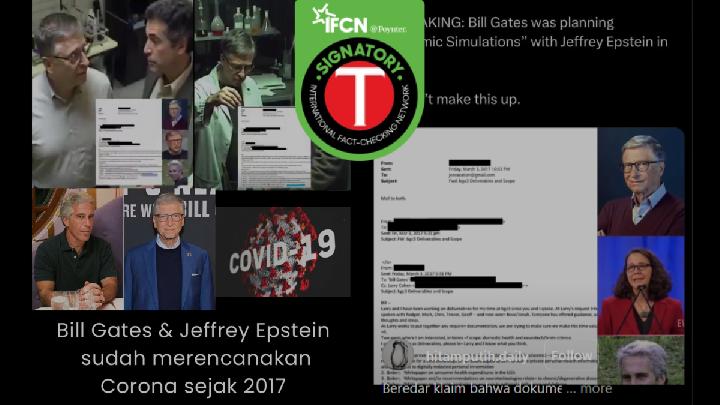
Claims circulating on social media that Bill Gates and Jeffrey Epstein planned the COVID-19 pandemic as early as 2017 have been debunked by a comprehensive Tempo investigation. The allegations emerged after the U.S. Department of Justice released millions of documents from the “Epstein Files” to the public in late 2025.
Various Facebook and Instagram posts pointed to a document labeled “EFTA02657725.pdf,” which contains correspondence between Gates and Epstein regarding a “strain pandemic simulation.” These posts presented this email as evidence that Gates orchestrated a COVID-19 simulation years before the global outbreak occurred.
However, after consulting epidemiology and immunology experts and examining official records, Tempo found no evidence supporting these claims. While the pandemic simulation document does exist within the Epstein Files, experts confirm that such simulations are standard practice in epidemiology to prepare for potential health crises.
The Epstein Files comprise over 3.5 million pages of documents released on December 19, 2025, detailing the criminal activities of Jeffrey Epstein, who died in a New York prison in August 2019. The collection includes flight logs, phone books, digital evidence, FBI records, and grand jury transcripts mentioning several prominent figures including Donald Trump, Prince Andrew, Bill Gates, Hillary Clinton, and Elon Musk.
Tempo’s investigation located two files coded EFTA02381427 and EFTA02657725 on the DOJ website. These documents contain a March 3, 2017 correspondence titled “bgc3 Deliverables and Scope” involving Gates, Larry Cohen, and Epstein. BGC3, now known as Gates Ventures, is a think tank founded by Gates focusing on global health issues.
The email outlines five areas of proposed work in health and neurotechnology, with the fifth point referencing technical recommendations for a strain pandemic simulation. When forwarded to Epstein, he simply responded with “okay.” Nothing in this exchange indicates planning for the COVID-19 pandemic specifically.
Gates addressed these allegations in an exclusive interview with 9News Australia on February 4, 2026, expressing regret over his relationship with Epstein and claiming the circulating email had been manipulated. “The email was false. So, I don’t know what his thinking was there,” Gates stated.
Airlangga University epidemiologist Windhu Purnomo explained to Tempo that pandemic simulations are routine preventive measures. “This simulation is as mandatory as earthquake or fire drills,” Purnomo said on February 6, 2026.
Several pandemic simulations have been conducted globally. The United States held “Event 201” in 2019, a collaboration between Johns Hopkins Center for Health Security, the World Economic Forum, and the Bill and Melinda Gates Foundation. The United Kingdom conducted “Exercise Cygnus” in October 2016 involving 950 personnel. Indonesia performed its own H7N9 influenza simulation in September 2017, despite the virus not yet being detected in the country.
Scientific consensus identifies COVID-19’s origins at a seafood market in Wuhan, with the first case hospitalized on December 26, 2019. Research published in Nature found genetic similarities between SARS-CoV-2 and bat coronaviruses.
Ari Baskoro, a clinical immunology lecturer at Airlangga University, emphasized that most scientists agree SARS-CoV-2 emerged naturally. “The initial transmission is suspected to have originated in bats,” Baskoro told Tempo on February 8, 2026.
Baskoro explained that viruses can be synthesized for scientific purposes such as vaccine development, cancer therapies, and treatment research—not to create new diseases. This research helps scientists understand viral evolution and develop preventative measures.
The COVID-19 pandemic follows a historical pattern of devastating outbreaks, including smallpox (eradicated in 1977) and the 1918-1920 Spanish influenza that infected one-third of the global population. These past epidemics have provided valuable lessons about the importance of rapid response and vaccine development.
After thorough investigation, Tempo concludes that claims linking the COVID-19 pandemic to 2017 email exchanges between Gates and Epstein are misleading and unsupported by evidence.
Fact Checker
Verify the accuracy of this article using The Disinformation Commission analysis and real-time sources.

12 Comments
I appreciate the detailed reporting and expert analysis that went into debunking these claims. It’s concerning to see misinformation spreading on social media, so I’m glad to see a fact-based response.
The Epstein Files contain a massive amount of information, so it’s important to scrutinize any specific claims and not jump to conclusions. This fact check provides a balanced and evidence-based perspective.
This fact check provides important context on the claims linking Bill Gates and Jeffrey Epstein to COVID-19 planning. It’s good to see a thorough investigation refuting these misleading allegations.
Pandemic simulations are standard practice in epidemiology, so the existence of such a document doesn’t necessarily indicate any wrongdoing. It’s critical to examine claims like these carefully.
While the Epstein Files are undoubtedly a sensitive and complex topic, it’s important that we approach claims about them with a critical eye and rely on credible sources. This fact check seems to do a good job of that.
Pandemic simulations are a common practice in epidemiology, so the existence of such a document in the Epstein Files doesn’t necessarily indicate any wrongdoing. This fact check provides a helpful perspective on these claims.
This fact check is a valuable resource for anyone looking to understand the truth behind the claims linking Bill Gates and Jeffrey Epstein to COVID-19 planning. The detailed analysis and expert input help provide a clear and objective perspective.
While the Epstein Files likely contain many troubling revelations, we should be cautious about unsubstantiated claims that link them to events like the COVID-19 pandemic. This fact check highlights the importance of separating fact from fiction.
Conspiracy theories often arise around high-profile figures like Bill Gates, but it’s crucial to rely on credible sources and expert opinions when evaluating these claims. This fact check seems to do a good job of that.
It’s concerning to see misinformation and conspiracy theories spreading so rapidly on social media. This fact check is a valuable resource for anyone looking to separate the facts from the fiction in this case.
It’s good to see a thorough investigation into these allegations, which seem to be part of a broader effort to spread misinformation and conspiracy theories. Fact-checking is essential to counter the spread of such harmful narratives.
While the Epstein Files are certainly a sensitive and complex topic, it’s important that we rely on credible sources and avoid jumping to conclusions. This fact check does a good job of separating fact from fiction in a balanced way.