


Listen to the article
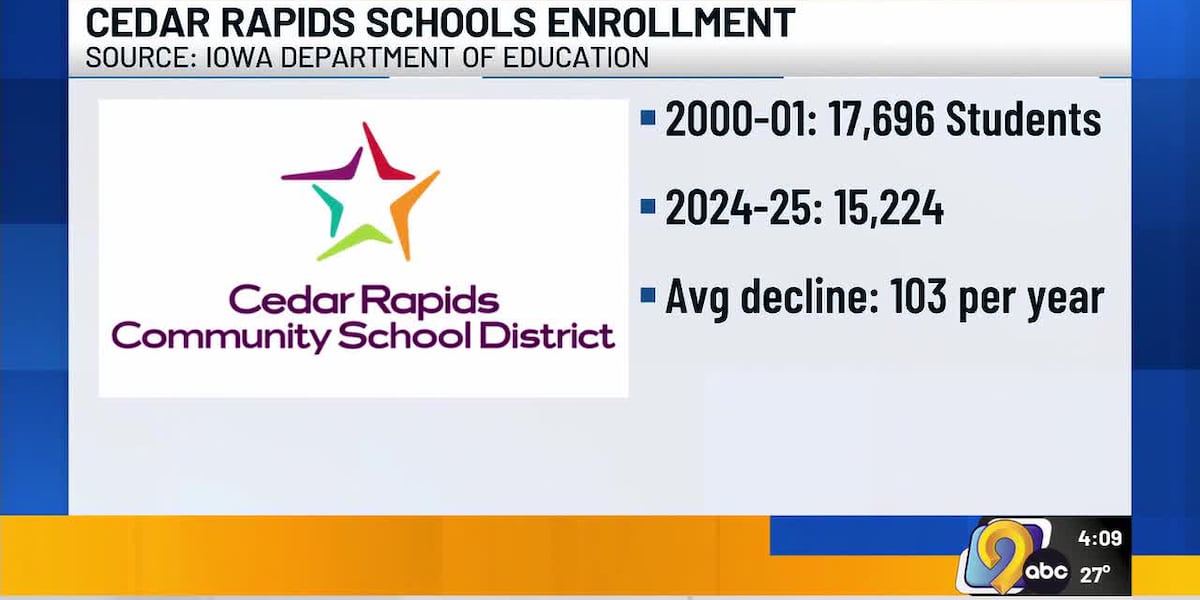
Declining student enrollment is at the heart of the financial crisis facing the Cedar Rapids Community School District, with current figures dropping to levels not seen since the 1950s, district officials confirmed this week.
The district, Iowa’s second-largest, has experienced a steady decline in student numbers over the past decade, losing approximately 2,500 students since 2014. This enrollment drop translates directly into reduced state funding, as Iowa’s education finance formula allocates resources primarily based on student headcount.
“Each student represents approximately $7,400 in state funding,” explained Superintendent Tawana Grover during a recent school board meeting. “When we lose students, we lose the financial resources needed to maintain our existing infrastructure and educational programs.”
The district currently serves about 14,800 students across its elementary, middle, and high schools. Historical records indicate the last time Cedar Rapids schools had enrollment this low was shortly after World War II, when the city’s population was significantly smaller than today’s 130,000 residents.
District officials attribute the decline to several factors, including changing demographics, lower birth rates, and families moving to neighboring suburban districts. The COVID-19 pandemic accelerated the trend, with some families opting for private schools, homeschooling, or online alternatives during the height of the health crisis.
The financial impact has been severe. The district faces a projected $14 million budget deficit for the 2024-2025 school year, forcing administrators to consider difficult cost-cutting measures including staff reductions, program eliminations, and potential school closures.
“We’re in a position where we simply can’t maintain the same operational footprint with significantly fewer students,” said David Tominsky, president of the Cedar Rapids School Board. “These are painful but necessary discussions to ensure the district remains financially viable.”
Iowa’s school funding formula, established in the 1970s and modified periodically, ties approximately 87% of a district’s general fund revenue directly to enrollment. When student numbers fall, districts experience what educators call a “phantom student” problem – costs remain relatively fixed while revenue decreases.
Cedar Rapids isn’t alone in facing these challenges. Districts across Iowa and the Midwest have reported similar trends, though Cedar Rapids’ decline has been particularly steep compared to its regional peers. Des Moines Public Schools, Iowa’s largest district, has also experienced enrollment losses but at a slower rate.
Education policy experts point to broader demographic shifts affecting school enrollment nationwide. The U.S. birth rate has fallen nearly 20% since 2007, creating a smaller pool of school-age children. Additionally, pandemic-era disruptions prompted many families to reconsider their educational choices.
“What we’re seeing in Cedar Rapids reflects national trends,” said Dr. Margaret Buckton, professional advocate for Urban Education Network of Iowa. “Districts built for peak baby-boomer enrollment are now struggling with excess capacity as family sizes shrink and educational options diversify.”
The district has launched a comprehensive review of its facilities, programs, and staffing levels. Officials stress that any cuts will be made with student needs as the priority, though community members have expressed concerns about potential school closures in historically underserved neighborhoods.
Local business leaders have also raised alarms about the potential economic impact of a weakened school system. The Cedar Rapids Metro Economic Alliance noted that quality public education remains a critical factor in workforce development and business attraction.
“Strong schools are fundamental to our community’s economic health,” said Ron Corbett, Business Retention and Expansion Strategist for the Economic Alliance. “Companies considering relocation or expansion look closely at educational infrastructure when making their decisions.”
The school board has scheduled a series of public forums throughout April and May to gather community input on budget priorities. District administrators expect to present a preliminary budget reduction plan by early June, with implementation beginning in the 2024-2025 academic year.
As Cedar Rapids grapples with these challenges, education advocates are calling for state lawmakers to reconsider Iowa’s school funding formula to provide more stability for districts experiencing enrollment fluctuations.
“The current system works well when enrollment is steady or growing,” Tominsky said. “But it creates severe hardships for communities in transition. We need funding mechanisms that recognize the fixed costs of education and give districts time to adapt to changing demographics.”
Fact Checker
Verify the accuracy of this article using The Disinformation Commission analysis and real-time sources.

25 Comments
Exploration results look promising, but permitting will be the key risk.
If AISC keeps dropping, this becomes investable for me.
Good point. Watching costs and grades closely.
Good point. Watching costs and grades closely.
Silver leverage is strong here; beta cuts both ways though.
Good point. Watching costs and grades closely.
Good point. Watching costs and grades closely.
Silver leverage is strong here; beta cuts both ways though.
Good point. Watching costs and grades closely.
Good point. Watching costs and grades closely.
Nice to see insider buying—usually a good signal in this space.
Good point. Watching costs and grades closely.
I like the balance sheet here—less leverage than peers.
Good point. Watching costs and grades closely.
Nice to see insider buying—usually a good signal in this space.
Interesting update on Fact Check: Cedar Rapids Schools Face Budget Crisis Amid Lowest Enrollment Since 1950s. Curious how the grades will trend next quarter.
I like the balance sheet here—less leverage than peers.
Good point. Watching costs and grades closely.
Good point. Watching costs and grades closely.
Interesting update on Fact Check: Cedar Rapids Schools Face Budget Crisis Amid Lowest Enrollment Since 1950s. Curious how the grades will trend next quarter.
Good point. Watching costs and grades closely.
Good point. Watching costs and grades closely.
If AISC keeps dropping, this becomes investable for me.
Good point. Watching costs and grades closely.
Good point. Watching costs and grades closely.