


Listen to the article
Canadian and American officials celebrated a major milestone this week as the final piece of the Gordie Howe International Bridge was installed, connecting Windsor, Ontario, and Detroit, Michigan. However, claims about the bridge’s ownership and financing have sparked confusion on both sides of the border.
The $6.4 billion (CAD) project represents one of North America’s largest infrastructure undertakings in recent years. While Canada has indeed fronted the entire cost of construction, statements suggesting the bridge is solely Canadian-owned misrepresent the complex binational arrangement that governs the crossing.
“Canada is paying for this bridge, but ownership is shared between our two countries,” explained Heather Grondin, CEO of the Windsor-Detroit Bridge Authority (WDBA), the Canadian Crown corporation overseeing the project. “This has always been structured as a true partnership with joint governance, despite the financing arrangement.”
The misconception gained traction following comments from Michigan Governor Gretchen Whitmer during the ceremony marking the joining of the bridge’s main span. While celebrating the achievement, Whitmer’s remarks about Canadian financing were interpreted by some as indicating exclusive Canadian ownership.
Under the 2012 Crossing Agreement between Canada and Michigan, the bridge will be jointly owned, with Canada recouping its investment through toll revenues once operations begin. The WDBA will maintain administrative control of the crossing, but a three-member International Authority with representatives from both countries provides oversight and governance.
Infrastructure experts note that this financing model is unusual but practical. “Having Canada front the costs solved what was essentially a political impasse in Michigan,” said Joseph Schofer, Professor Emeritus of Civil Engineering at Northwestern University. “The Michigan legislature was unwilling to allocate funds, so Canada’s willingness to finance the entire project became the path forward.”
The financing agreement includes not only the bridge itself but also customs plazas on both sides and connecting road infrastructure. Bridging North America, a private consortium, is building the bridge under a public-private partnership that includes a 30-year maintenance agreement.
The project has significant economic implications for both nations. The Detroit-Windsor corridor handles approximately 25 percent of all merchandise trade between the United States and Canada, valued at over $400 billion annually. The existing Ambassador Bridge, privately owned by the Detroit International Bridge Company, has long been considered a bottleneck and vulnerability in this crucial trade route.
“Having redundancy in this vital economic corridor has been a priority for both governments for decades,” said Bill Anderson, director of the Cross-Border Institute at the University of Windsor. “The new bridge creates competition in a crossing that has been monopolized for nearly a century, and its modern design will improve efficiency for commercial traffic.”
The 2.5-kilometer bridge will feature six lanes, a dedicated cycling and pedestrian path, and state-of-the-art border inspection facilities. Officials expect it will handle approximately 14,000 vehicles daily upon opening, with capacity for significant growth.
For residents of Windsor and Detroit, the project represents more than just improved transportation. Both cities have seen neighborhood improvements through community benefits programs tied to the project, including $20 million for local initiatives ranging from workforce development to environmental improvements.
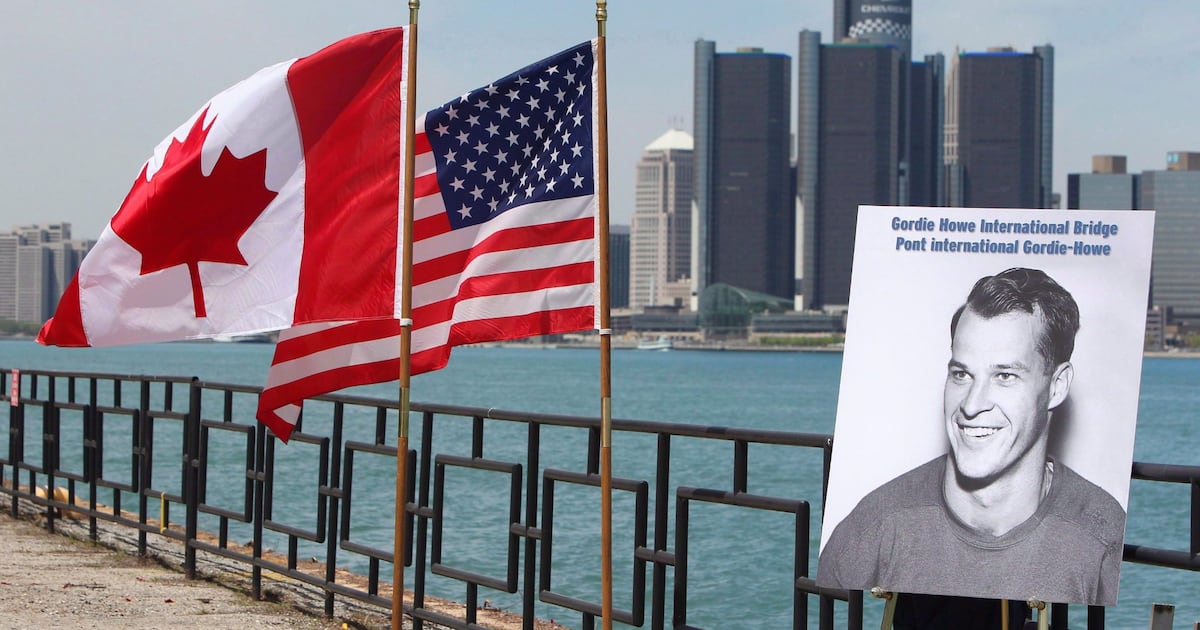
The bridge, named after Canadian hockey legend Gordie Howe who played for the Detroit Red Wings, symbolizes the deep connections between the two countries. When it opens to traffic in late 2025, it will stand as North America’s longest cable-stayed bridge.
“This project demonstrates what’s possible when our countries work together despite complex political and financial challenges,” said Carlo Allegrina, an international infrastructure policy analyst. “While Canada provided the financing solution, both nations will share in the economic benefits and governance responsibilities.”
Officials emphasize that toll revenues will eventually reimburse Canadian taxpayers for the construction costs, with projections suggesting full repayment could take approximately 45 years based on anticipated traffic volumes.
Fact Checker
Verify the accuracy of this article using The Disinformation Commission analysis and real-time sources.

14 Comments
The Gordie Howe Bridge is an impressive $6.4 billion project, with Canada covering the full construction costs. The shared ownership arrangement between the two countries is an intriguing approach.
Interesting that Canada is funding the entire Gordie Howe Bridge project, yet ownership is structured as a true binational partnership with the US. A novel approach to cross-border infrastructure.
The joint governance model will be critical to ensuring the bridge meets the needs of both countries over the long term. Curious to see how decision-making and oversight functions in practice.
Sounds like an important milestone for the Gordie Howe Bridge project, connecting Windsor and Detroit. Interesting that Canada is financing it fully but ownership is shared – a true cross-border partnership.
This is a significant infrastructure investment by Canada, even if the bridge’s ownership is shared with the US. Curious to see how the joint governance structure functions in practice over time.
Glad to see the two countries working together on this crucial border crossing. Shared ownership likely helps ensure it serves the needs of both Canada and the US.
The misconception around Canada’s full ownership seems understandable given that they are covering the entire $6.4 billion price tag. But it’s good to have the nuanced details clarified – this is a shared binational asset.
Curious to learn more about the specific governance structure and how decision-making will work with the two countries sharing ownership. Proper collaboration will be crucial for the bridge’s long-term success.
Despite Canada fronting the full construction costs, it’s good to see the Gordie Howe Bridge ownership structured as a true binational partnership with the US. Shared governance will be key.
This joint approach could set a useful precedent for future cross-border infrastructure projects, where the financing burden may fall more heavily on one side but both countries have an equal stake.
Kudos to Canada for stepping up to fully fund this major $6.4 billion bridge project, even if ownership is shared with the US. A smart approach to bolstering crucial cross-border infrastructure.
The Gordie Howe Bridge represents a significant infrastructure investment by Canada, even if the ownership is shared with the US. Curious to learn more about how the joint governance model will function in practice.
Interesting to learn about the shared ownership structure of the Gordie Howe Bridge despite Canada fronting the full construction costs. A true binational partnership, as the WDBA CEO described it.
Glad to see this major infrastructure project moving forward through collaboration between Canada and the US. Joint governance will be key to ensuring it serves the needs of both countries.