


Listen to the article
Deepfake Videos Falsely Show Indian Political Reactions to Pakistan’s Role in US-Iran Negotiations
Amid rising tensions between the United States and Iran, fabricated videos circulating on social media platforms have falsely depicted Indian political figures criticizing Prime Minister Narendra Modi over Pakistan’s alleged mediation efforts. An investigation by Geo Fact Check has confirmed these widely shared clips were created using artificial intelligence technology.
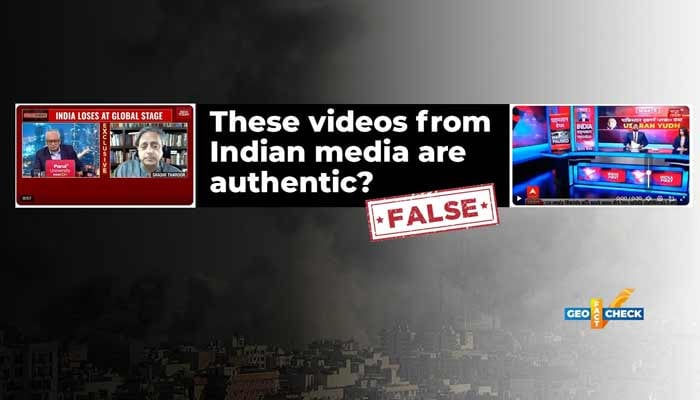
The first video, shared by Sharjeel Inam Memon, a minister in Pakistan’s Sindh province, appeared to show prominent Indian politician Shashi Tharoor praising Pakistan’s diplomatic role in facilitating a US-Iran ceasefire. In the manipulated clip, Tharoor appears on India Today making critical statements about Modi’s government, claiming it represented “a massive strategic failure” that Pakistan had outmaneuvered India diplomatically.
“If you saw Donald Trump’s latest tweet, crediting Pakistan with stepping in to end the Iranian war, you know why I am in shock,” the fabricated Tharoor says in the clip. “I have never criticised Prime Minister Modi or the BJP before, but today, silence is just blind loyalty.”
Fact-checkers determined this video was a sophisticated deepfake. Through reverse image searches, investigators found the original footage came from an episode of “News Today With Rajdeep Sardesai” broadcast on December 26, 2025—predating the US-Iran military confrontation that began in February 2026. In the authentic interview, Tharoor was discussing entirely different topics: India’s Bangladesh policy and the impact of American tariffs on India’s economy.
Technical analysis using Hiya, a specialized deepfake voice detection tool, gave the audio an authenticity score of just 37 out of 100, strongly indicating synthetic voice generation.
The second fabricated video portrayed an Indian news anchor supposedly destroying a television studio set in anger while discussing Pakistan’s alleged diplomatic triumph. This clip gained significant traction after being shared by official Pakistani government accounts, including a spokesperson for Pakistan’s president.
Analysis by Truth Scan, an AI content detection platform, assigned the video an aggregate score of 82.7%, indicating high probability of artificial generation. Voice authentication tools gave the audio an even lower authenticity rating—just 4 out of 100—providing near-certain evidence of synthetic creation.
Visual inconsistencies further betrayed the video’s artificial nature. The broadcast graphics featured hybrid logos combining elements from multiple Indian news channels rather than any actual media outlet’s branding. Even the Hindi text displayed at the bottom of the screen was nonsensical when translated.
“The Hindi headlines at the bottom of the screen and back screen behind anchors when translated, it doesn’t mean anything, just a made-up language by AI,” confirmed Anees Qureshi, an open-source intelligence analyst at Bytes for All, an Islamabad-based digital rights organization.
These fabrications emerge against a backdrop of complex regional dynamics. Relations between India and Pakistan remain strained, with both nations competing for diplomatic influence in South Asia and the Middle East. The spread of these videos appears designed to suggest Pakistan has gained strategic advantage by mediating between global powers.
The incident highlights the growing sophistication of deepfake technology and its potential to disrupt international relations and domestic politics. As AI tools become more accessible, the challenge of distinguishing genuine news from synthetic content grows increasingly difficult for both media organizations and the public.
Digital rights experts warn that such deceptive content can inflame regional tensions and potentially impact diplomatic relations. The rapid spread of these videos across social platforms demonstrates how easily artificial content can be weaponized to create false narratives about geopolitical developments.
Media literacy organizations have urged greater public awareness about deepfake detection and called for social media platforms to improve their identification and labeling of manipulated content, especially when it involves political figures or sensitive international relations.
Fact Checker
Verify the accuracy of this article using The Disinformation Commission analysis and real-time sources.

23 Comments
The cost guidance is better than expected. If they deliver, the stock could rerate.
I like the balance sheet here—less leverage than peers.
Good point. Watching costs and grades closely.
Good point. Watching costs and grades closely.
Nice to see insider buying—usually a good signal in this space.
Interesting update on Fact-check: AI-generated videos falsely show Indian media discussing Pakistan’s role in US-Iran ceasefire. Curious how the grades will trend next quarter.
Good point. Watching costs and grades closely.
Exploration results look promising, but permitting will be the key risk.
Good point. Watching costs and grades closely.
The cost guidance is better than expected. If they deliver, the stock could rerate.
Good point. Watching costs and grades closely.
Good point. Watching costs and grades closely.
Production mix shifting toward Fact Check might help margins if metals stay firm.
Good point. Watching costs and grades closely.
Uranium names keep pushing higher—supply still tight into 2026.
Uranium names keep pushing higher—supply still tight into 2026.
If AISC keeps dropping, this becomes investable for me.
Good point. Watching costs and grades closely.
Good point. Watching costs and grades closely.
Interesting update on Fact-check: AI-generated videos falsely show Indian media discussing Pakistan’s role in US-Iran ceasefire. Curious how the grades will trend next quarter.
I like the balance sheet here—less leverage than peers.
I like the balance sheet here—less leverage than peers.
Good point. Watching costs and grades closely.