


Listen to the article
Media Literacy Alert: AI-Generated Epstein Photo Spreads Misinformation on Social Media
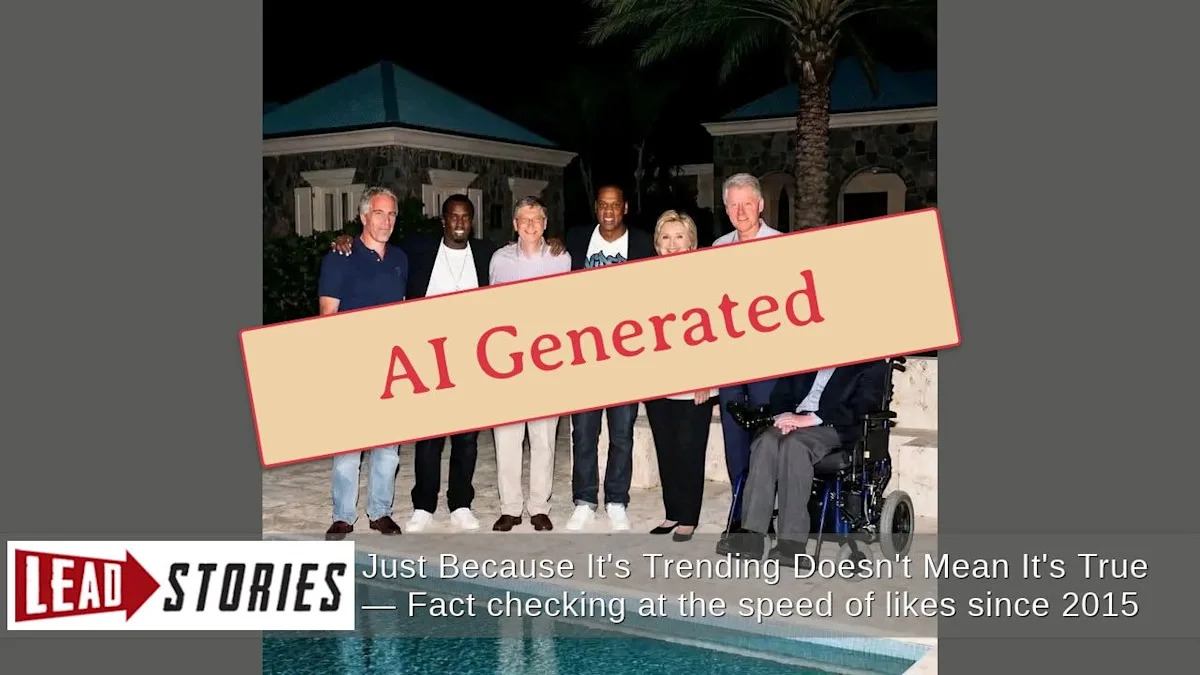
A supposedly “real” photograph from 2006 showing Jeffrey Epstein alongside Bill and Hillary Clinton, Sean “Diddy” Combs, Bill Gates, Jay-Z, and Stephen Hawking by a swimming pool has been circulating on social media platforms, but fact-checkers have confirmed the image is entirely fabricated.
The image, shared by a Facebook page called “Take Step Africa” on February 7, was created using Google AI technology and contains an invisible digital watermark that can be detected using the Google Gemini application. This watermark, known as SynthID, is embedded directly into the image pixels and serves as a verification tool to identify AI-generated content.
The misleading post accompanied the fake image with a caption suggesting it revealed troubling connections between the disgraced financier and prominent figures: “2006. A single photo. Jeffrey Epstein surrounded by names that shaped politics, science, business, and culture: Bill Clinton, Hillary Clinton, Bill Gates, Jay-Z, Diddy, Stephen Hawking.”
The caption went further, implying the image provided evidence of “proximity” if not “complicity” between these high-profile individuals and Epstein, who died in jail in 2019 while awaiting trial on sex trafficking charges. The post framed the fabricated image as proof of “structures that protect predators while punishing the powerless.”
This incident highlights growing concerns about the sophistication of AI-generated imagery and its potential to spread misinformation. As artificial intelligence tools become more accessible to the general public, distinguishing between authentic and fabricated content grows increasingly challenging for social media users.
While Jeffrey Epstein did have documented connections to some powerful figures, including Bill Gates and former President Bill Clinton, this particular image does not constitute evidence of any gathering. The artificial inclusion of multiple celebrities and political figures in a single fabricated scene appears designed to inflame speculation and controversy.
Media literacy experts warn that AI-generated images are becoming a significant vector for spreading conspiracy theories and political misinformation. Unlike obvious photoshop manipulations of the past, modern AI tools can create highly convincing fake imagery that requires specialized detection tools to identify.
“The technology has reached a point where visual evidence, once considered relatively reliable, must now be approached with heightened skepticism,” said Dr. Claire Wardle, a misinformation researcher at the University of Pennsylvania, in a recent interview on digital media literacy. “Without the proper tools or training, distinguishing between real and synthetic media is becoming nearly impossible for the average person.”
The SynthID watermarking technology represents one approach to addressing this challenge. Developed by Google, it allows AI-generated images to be invisibly marked at creation, providing a verification method that can help identify fabricated content. However, not all AI image generators include such safeguards, and detection methods struggle to keep pace with advancing generation capabilities.
Social media platforms have implemented various measures to combat synthetic media, but these policies often lag behind technological developments. Meta, Facebook’s parent company, has expanded its fact-checking program to address AI-generated content, but the viral spread of such images often outpaces verification efforts.
This incident serves as a reminder for social media users to approach sensational images with caution, particularly those showing unlikely groupings of high-profile individuals or events not covered by mainstream news sources. Before sharing such content, users are encouraged to verify images through reverse image searches or dedicated fact-checking resources.
As AI image generation technology continues to evolve, the line between authentic and fabricated visual evidence will likely become increasingly blurred, making critical media consumption skills essential in navigating the digital information landscape.
Fact Checker
Verify the accuracy of this article using The Disinformation Commission analysis and real-time sources.
