


Listen to the article
In a wave of misinformation that has spread across social media in recent days, false claims regarding class suspensions due to an alleged Nipah virus outbreak in the Philippines have gained significant traction online, prompting officials to issue clarifications.
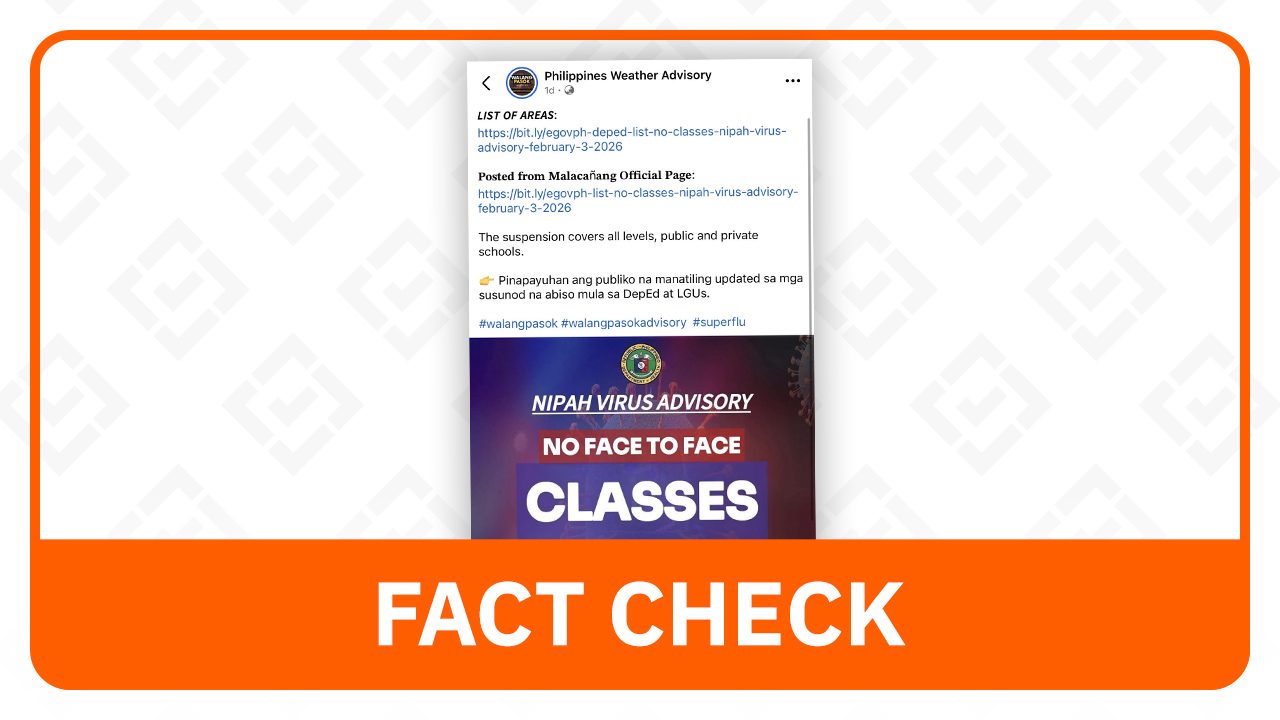
The Facebook page “Philippine Weather Advisory” published multiple posts claiming that the Department of Education (DepEd) had announced the suspension of classes from February 3 to 5, 2026, purportedly in response to a Nipah virus outbreak. One post garnered over 270 reactions and 970 shares, while another received more than 120 reactions and 500 shares.
“DepEd Announcement: No classes due to the Nipah virus outbreak, classes and work are suspended in selected areas as declared by local government units on Monday, February 3, 2026,” read one of the posts, which included alleged links to areas affected by the suspension and an advisory supposedly issued by Malacañang.
However, an investigation reveals these claims are entirely fabricated. No such announcement has been made by DepEd, and no advisory has been issued by Malacañang regarding class suspensions related to the Nipah virus. The links included in the posts redirect users to an online shopping website rather than any official government portal.
The Department of Health (DOH) has categorically denied the existence of a Nipah virus outbreak in the Philippines. In a recent interview with Super Radyo dzBB, DOH Assistant Secretary Albert Domingo clarified the situation: “For the record, we are not monitoring or seeing any symptoms or history of exposure… India has confirmed only two cases… Their contact tracing and isolation efforts reached nearly 200 individuals, all of whom tested negative… In the view of India, the situation is contained.”
Health authorities have confirmed that border surveillance and screening protocols are actively in place to prevent the virus from entering and spreading within the country, following reports of two confirmed cases in India. These preventive measures are standard procedure for monitoring potential public health threats.
The Nipah virus, according to the World Health Organization, is a zoonotic virus that can be transmitted to humans from animals, contaminated food, or through direct person-to-person contact. While not highly transmissible, the virus carries a concerning case fatality rate estimated between 40% and 75%.
Individuals who contract the Nipah virus may experience a range of symptoms including fever, headaches, muscle pain, vomiting, and sore throat, though some infected persons remain asymptomatic. The severity of this disease likely contributes to why false information about it spreads so rapidly, causing unnecessary public concern.
This is not the first time that fabricated announcements regarding class suspensions have circulated online. DepEd has repeatedly warned the public about such false claims, noting that many are created using artificial intelligence tools designed to mimic official communications.
The education department continues to urge the public to verify information through its official communication channels before accepting or sharing news about class suspensions or other important announcements. Similar false claims regarding class suspensions allegedly due to public health emergencies have been debunked by fact-checkers in the past.
This incident highlights the ongoing challenge of combating misinformation in the digital age, particularly when it pertains to public health and education. The rapid spread of these false claims demonstrates how easily misinformation can proliferate through social media, potentially causing unnecessary alarm and confusion among students, parents, and educators alike.
Authorities continue to monitor for actual public health threats while working to counter the spread of false information that could undermine legitimate response efforts.
Fact Checker
Verify the accuracy of this article using The Disinformation Commission analysis and real-time sources.

5 Comments
Fabricated news about class suspensions can cause unnecessary panic. I’m relieved the DepEd moved swiftly to debunk these false claims and reassure the public. Fact-checking is crucial to combat the spread of misinformation.
It’s concerning to see how quickly misinformation can spread online, even about something as important as public health. Kudos to the DepEd for promptly addressing these false claims regarding the Nipah virus. Vigilance is key to stopping the spread of disinformation.
The DepEd’s swift response to correct the false claims about Nipah virus-related class suspensions is commendable. It’s a good reminder to always verify information, especially on social media, before sharing or believing it.
I’m glad the DepEd stepped in to clarify that there are no Nipah virus-related class suspensions. Fact-checking is crucial to prevent the spread of misinformation, which can cause unnecessary panic and confusion.
Glad to see the DepEd quickly clearing up the misinformation about Nipah virus class suspensions. It’s important to rely on official sources and fact-check social media claims, especially around public health issues.