


Listen to the article
FALSE: NO CELEBRITIES ARE INTRODUCING BILLS AGAINST GEORGE SOROS
No evidence exists that Adam Sandler, Jeanine Pirro, Vince Gill, or any other celebrity has introduced legislation that would classify George Soros’ alleged funding of protests as organized crime under the RICO Act, despite widespread claims circulating on social media.
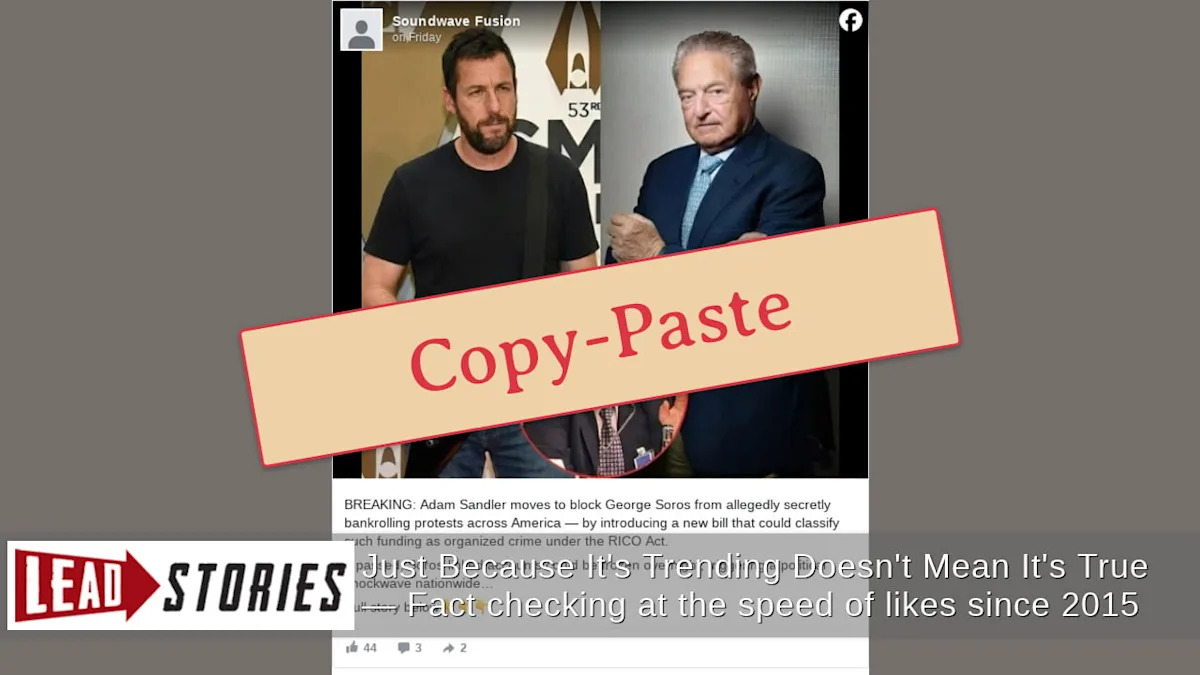
A viral Facebook post from February 13 claimed: “BREAKING: Adam Sandler moves to block George Soros from allegedly secretly bankrolling protests across America — by introducing a new bill that could classify such funding as organized crime under the RICO Act.” The post suggested that if passed, “Soros-linked accounts could be frozen overnight, triggering a political shockwave nationwide.”
This claim, however, is entirely fabricated. The story appears to be part of a coordinated misinformation campaign originating from Vietnam, with nearly identical narratives circulating across social media platforms, simply substituting different celebrity names.
Clicking on links provided in these posts leads to an article that openly acknowledges the lack of evidence. The article states: “While no verified evidence supports the existence of such a bill–or any direct political action by Sandler–the viral narrative itself has become a flashpoint.” This admission directly contradicts the sensationalist claims in the Facebook posts.
Further investigation revealed that the Facebook page “Beyond The Lens,” which promoted one version of the story, is operated by individuals based in Vietnam, according to the page’s transparency information. This connection is particularly noteworthy as fact-checkers have identified Vietnam as a significant source of AI-generated false stories in recent months.
Comprehensive searches across reputable news sources yielded no legitimate reporting about any celebrity or politician introducing legislation targeting Soros under the RICO Act. A search for the specific phrase “moves to block George Soros from allegedly secretly bankrolling protests across America” on Facebook produced dozens of nearly identical posts featuring different public figures, including actors, athletes, and television personalities.
Many of these claims are implausible on their face—only elected members of legislative bodies have the authority to introduce bills, making it impossible for actors like Adam Sandler or musicians like Vince Gill to propose such legislation.
This pattern of substituting different names into the same false narrative is a common tactic used by misinformation networks. The operation appears designed to generate engagement by leveraging celebrities’ popularity while spreading politically divisive content.
Fact-checkers have dubbed this phenomenon “Viet Spam,” referring to networks of fake fan pages that spread false stories about celebrities. These operations typically use AI-generated content distributed across multiple platforms to maximize reach and engagement.
The widespread dissemination of these false claims highlights the ongoing challenge of combating coordinated misinformation campaigns on social media platforms. Users are encouraged to verify information through legitimate news sources before sharing sensational political claims, especially those involving celebrities taking unprecedented political actions.
No bill classifying protest funding as organized crime under RICO has been introduced by celebrities or politicians, and claims suggesting otherwise remain wholly unsubstantiated.
Fact Checker
Verify the accuracy of this article using The Disinformation Commission analysis and real-time sources.

12 Comments
This is a helpful reminder to be cautious of sensational stories, especially those involving public figures or controversial topics. Checking the facts is important before sharing or believing such claims.
The article highlights how misinformation can spread quickly online, even when the underlying claims lack any real evidence. Fact-checking is crucial to counter the spread of such fabricated narratives.
The lack of evidence for the claims about a bill targeting Soros-funded protests is telling. I appreciate the Disinformation Commission’s efforts to set the record straight on this issue.
Agreed, verifying claims and providing accurate information is crucial, especially on sensitive political topics.
I’m glad to see the Disinformation Commission taking the time to thoroughly investigate and debunk these kinds of false claims. Maintaining the integrity of the information ecosystem is crucial for a healthy democracy.
While the claims about celebrities introducing bills against Soros may be false, the larger issue of foreign interference and the spread of misinformation online is a serious concern that deserves ongoing attention.
You’re right, this is just one example of a broader problem that requires vigilance and a multi-faceted response.
While I’m curious about the motivations behind these viral posts, I’m glad the Disinformation Commission was able to thoroughly debunk the claims. It’s good to see responsible reporting on these issues.
This is an interesting fact check. I’m glad to see the claims about celebrities introducing bills against Soros are false. It’s important to verify information, especially around politically-charged topics like this.
It’s concerning to see coordinated misinformation campaigns originating from other countries, like this one from Vietnam. Vigilance is needed to identify and counter foreign influence operations targeting US audiences.
This fact check highlights the importance of critical thinking and media literacy. It’s easy for misinformation to spread, so we must always question the sources and validity of online content.
Absolutely. Fact-checking is an essential skill in today’s information landscape.