


Listen to the article
Canada’s Financing of Gordie Howe Bridge Comes Under Scrutiny After Trump Comments
Canada is paying the full upfront cost of the Gordie Howe International Bridge due to a binational agreement reached after years of studies, legal battles, and political resistance on the American side of the border.
The 2012 Canada-Michigan Crossing Agreement established that Canada would finance, build, and operate the new Windsor-Detroit crossing, including portions on U.S. soil, to advance the long-delayed infrastructure project. This arrangement has become a focal point after former U.S. President Donald Trump criticized the project in a Truth Social post on Monday.
Trump claimed that Canada “owns both the Canada and the United States side” and built the bridge with “virtually no U.S. content.” He suggested he would not allow the bridge to open unless the United States receives full compensation, arguing that the U.S. should own at least half of the project.
The cross-border infrastructure initiative has a complex history dating back more than two decades. In the early 2000s, transportation agencies from both countries conducted traffic studies that determined existing infrastructure would be inadequate for future trade demands. A binational planning and feasibility study between 2001 and 2004 recommended new infrastructure to handle long-term growth in cross-border commerce.
This initial work led to a comprehensive environmental review from 2005 to 2008, which included hundreds of public consultations. The process ultimately identified a new publicly owned bridge as the preferred solution, with environmental approvals granted by both Canadian and U.S. authorities in 2009.
Despite these approvals, the project stalled for years over funding concerns. Michigan lawmakers refused to commit state money to the crossing, facing opposition and legal challenges from interests connected to the privately owned Ambassador Bridge, which has long been the primary Detroit-Windsor link.
Rather than risk further delays to a crucial trade corridor, Canada opted to negotiate directly with Michigan. The resulting 2012 agreement allowed the project to advance, with Canada agreeing to design, build, finance, operate, and maintain the crossing through a public-private partnership.
The agreement explicitly states that the bridge will be publicly owned by Canada and Michigan, and requires that iron and steel for key components must be sourced from either country, contradicting Trump’s claim about lack of U.S. content.
To manage the project, the Canadian federal government established the Windsor-Detroit Bridge Authority in 2012, a Crown corporation responsible for delivering and operating the new crossing. A private consortium was awarded the construction contract in 2018, with work beginning later that year.
The total cost has climbed to approximately $6.4 billion after increases and delays. While Canada is covering the full upfront investment, the federal government expects to recover these funds over time through toll revenue. Under the agreement, tolls collected from bridge users will reimburse Canada for its advance funding. Once costs are fully recouped, toll revenue will be shared with Michigan.
Transportation officials have consistently maintained that the project represents a strategic investment, given that the Windsor-Detroit corridor handles a significant portion of bilateral trade, particularly in the automotive sector. The crossing is designed to provide a crucial second major link between the cities, easing congestion at the Ambassador Bridge and strengthening cross-border commerce.
The Windsor-Detroit gateway’s strategic importance cannot be overstated, as it represents the busiest commercial land border crossing between Canada and the United States, accounting for more than 25 percent of overall trade between the two countries. The automotive supply chains that power manufacturing in both nations rely heavily on this corridor.
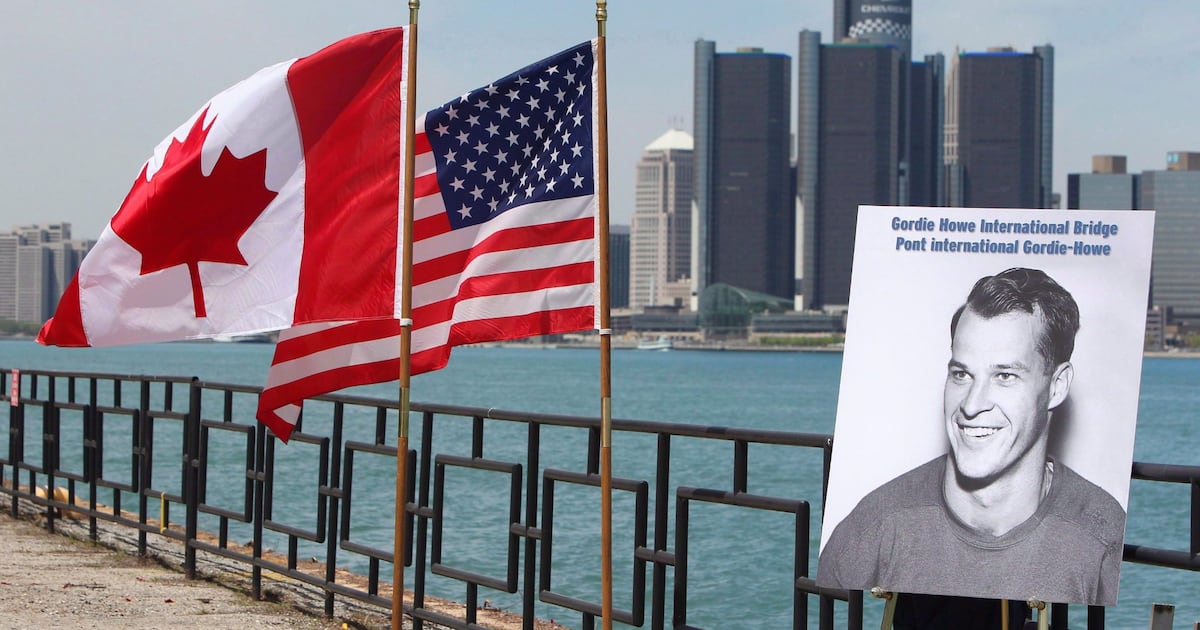
The bridge, named after Canadian hockey legend Gordie Howe who played much of his career in Detroit, symbolizes the interconnected nature of the Canadian and U.S. economies. Industry analysts expect the new crossing to significantly improve logistical efficiency for manufacturers and reduce border wait times that have sometimes stretched for hours.
Fact Checker
Verify the accuracy of this article using The Disinformation Commission analysis and real-time sources.

8 Comments
I’m skeptical of Trump’s suggestion that the U.S. should receive full compensation or ownership. This was a collaborative effort between the two countries, and Canada taking on the upfront financing burden seems like a reasonable arrangement given the history. It would be counterproductive to renegotiate the terms at this stage.
Interesting background on the complex cross-border infrastructure project. It makes sense that Canada is financing the upfront costs given the long delays and political resistance on the U.S. side. I’m curious to see how this public debate around ownership and compensation plays out.
Yes, it’s a nuanced issue with a lot of history behind it. I imagine both sides will be closely watching any developments around the project’s ownership and control.
As a mining and metals investor, I’m always interested in new infrastructure that could impact the movement of key commodities like copper, lithium, and uranium. The Gordie Howe bridge seems like an important piece of the North American supply chain. I’ll be monitoring updates on its progress.
Good point. Cross-border infrastructure like this can have wide-ranging implications for the mining and energy sectors. It will be worth tracking how this situation evolves.
As someone who follows the energy and resources sectors, I’m curious to see how this plays out. The Gordie Howe bridge could have important implications for the flow of key commodities and materials between Canada and the U.S. I’ll be keeping an eye on further developments.
Absolutely, this cross-border infrastructure is crucial for many industries beyond just the automakers. The ownership debate is interesting, but the practical benefits for energy and mining companies could be the more important factor here.
Trump’s comments seem to mischaracterize the agreement and the decades-long process behind this project. While the U.S. may not own part of the bridge, it’s shortsighted to view this solely through the lens of ownership. The economic benefits and improved logistics could be significant for both countries.