


Listen to the article
Misleading Claims Circulate About BJP Leader’s Family Photo from UAE Visit
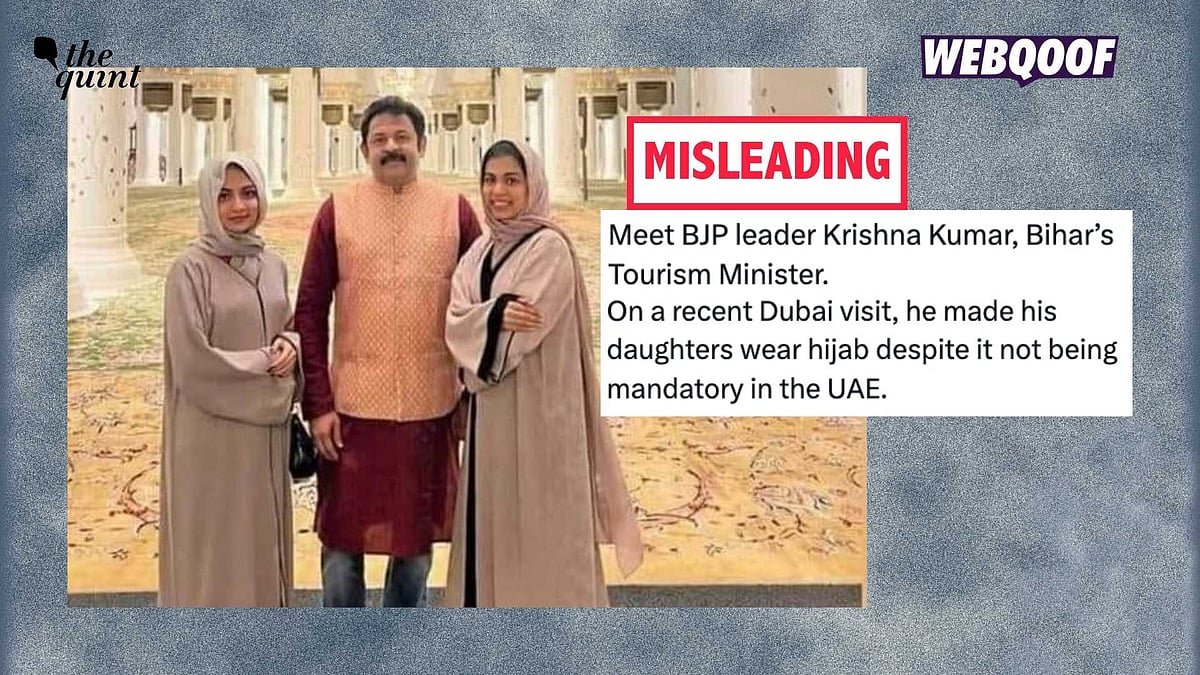
Social media users are circulating an old photograph of Bharatiya Janata Party (BJP) leader Krishna Kumar with his daughters wearing traditional abayas, accompanied by false claims about his identity and the context of the image.
The viral posts incorrectly identify Kumar as “Bihar’s Tourism Minister” while suggesting he forced his daughters to wear hijabs during a Dubai visit “despite it not being mandatory in the UAE.” However, a fact-check reveals multiple inaccuracies in these widely shared claims.
The photograph actually dates back to 2022 and was taken during the family’s visit to the Sheikh Zayed Grand Mosque in Abu Dhabi, not Dubai. The Sheikh Zayed Grand Mosque, one of the UAE’s most significant cultural and religious landmarks, requires all female visitors to wear abayas as part of its dress code policy, regardless of their religion or nationality.
Furthermore, Kumar is not Bihar’s Tourism Minister as claimed. He is a BJP leader from Kerala who has held various positions within the party’s state organization but does not currently serve in any ministerial capacity in Bihar or elsewhere.
This case highlights a growing trend of misinformation on social media platforms where images are repurposed with misleading captions to create false narratives, often with political undertones. The viral nature of such content can lead to rapid spread before fact-checking can occur.
Religious dress codes at cultural and religious sites remain standard practice in many countries. The Sheikh Zayed Grand Mosque, which attracts millions of visitors annually, maintains its dress policy as a sign of respect for Islamic traditions and local customs. Tourists from around the world regularly comply with these requirements when visiting such sites.
The misrepresentation of Kumar’s identity appears designed to create controversy around BJP leaders’ personal choices and religious practices. The BJP, India’s ruling party, has often faced scrutiny regarding its positions on religious and cultural issues, making its leaders frequent targets for such misleading content.
Social media platforms have struggled to contain the spread of misleading information despite implementing various fact-checking measures. Posts containing false claims can amass thousands of shares before being flagged or removed, contributing to information disorder in the digital space.
Media literacy experts recommend that users verify information from multiple sources before sharing content, especially posts that evoke strong emotional responses or seem designed to provoke outrage.
The image of Kumar and his daughters represents a common tourist experience—visitors respecting local customs at a religious site—rather than any political statement or controversial decision as the misleading posts suggest.
As digital misinformation continues to challenge public discourse in India and globally, this incident serves as a reminder of how easily context can be stripped from images and how regional political figures can be misrepresented to create divisive narratives.
The original posts have been archived by fact-checkers, but variations continue to circulate across multiple social media platforms, demonstrating the persistent challenge of containing false information once it begins spreading online.
Fact Checker
Verify the accuracy of this article using The Disinformation Commission analysis and real-time sources.

10 Comments
The misleading claims about the BJP leader’s family photo seem to be a classic example of political spin and agenda-driven narratives. It’s heartening to see the Disinformation Commission stepping in to set the record straight with the actual facts.
Absolutely. Fact-checking initiatives are crucial to countering the proliferation of misinformation, especially when it comes to politically charged issues. Maintaining trust in information sources is vital for a healthy democracy.
The misleading claims about the BJP leader’s family photo highlight the need for greater media literacy and critical thinking. We should all be more discerning consumers of information, especially when it comes to political figures and sensitive cultural issues.
Well said. Developing the skills to identify and resist misinformation is an important civic responsibility in the digital age. Fact-checking efforts like this play a vital role in upholding the truth.
Interesting case of misleading claims about a BJP leader’s family photo. Good to see the facts clarified – the dress code at the Sheikh Zayed Grand Mosque applies to all visitors, and the minister title was incorrect. Wonder what the motivation was behind spreading this misinformation.
Yes, it’s important to verify claims, especially around political figures. Spreading misinformation, whether intentional or not, can be damaging. Fact-checking helps provide the full context.
This seems like a textbook example of how social media can be used to distort reality and spread false narratives, even about mundane family photos. Glad the Disinformation Commission stepped in to set the record straight on the details.
Absolutely. Fact-checking is crucial to combat the proliferation of misinformation online. It’s the only way to maintain trust and ensure the public has access to accurate information.
This case underscores the complexities around religious and cultural dress codes, and how they can be misunderstood or misrepresented. The Disinformation Commission’s clarification on the dress code at the Sheikh Zayed Grand Mosque is helpful context.
Agreed. It’s important to be mindful of cultural nuances and avoid making assumptions, especially when it comes to sensitive topics like religious practices. Fact-checking is key to avoiding the spread of misinformation.