


Listen to the article
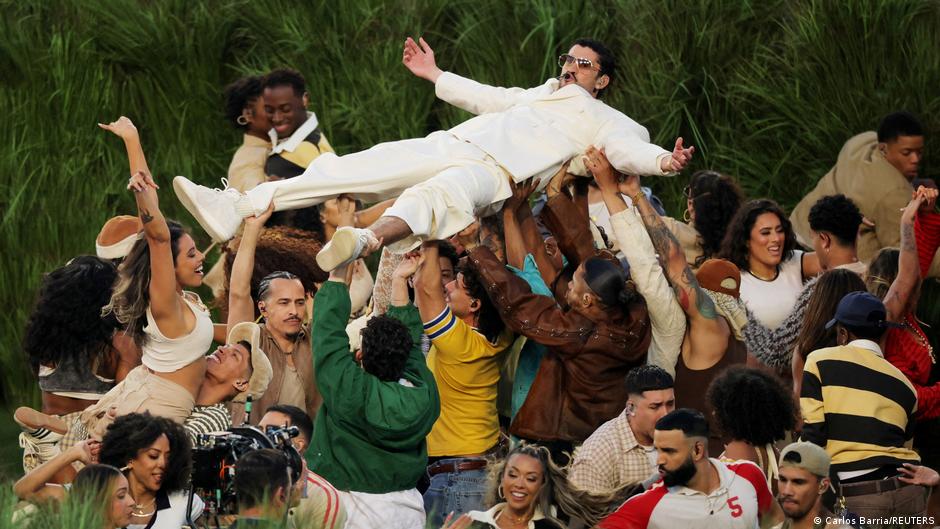
In a historic Super Bowl halftime show, Bad Bunny became the first artist to perform entirely in Spanish, delivering a powerful message of unity while drawing both praise and controversy. His performance, which featured a prominent billboard reading “The only thing more powerful than hate is love,” represented a significant cultural moment in one of America’s most-watched television events.
The Puerto Rican superstar, who remains the world’s most streamed musician, has never shied away from political statements. During his Grammy acceptance speech for Best Musica Urbana Album, he notably called for “ICE out,” referencing U.S. Immigration and Customs Enforcement operations that have caused controversy in Minneapolis.
Following his Super Bowl performance, former President Donald Trump publicly criticized Bad Bunny on Truth Social, amplifying the polarizing reception to his appearance. As often happens with high-profile figures who take political stances, Bad Bunny quickly became the target of widespread misinformation across social media platforms.
Among the false claims that gained traction was a viral video allegedly showing the artist refusing to stand for the U.S. national anthem. The video, which garnered over one million views, actually originated months earlier during an October 7 New York Yankees baseball game. Fact-checking revealed that the footage didn’t show the national anthem at all, but rather spectators singing “God Bless America” – a patriotic song but not the official national anthem.
According to U.S. Code, only “The Star-Spangled Banner” holds the designation of national anthem, with suggested customs for how citizens should behave during its playing. Legal experts note that these customs use the word “should” rather than “must,” emphasizing their voluntary nature.
Another fabricated claim featured an AI-generated image showing Bad Bunny in a dress with transgender pride flag colors burning an American flag. The viral image, which spread across multiple social media platforms, was clearly artificial. When analyzed with Google’s Gemini AI system, the image revealed a SynthID watermark confirming its creation through AI tools. Additionally, the tattoos depicted in the image didn’t match Bad Bunny’s actual body art.
A third piece of misinformation involved the identity of a young boy who appeared in Bad Bunny’s halftime performance. Social media posts incorrectly claimed the child was Liam Conejo Ramos, a boy whose arrest alongside his father during an ICE operation in Minnesota had recently made national headlines. In reality, the 5-year-old featured in the show was child actor Lincoln Fox, as confirmed by Fox’s own Instagram account, his talent agency, and Bad Bunny’s publicist.
The rapid spread of these false narratives demonstrates how major cultural moments can become battlegrounds for misinformation, particularly when they involve artists who engage with politically charged topics. Bad Bunny’s performance represented a milestone for Latino representation at one of America’s premier cultural events, while simultaneously becoming a lightning rod for divisive reactions and deliberate falsehoods.
As streaming platforms continue to elevate global artists to unprecedented levels of visibility, performances like Bad Bunny’s highlight both the evolution of American mainstream entertainment and the increasingly complex information environment surrounding high-profile cultural events.
Fact Checker
Verify the accuracy of this article using The Disinformation Commission analysis and real-time sources.

10 Comments
As a global music superstar, Bad Bunny has every right to use his platform to express his political views, even if they’re controversial. Kudos to him for taking a stand, even if it draws the ire of certain public figures.
I agree, artists shouldn’t have to stay silent on important issues just to avoid backlash. It’s heartening to see someone like Bad Bunny use their celebrity to amplify messages of unity and social justice.
The claims about Bad Bunny refusing to stand for the national anthem seem clearly unfounded. Viral misinformation is always a risk with high-profile events like this, but it’s good to see fact-checkers working to debunk the false narratives.
You’re right, it’s important to rely on credible sources and not get swept up in unsubstantiated social media claims, no matter how shareable they might be. Fact-checking is crucial in an age of rampant online misinformation.
Interesting to see the cultural and political dynamics at play with Bad Bunny’s Super Bowl performance. While the misinformation is disappointing, it’s good to see fact-checkers working to set the record straight.
You make a fair point. In today’s polarized climate, any high-profile figure who takes a political stance is bound to face a wave of misinformation and criticism. But that shouldn’t deter artists from using their platform for important messages.
Bad Bunny’s Super Bowl show was a groundbreaking moment for representation and cultural expression on one of the biggest stages. While the backlash and misinformation are predictable, it’s admirable that he stayed true to his values.
Agreed. Moments like this are important for expanding the visibility and acceptance of diverse cultures and perspectives in mainstream American entertainment. The fact-checking efforts are crucial to combat the inevitable spread of false narratives.
Interesting to see the cultural impact and political overtones of Bad Bunny’s Super Bowl performance. Kudos to him for using his platform to make a statement, though it’s no surprise it sparked controversy in these divided times.
I agree, artists shouldn’t shy away from using their voice, even if it ruffles some feathers. It’s a shame the misinformation and false claims distracted from the broader message.