


Listen to the article
Earth’s Distance From Sun Not to Blame for Cold Weather, PAGASA Clarifies
Recent claims circulating on social media about an “aphelion phenomenon” causing prolonged cold weather in the Philippines have been debunked by the country’s weather bureau.
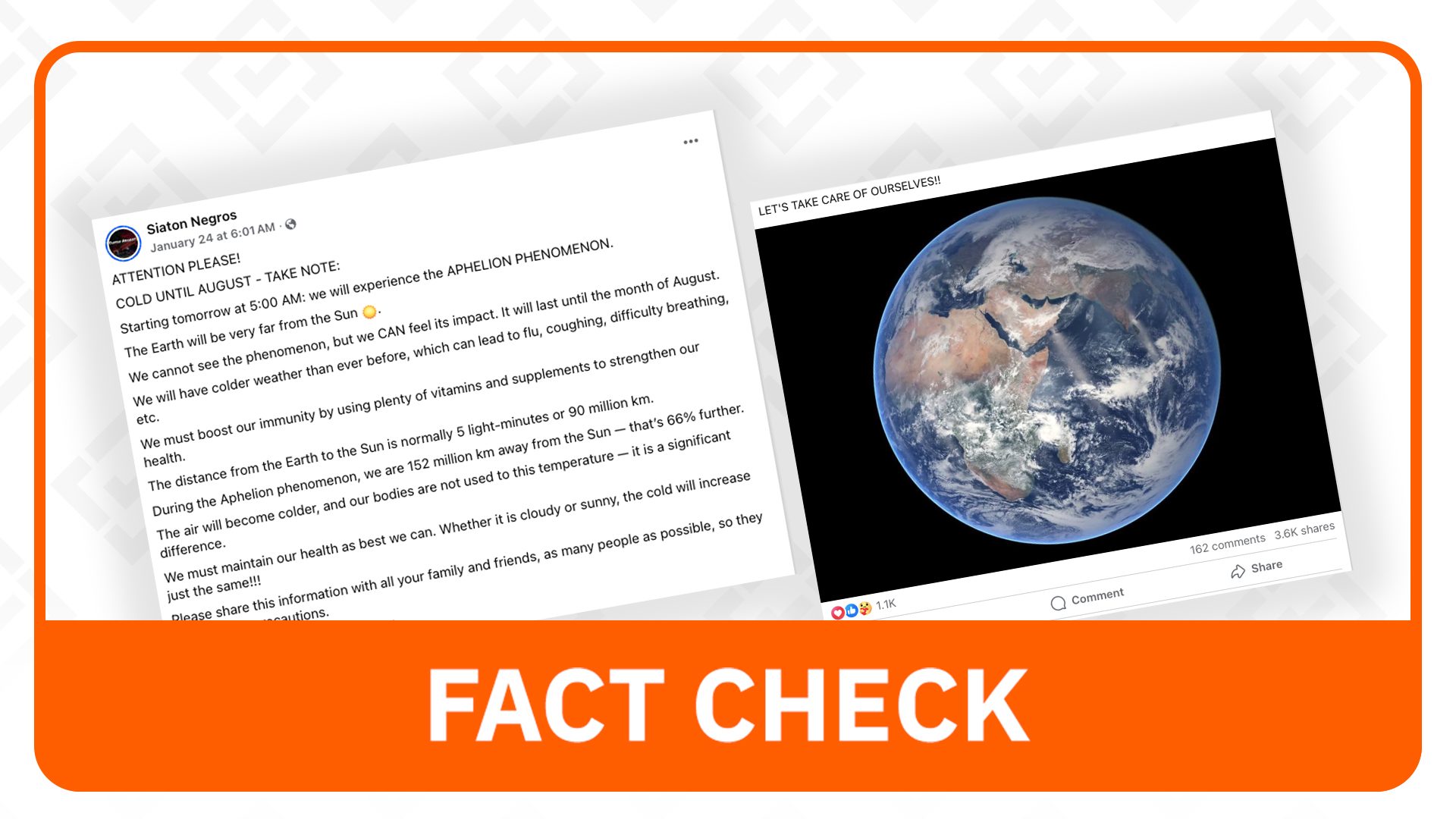
The Philippine Atmospheric, Geophysical, and Astronomical Services Administration (PAGASA) has issued a statement refuting viral posts that suggested Earth’s increased distance from the sun would cause unusually cold weather until August, potentially leading to health problems such as flu, coughs, and breathing difficulties.
One such post, shared by Facebook page “Siaton Negros” which has 18,000 followers, garnered substantial attention with over 3,600 shares. The post warned of extended cold conditions and advised people to take vitamins and supplements to prevent illness.
According to PAGASA, while aphelion—the point at which Earth is farthest from the sun—is a real astronomical event, it does not significantly impact Earth’s weather patterns or temperatures.
“[Department of Science and Technology]-PAGASA clarifies that while Earth’s orbital position changes throughout the year, these astronomical shifts do not dictate short-term weather patterns,” the agency explained in its press release.
During aphelion, Earth is approximately 152 million kilometers away from the sun, only about two million kilometers farther than its average distance of 150 million kilometers. This relatively minor difference does not cause drastic temperature changes globally or locally.
The weather bureau further explained that seasonal changes on our planet are primarily influenced by Earth’s axial tilt rather than its orbital distance. “The tilt dictates the angle of solar incidence and the duration of daylight, which have a far more profound effect on global temperatures than the slight difference in distance during Aphelion or Perihelion,” PAGASA stated.
The agency also noted that, contrary to claims in the viral post, aphelion is projected to occur on July 7, 2026, not January 2026.
The actual cause of cooler temperatures currently experienced in the Philippines is the northeast monsoon, locally known as amihan. This weather system, which typically affects the country from October to March, brings cold, dry air from high-pressure areas in East Asia. On January 29, 2026, PAGASA recorded a minimum temperature of 19.2°C at its Science Garden in Quezon City, attributing this to amihan rather than any astronomical phenomenon.
Health experts have also weighed in on claims linking cold weather to flu outbreaks. According to information from Johns Hopkins Medicine and The Conversation, colds and flu are caused by viruses, not by cold weather itself.
Dr. Zetch Cruz-Ram, medical director of Doctor Anywhere Philippines, explained that cold weather may indirectly contribute to virus transmission because people tend to congregate indoors during colder months, increasing the likelihood of virus spread. Additionally, dry air can dry out nasal passages, potentially making it easier for viruses to enter the body.
The Department of Health has previously issued reminders about seasonal increases in flu-like illnesses but has not released any advisories connecting aphelion or Earth’s distance from the sun to respiratory illness outbreaks.
Similar claims associating aphelion with extreme cold and health risks have surfaced online in previous years and have been fact-checked by various organizations including Rappler.
The persistence of such misinformation highlights the importance of consulting official sources like PAGASA and health authorities for accurate information on weather patterns and health risks, rather than relying on unverified social media posts that can spread unnecessary alarm.
Fact Checker
Verify the accuracy of this article using The Disinformation Commission analysis and real-time sources.

13 Comments
Appreciate PAGASA taking the time to issue this statement and set the record straight. Important to counter misinformation, especially around weather and climate topics.
Agree, PAGASA’s clarification helps maintain public trust in authoritative sources of weather information.
Curious about what may have sparked these social media claims in the first place. Glad PAGASA could provide the actual facts about aphelion’s limited influence on weather and health.
Interesting to know that aphelion doesn’t actually impact weather and health as some claimed. PAGASA’s clarification is helpful to dispel misconceptions about this astronomical event.
Appreciate the authoritative input from PAGASA to provide the facts and correct any false claims circulating online.
Glad to see PAGASA take the time to refute these misleading claims about aphelion causing unusual weather and health issues. Fact-checking is essential.
Kudos to PAGASA for addressing this misinformation head-on and providing the scientific facts. Dispelling false narratives around weather is crucial.
Good to see PAGASA take the time to address and debunk these viral social media posts about aphelion causing unusual cold weather and health issues. Fact-checking is crucial.
Agree, it’s important for weather agencies to proactively counter misinformation, especially when it could lead people to take unnecessary actions.
Good on PAGASA for promptly addressing the viral social media posts and providing the scientific facts about aphelion. Debunking misinformation is critical.
The scientific explanation from PAGASA that aphelion does not significantly impact weather patterns is helpful context. Glad to see them clarify the facts.
Interesting to learn that aphelion, while a real astronomical event, doesn’t significantly impact short-term weather patterns as some had claimed. Appreciate PAGASA’s explanation.
Agreed, PAGASA’s statement helps provide important context and clarity around this issue.