


Listen to the article
Trump’s Brief Iran Remarks Signal Broader Middle East Concerns
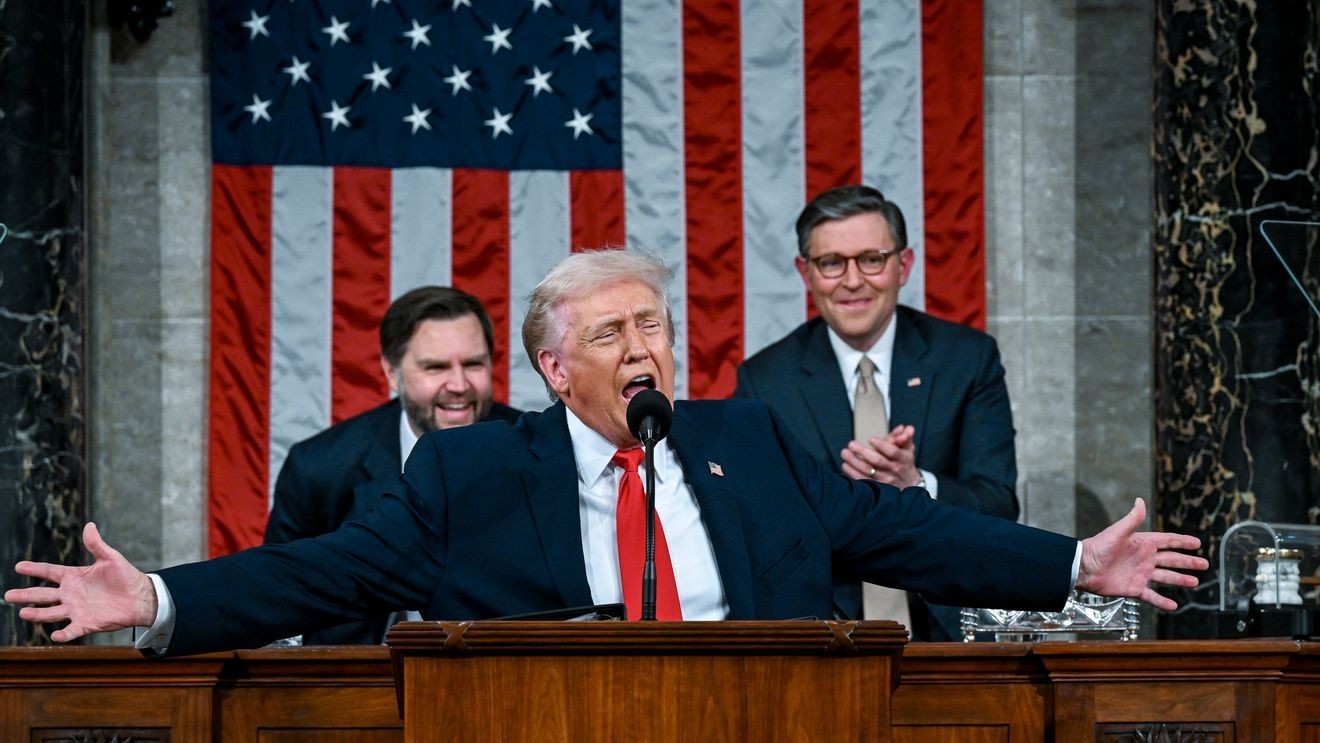
President Donald Trump dedicated just a few minutes to Iran during his record-breaking State of the Union address this week, but those brief comments highlighted the administration’s continued focus on Tehran as a persistent security threat.
During his one hour and 47 minute speech, Trump accused Iran of working to revive its nuclear program despite previous American military action. “They were warned to make no future attempts to rebuild their weapons program, yet they continue and are at this moment again pursuing their sinister ambitions,” Trump said, according to Associated Press reports of the official transcript.
While expressing preference for diplomatic solutions, the president made clear that military options remain available should Iran move toward developing nuclear weapons—a statement that gains significance against the backdrop of the Pentagon’s substantial military buildup in the Middle East region.
Security analysts warn that any direct U.S.-Iran confrontation would likely expand beyond a bilateral conflict. The Institute for National Security Studies has outlined several potential scenarios, including one where Iran launches missile or drone attacks against Israel to impose costs on U.S. allies without triggering an immediate full-scale American response.
Such a conflict would almost certainly draw in Israel and potentially involve logistical or defensive support from other Western partners. The regional implications could be far-reaching, with Iran likely to activate its extensive proxy network that includes Hezbollah in Lebanon, various militias in Iraq and Syria, and Houthi fighters in Yemen.
The Council on Foreign Relations’ Global Conflict Tracker notes this proxy network could effectively spread hostilities across multiple fronts throughout the Middle East, creating a complex regional war rather than a contained bilateral conflict.
While Russia and China would likely avoid direct military involvement, both powers could offer Iran diplomatic or economic support, substantially raising the geopolitical stakes of any conflict and potentially complicating U.S. strategic objectives.
Parallel to these military preparations, the administration continues pursuing diplomatic channels. U.S. envoy Steve Witkoff and presidential adviser Jared Kushner are scheduled to meet with Iranian representatives in Geneva. This dual-track approach reflects the administration’s stated preference for negotiation, even as it positions what officials describe as one of the largest shows of American military force in the region in decades.
Several foreign policy experts have voiced concerns that the administration may be underestimating the potential for escalation. In his analysis for the Council on Foreign Relations, Max Boot argues that the U.S. military has quietly signaled that a conflict with Iran could become more protracted and dangerous than policymakers anticipate.
Boot highlights Iran’s capability to strike U.S. military installations, target critical oil infrastructure in Gulf states, or disrupt shipping through the Strait of Hormuz—a crucial chokepoint through which a significant portion of global oil supplies pass. Any disruption to this maritime passage could trigger a surge in global energy prices, with ripple effects across the world economy.
Additional concerns include the potential strain on U.S. precision-weapon inventories and the diversion of military resources from other global priorities, without guarantees that Iran would yield to pressure or that Washington would have a well-defined exit strategy.
The specter of the 2003 Iraq War looms large over any consideration of major military action in the Middle East. That conflict, which began with the toppling of Saddam Hussein’s regime, evolved into a years-long American military presence in the country.
Brown University’s Costs of War Project estimates the Iraq War’s total financial burden exceeded $2 trillion, with more than 4,400 American service members killed, approximately 32,000 wounded, and hundreds of thousands of Iraqi casualties.
Since Iraq, U.S. military interventions in the region have been more limited in scope, including operations against ISIS beginning in 2014, airstrikes in Yemen, and targeted actions against Iran-backed groups. None of these, however, have approached the scale of formal declarations of war or major ground invasions—a threshold that any substantial conflict with Iran would likely cross.
Fact Checker
Verify the accuracy of this article using The Disinformation Commission analysis and real-time sources.

14 Comments
Interesting analysis of the potential implications of U.S.-Iran tensions. The prospect of a wider regional conflict is certainly concerning. I’m curious to see how diplomatic efforts might defuse the situation and avoid further escalation.
Agreed, diplomacy seems crucial here to prevent an uncontrolled escalation. Both sides will need to exercise caution and restraint.
This is a highly complex and volatile situation that demands a very measured, thoughtful response from all involved. Unilateral military action by either side could have severe unintended consequences across the Middle East.
I agree, the risks of miscalculation or overreaction are extremely high. Diplomacy, restraint, and a comprehensive regional approach will be essential to finding a stable, lasting solution.
The potential for a broader regional conflict stemming from U.S.-Iran tensions is deeply worrying. Diplomatic efforts to defuse the situation and address the legitimate security concerns of all parties in the region seem absolutely crucial.
Absolutely. De-escalation through open dialogue and compromise, rather than further military posturing, appears to be the wisest path forward here.
The Trump administration’s hardline stance on Iran’s nuclear ambitions is certainly raising the stakes. However, military action could have severe unintended consequences across the Middle East. A thoughtful, measured approach is essential.
Absolutely. Any miscalculation or overreaction could spiral out of control quickly. Careful strategy and communication will be vital to find a peaceful resolution.
The prospect of a broader regional conflict stemming from U.S.-Iran tensions is deeply concerning. Diplomatic efforts to reduce the risk of miscalculation and unintended escalation seem absolutely critical at this stage.
Absolutely. De-escalation through dialogue and compromise, rather than military posturing, is the wisest path forward here.
This is a complex geopolitical situation with no easy solutions. I hope both the U.S. and Iran can find a diplomatic path forward that addresses the legitimate security concerns of all parties in the region.
Agreed, nuance and compromise will be key. Escalating tensions further risks disastrous consequences that would affect civilians across the Middle East.
This is a tense and delicate situation that demands a very careful, thoughtful response from all parties involved. Unilateral military action could have severe unintended consequences that destabilize the entire region.
I agree, the risks of miscalculation or overreaction are extremely high. Diplomacy, restraint, and a comprehensive regional approach will be essential to finding a lasting solution.