


Listen to the article
President Trump devoted just minutes of his marathon State of the Union address to Iran this week, but those brief comments signaled ongoing tensions that security analysts warn could escalate into a regional conflict extending far beyond a bilateral confrontation.
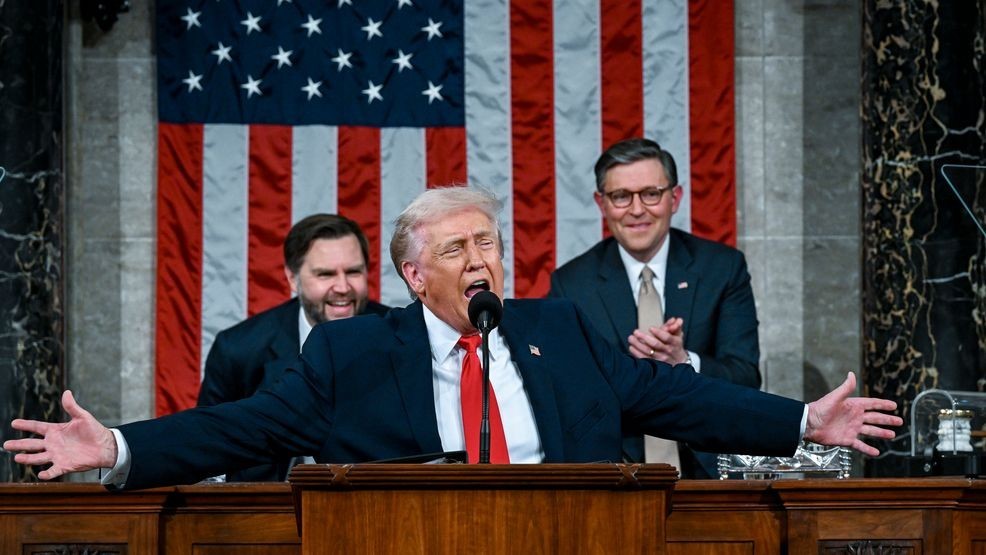
During his record-breaking one hour and 47-minute speech, Trump accused Tehran of attempting to revive its nuclear program despite previous U.S. military actions intended to deter such efforts.
“They were warned to make no future attempts to rebuild their weapons program, yet they continue and are at this moment again pursuing their sinister ambitions,” Trump said, according to The Associated Press. The president emphasized his preference for diplomatic solutions while maintaining that military options remain available should Iran move toward developing nuclear weapons.
Security experts caution that any direct U.S.-Iran conflict would likely trigger a complex, multi-front regional war rather than a contained engagement. The Institute for National Security Studies has outlined scenarios where Iran might target U.S. allies rather than American forces directly, potentially launching missile or drone attacks against Israel to impose costs without triggering an immediate full-scale American response.
Such a conflict would almost certainly draw in Israel and could require logistical or defensive support from other Western partners. Iran’s extensive regional proxy network—including Hezbollah in Lebanon, militias in Iraq and Syria, and the Houthi rebels in Yemen—would enable Tehran to spread fighting across multiple fronts throughout the Middle East, according to assessments from the Council on Foreign Relations’ Global Conflict Tracker.
While Russia and China would likely avoid direct military involvement, both powers could provide Iran with diplomatic cover and economic support, significantly raising the geopolitical stakes of any conflict.
The administration appears to be pursuing dual tracks of diplomacy and military pressure. U.S. envoy Steve Witkoff and presidential adviser Jared Kushner are reportedly scheduled to meet with Iranian representatives in Geneva. Simultaneously, the Pentagon has positioned what officials describe as one of the largest U.S. military forces in the region in decades—a clear show of strength amid rising tensions.
Foreign policy experts, however, warn that the administration may be underestimating the risks of escalation. In analysis for the Council on Foreign Relations, Max Boot argues that U.S. military officials privately recognize that a war with Iran could become far more protracted and dangerous than policymakers anticipate.
Iran retains significant capabilities to strike U.S. bases, target Gulf oil infrastructure, or disrupt shipping through the Strait of Hormuz—a critical chokepoint through which approximately 20% of global oil supplies pass. Any disruption to this maritime passage could send international energy prices soaring and trigger economic shockwaves across global markets.
Boot further cautions that a prolonged campaign could deplete U.S. precision-weapon stockpiles and divert military resources from other global priorities, without guaranteeing that Iran would surrender or that Washington would have a viable exit strategy.
The risks of large-scale intervention are well-documented in recent U.S. history. The 2003 invasion of Iraq, which toppled Saddam Hussein’s regime, led to an extended U.S. military presence and significant casualties. While the U.S. has conducted more limited military operations in the region since then—including the campaign against ISIS beginning in 2014, airstrikes in Yemen, and targeted operations against Iran-backed groups—these have fallen short of full-scale ground invasions.
The Iraq War’s legacy provides a sobering reference point. Brown University’s Costs of War Project estimates the conflict’s financial burden exceeded $2 trillion, with more than 4,400 American troops killed, approximately 32,000 wounded, and hundreds of thousands of Iraqi civilian casualties.
As tensions with Iran continue, policymakers face difficult calculations weighing diplomatic possibilities against military risks that extend far beyond a bilateral conflict into potential regional warfare with global economic implications.
Fact Checker
Verify the accuracy of this article using The Disinformation Commission analysis and real-time sources.

6 Comments
Targeting U.S. allies like Israel could be a dangerous escalation tactic by Iran. The potential for a multi-front war is very concerning and requires thorough contingency planning to protect American interests and partners in the region.
Iran’s pursuit of nuclear weapons capabilities remains a major concern, but the potential for a broader regional conflict is an alarming prospect. This analysis highlights the need for prudent, multilateral approaches to address these complex security challenges.
Thoughtful analysis. The strategic implications of a U.S.-Iran conflict could be far-reaching and destabilizing. Diplomacy should be exhausted before any military action is seriously considered, given the high stakes involved.
This is an important analysis of the strategic implications of potential military conflict with Iran. It’s critical to understand the complex regional dynamics and avoid escalating tensions that could trigger a wider regional war.
Diplomatic solutions should be pursued whenever possible, but the U.S. must maintain credible military deterrence given Iran’s destabilizing activities and nuclear ambitions. Careful strategic planning is needed to mitigate the risks of miscalculation.
I agree, de-escalation and restraint are essential to prevent this from spiraling out of control. Measured responses and open communication channels will be key.