


Listen to the article
Fake Medical Report of President Marcos Circulates Online, Authorities Respond
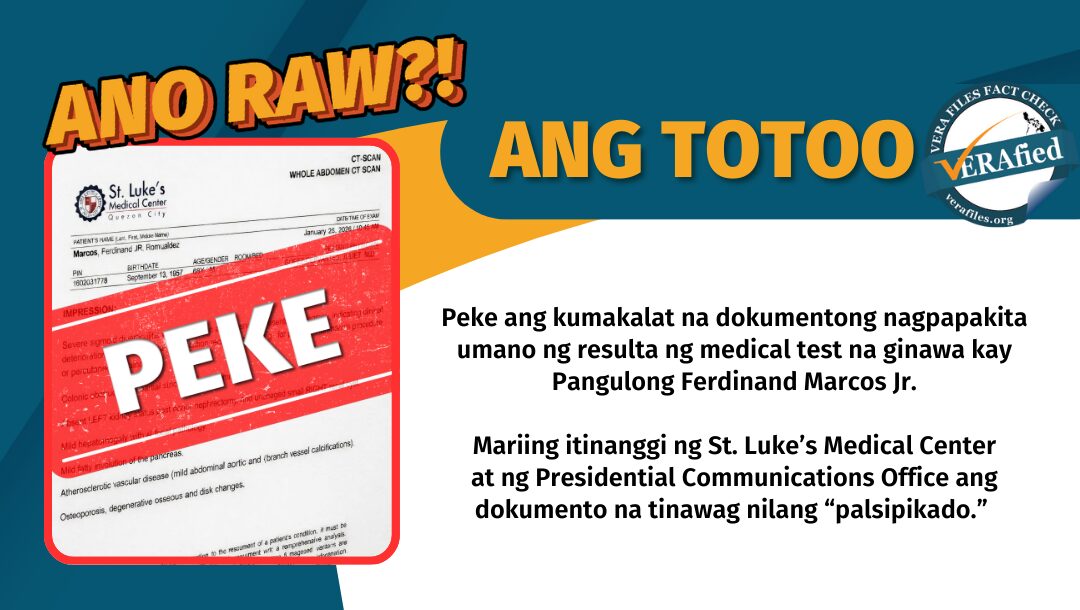
A fabricated medical report allegedly showing President Ferdinand Marcos Jr.’s test results began circulating online just days after he publicly disclosed his diagnosis of diverticulitis. Both the Presidential Communications Office (PCO) and St. Luke’s Medical Center (SLMC) have firmly denounced the document as fraudulent.
The false medical report, which appeared on Facebook on January 28, featured SLMC’s logo and was dated January 25. It purportedly named Dr. Juliet Gopez-Cervantes, a gastroenterologist who heads SLMC’s Liver Disease and Transplant Center, as the requesting physician.
The document presented alarming medical findings, including “severe sigmoid diverticulitis with perforation,” “colonic obstruction,” and several other serious conditions, suggesting the president’s health was in critical condition.
SLMC quickly issued a statement on its official Facebook page, labeling the document as “fake and falsified.” The hospital emphasized that any medical results shared outside authorized channels should be considered fraudulent, adding that sharing a patient’s medical information without consent constitutes a breach of data privacy and violates both hospital policy and applicable laws.
Similarly, the PCO released a statement confirming that the circulating report “does not reflect the president’s health.” Palace Press Officer Claire Castro announced on January 29 that Malacañang has requested the National Bureau of Investigation to identify those responsible for creating and spreading the fabricated document.
The false medical report emerged amid legitimate news about the president’s health. On January 22, Castro had announced that Marcos spent a night in the hospital after experiencing discomfort. The same day, the PCO released a video of Marcos addressing rumors about his health, where he confirmed his diverticulitis diagnosis.
In the video, Marcos explained diverticulitis—a condition where small pouches form and push through weak spots in the colon wall—and stressed that his condition is not life-threatening, dismissing rumors of his death as “highly exaggerated.” While acknowledging that he had canceled some scheduled events to consult with doctors, he assured the public that he was doing well.
The president has since resumed his official duties. On January 29, he attended the ceremonial handover of the Association of Southeast Asian Nations-Business Advisory Council chairship for 2026 at Malacañang Palace, further demonstrating his ability to continue with his responsibilities.
This is not the first instance of misinformation about the president’s health. Fact-checking organization VERA Files has previously debunked other disinformation related to Marcos’s health condition.
The fake medical report gained significant traction on social media, with six copies posted by Facebook users and pages including “Kababayan PH,” “Cebu Flash Report,” and “Taga Ormoc Daily” collectively accumulating over 1,500 reactions, nearly 1,000 comments, and more than 330 shares.
This incident highlights the ongoing challenge of combating health-related misinformation about public officials in the Philippines, where social media platforms continue to serve as vectors for the rapid spread of false information, particularly regarding sensitive matters like the health of national leaders.
Fact Checker
Verify the accuracy of this article using The Disinformation Commission analysis and real-time sources.

6 Comments
While I understand the public’s interest in the president’s health, circulating unverified medical information is unethical and can cause unnecessary panic. I’m glad the authorities have taken steps to address this fraudulent document.
It’s troubling to see how easily misinformation can spread, even about sensitive medical topics. I commend the hospital and government for their swift action to shut down this false report and protect the president’s privacy.
Fabricating medical records is a serious breach of ethics and patient privacy. I appreciate the hospital’s swift response to clarify that this report is fraudulent and that they did not authorize the release of any confidential information.
Absolutely. It’s crucial that the public can trust the accuracy of medical information, especially for high-profile individuals. Spreading disinformation undermines that trust.
It’s concerning to see such a blatantly false medical report circulating online. Spreading misinformation about a public figure’s health is irresponsible and can have serious consequences. I’m glad the authorities swiftly denounced this fabricated document.
This situation highlights the importance of verifying the source and authenticity of any medical reports, especially those involving public figures. I’m glad the authorities were proactive in addressing this fraudulent document.