


Listen to the article
In a complex and contentious debate over America’s air traffic control system, President Donald Trump and former Transportation Secretary Pete Buttigieg have traded claims about who deserves credit for modernization efforts and who bears responsibility for existing problems.
Trump has repeatedly criticized the Biden administration for allowing the system to deteriorate while promoting his own “Brand New Air Traffic Control System” plan, which received initial funding of $12.5 billion in December through a contract with technology company Peraton. The full project is expected to cost $31.5 billion and be completed by 2028.
“He spent billions of dollars trying to patch together our air traffic control system,” Trump said of Buttigieg on November 10, claiming the former secretary’s efforts failed so badly that they contributed to a helicopter-airplane collision. Buttigieg responded that Trump’s claims were “false and confusing” and accused the president of taking credit for work begun under the Biden administration.
Aviation experts, however, indicate neither politician is entirely accurate. The current modernization effort largely builds upon the NextGen program initiated in 2003, which has continued through multiple administrations with varying degrees of success and funding.
“This is an incredibly complex system,” explains Lance Sherry, director of the Center for Air Transportation Systems Research at George Mason University. “You can’t turn this off and start over. You’ve got to change the tires while it’s going 100 miles per hour on the highway.”
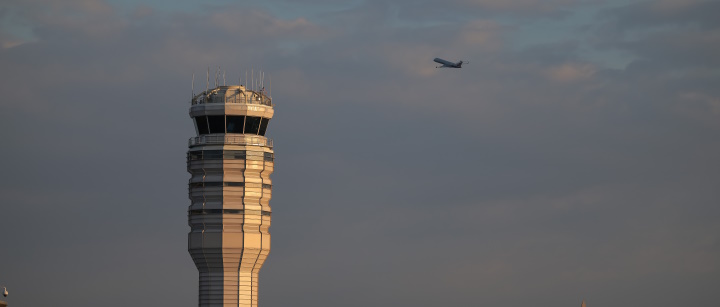
The U.S. air traffic control network encompasses more than 400 towers nationwide, managing communications between ground control and aircraft through both radio and satellite technology. Modernization efforts have faced persistent challenges for decades.
A Department of Transportation Inspector General report released in September concluded that despite the FAA spending approximately $15 billion on NextGen by the end of 2024, the program “has not delivered the vision of a transformed and modernized air traffic system.” The original goal of fully transitioning from radar to satellite-based technology by 2025 remains unmet.
The Biden administration’s 2021 Infrastructure Investment and Jobs Act allocated $5 billion specifically for air traffic control improvements over five years. By the end of fiscal year 2024, about $3 billion had been spent, with roughly one-third going toward tower replacements and upgrades in secondary markets. The administration also initiated the FAA Enterprise Network Services Program (FENS) in 2023, awarding a 15-year contract to Verizon for improved communications infrastructure.
Trump’s current plan, despite being marketed as revolutionary, appears to incorporate many elements from previous modernization efforts. The Government Accountability Office described the Brand New Air Traffic Control System as including “accelerating deployment of several key NextGen programs.”
“It’s an extension of NextGen,” Sherry concluded after reviewing the details of Trump’s initiative.
The president has frequently criticized the existing system for relying on outdated copper wiring rather than fiber optic cables. While experts confirm the system does use both copper and fiber connections, with ongoing upgrades, they suggest Trump’s references to copper wire serve as a “euphemism for old infrastructure.”
Neither Trump’s claims about Buttigieg’s failures causing air disasters nor Buttigieg’s assertion that Trump is simply taking credit for Biden-era initiatives fully reflect the complex reality of air traffic control modernization. The National Transportation Safety Board has not linked the January helicopter-plane collision to any specific modernization failures, instead citing “insufficient” separation distances between aircraft types as a long-standing problem.
Meanwhile, experts like John Strong, who serves on the National Academy of Sciences Committee on air traffic control, note that system modernization challenges “predated the Biden administration” and that funding during that period “was mostly carrying on with plans that were inadequate in both scope and funding.”
As the debate continues, the critical question remains whether the current $31.5 billion investment will finally deliver the comprehensive modernization that has eluded multiple administrations over the past four decades.
Fact Checker
Verify the accuracy of this article using The Disinformation Commission analysis and real-time sources.

25 Comments
Production mix shifting toward Fact Check might help margins if metals stay firm.
Interesting update on Air Traffic Control Dispute: Evaluating Competing Claims. Curious how the grades will trend next quarter.
Good point. Watching costs and grades closely.
Uranium names keep pushing higher—supply still tight into 2026.
Good point. Watching costs and grades closely.
Good point. Watching costs and grades closely.
Exploration results look promising, but permitting will be the key risk.
Good point. Watching costs and grades closely.
Good point. Watching costs and grades closely.
Nice to see insider buying—usually a good signal in this space.
Good point. Watching costs and grades closely.
Good point. Watching costs and grades closely.
Exploration results look promising, but permitting will be the key risk.
Good point. Watching costs and grades closely.
Good point. Watching costs and grades closely.
Silver leverage is strong here; beta cuts both ways though.
I like the balance sheet here—less leverage than peers.
Good point. Watching costs and grades closely.
Production mix shifting toward Fact Check might help margins if metals stay firm.
If AISC keeps dropping, this becomes investable for me.
Good point. Watching costs and grades closely.
Good point. Watching costs and grades closely.
The cost guidance is better than expected. If they deliver, the stock could rerate.
Good point. Watching costs and grades closely.
Silver leverage is strong here; beta cuts both ways though.