


Listen to the article
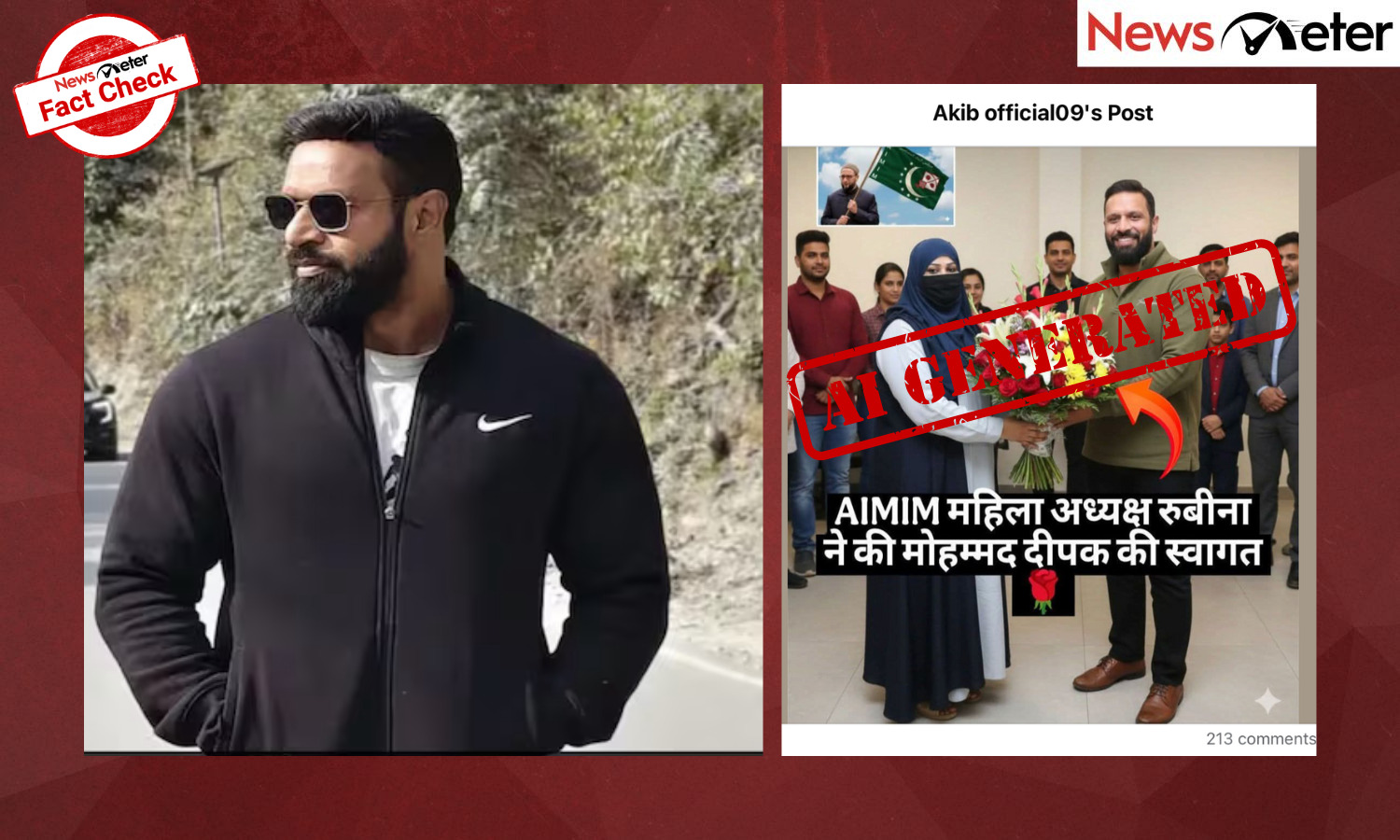
In the wake of a viral incident in Uttarakhand, social media platforms have been flooded with misleading content, including a fabricated image purportedly showing a meeting between Deepak Kumar and the women’s wing president of the All India Majlis-e-Ittehadul Muslimeen (AIMIM).
The image, which has been widely shared across multiple platforms, claims to show AIMIM women’s wing president Rubina welcoming Kumar, who has been dubbed “Mohammad Deepak” following a confrontation in Uttarakhand’s Kotdwar. An investigation has revealed the image is entirely AI-generated and does not depict any real event.
The fabricated photo emerged amid heightened attention around Kumar, a 37-year-old gym trainer who became an overnight social media sensation after standing up for an elderly Muslim shopkeeper. On January 26, Kumar reportedly intervened when a group of men pressured a 70-year-old shopkeeper suffering from Parkinson’s disease to remove the word “Baba” from his establishment’s signage. During the confrontation, when questioned about his identity, Kumar introduced himself as “Mohammad Deepak,” a moment captured on video that subsequently went viral.
The incident struck a chord with many online, leading to Kumar’s name trending across social platforms. Riding this wave of interest, the AI-generated image began circulating with text claiming “AIMIM women’s president Rubina welcomed Mohammed Deepak.” One Facebook user shared the image with an emotional caption: “Brand India Mohammad Deepak… Today his wife must be feeling the strongest because her husband did not cower in the face of hatred, did not bow to the mob and stood up for an elderly man.”
Technical analysis conducted by fact-checkers revealed unmistakable signs of artificial creation. A Google Gemini AI watermark is visible in the bottom-right corner of the image, confirming it was created using artificial intelligence rather than captured during an actual event. Additional verification using AI-detection tools like SynthID further confirmed the image was computer-generated with high probability.
Despite the viral nature of the image, no credible media outlets have reported any meeting between Kumar and AIMIM representatives. The party’s official channels have not acknowledged any such event, though AIMIM leader Asaduddin Owaisi has commented on the broader Kotdwar incident through his social media platforms.
The spread of this AI-generated content highlights growing concerns about the proliferation of synthetic media in current affairs. As AI technology becomes increasingly accessible, distinguishing between authentic and fabricated visual content presents a mounting challenge for news consumers and fact-checkers alike.
The original incident in Kotdwar, meanwhile, continues to generate discussion about religious harmony and communal tensions in Uttarakhand. Kumar’s intervention and his spontaneous response during the confrontation have resonated with many who see his actions as a stand against religious discrimination.
Law enforcement authorities in Uttarakhand have not issued any formal statements regarding the Kotdwar incident, and it remains unclear whether any official investigation into the confrontation has been initiated.
As this story develops, media literacy experts emphasize the importance of verifying content before sharing, particularly when images appear to validate emotionally charged narratives around sensitive social issues.
Fact Checker
Verify the accuracy of this article using The Disinformation Commission analysis and real-time sources.

16 Comments
Interesting to see this AI-generated image used to spread misinformation. I’m glad the investigation revealed it’s not a real event. We need to be vigilant about verifying claims, especially on social media.
Absolutely, it’s important to fact-check before sharing content online. Spreading misinformation, even unintentionally, can have real consequences.
I’m glad the investigation revealed the image as AI-generated. It’s important to stay vigilant against the spread of misinformation, especially around sensitive political and social issues.
Absolutely. The proliferation of AI-generated content is a real challenge that requires a multi-pronged approach to address.
The fabricated image of the AIMIM women’s wing president is a concerning example of how misinformation can spread quickly on social media. It’s a good reminder to always verify the source and authenticity of online content.
Agreed. In this age of digital information, critical thinking and fact-checking are essential skills. We must be cautious consumers of online content.
The use of AI-generated content to create false narratives is a concerning development. This incident highlights the importance of media literacy and critical thinking skills in the digital age. We must all be more diligent in verifying the information we encounter online.
Well said. As AI technology continues to advance, the potential for abuse only increases. Educating the public on identifying AI-generated content and fact-checking should be a key focus for media organizations and policymakers.
The fabricated image of the AIMIM women’s wing president is a concerning example of how AI-generated content can be used to create false narratives. It’s a stark reminder of the importance of critical thinking and fact-checking in the digital age.
Agreed. As AI technology continues to advance, the potential for abuse only increases. Vigilance and media literacy will be essential in combating the spread of misinformation.
This incident highlights the growing problem of AI-generated content being used to create false narratives. While the technology is advancing, we must remain critical consumers of information and not blindly trust what we see online.
Well said. As AI capabilities continue to improve, the potential for abuse only increases. Educating the public on spotting AI-generated content is crucial.
I’m glad the investigation revealed this image as AI-generated. It’s a worrying trend to see such content being used to spread misinformation, especially around sensitive political and social issues. We must all be more discerning consumers of online information.
Absolutely. Fact-checking and verifying the authenticity of online content should be a priority for everyone. Only by staying vigilant can we prevent the spread of misinformation.
This incident highlights the need for greater media literacy and fact-checking skills among the public. We must all be more discerning consumers of online information to prevent the spread of misinformation.
Well said. Educating people on identifying AI-generated content and verifying sources should be a priority for media organizations and policymakers.