


Listen to the article
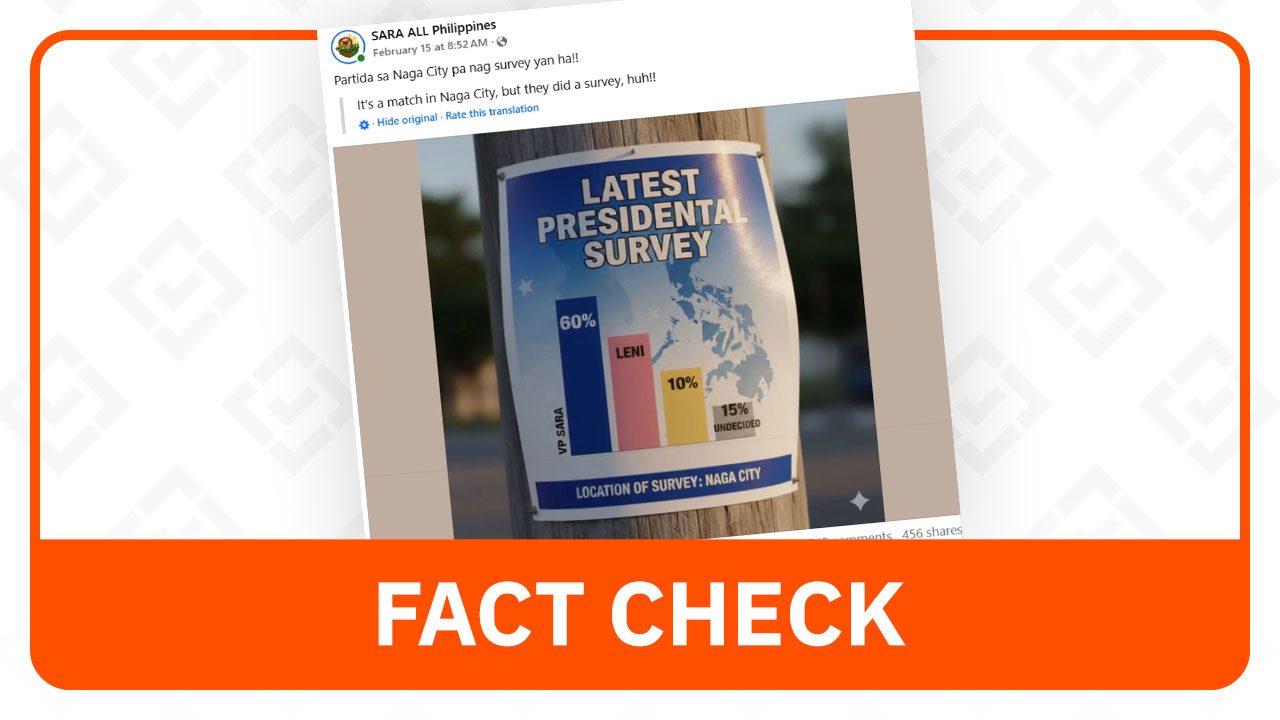
Philippine authorities have issued a warning about misleading social media content after an AI-generated image falsely depicting Vice President Sara Duterte leading in presidential preference surveys circulated widely online.
The fabricated image, which bears Google Gemini’s distinctive sparkle logo in the corner, shows Duterte supposedly commanding a 60% preference rating in a survey allegedly conducted in Naga City. Former Vice President Leni Robredo appears as a distant second place candidate with an unspecified percentage.
Digital forensic analysis confirmed the image’s artificial origin, with multiple AI detection tools identifying it as computer-generated with up to 100% certainty. Experts noted several telltale inconsistencies, including a bar graph showing a 10% result appearing taller than one representing 15%, and Robredo’s bar lacking any percentage figure.
The misleading post gained significant traction online, accumulating over 6,400 reactions, 743 comments and 456 shares since being published on February 15 – just days before Duterte officially announced her intention to run in the 2028 presidential elections. The image contained no disclaimer about its AI-generated nature.
While many social media users quickly identified the content as inauthentic, officials expressed concern about its potential to manipulate public perception ahead of the election cycle. “This kind of mind conditioning is terrible,” commented one Facebook user who recognized the deception.
Legitimate polling data presents a more nuanced picture of the current political landscape. A November 2025 survey by WR Numero showed Duterte leading with 33.3% support, followed by Senator Raffy Tulfo at 13.4% and Robredo at 13%. These findings align with other credible polls, including a non-commissioned survey by Oculum Research and Analytics that placed Duterte at 25.4%, Tulfo at 18.5%, and Robredo at 10.6%.
Duterte formally announced her presidential candidacy on February 18 via a Facebook livestream, amid mounting political pressure including a fourth impeachment complaint filed against her in the House of Representatives. Prior to the announcement, she had made several public statements indicating her presidential ambitions, telling reporters in January 2025 that she was “seriously considering” a run and dropping further hints during a March 2025 speech in Hong Kong.
This incident highlights growing concerns about the role of artificial intelligence in spreading political misinformation. As campaign season approaches, election watchdogs have urged voters to verify information sources and remain vigilant about manipulated content designed to influence public opinion.
The spread of such deceptive content comes at a particularly sensitive time in Philippine politics, as potential candidates position themselves for the 2028 presidential race while navigating complex political alliances and public opinion.
Fact Checker
Verify the accuracy of this article using The Disinformation Commission analysis and real-time sources.

8 Comments
While AI-generated content can be a useful tool, it’s clear that this particular image lacks the integrity and transparency we should demand from official election data. I hope the authorities are able to quickly address the spread of this misinformation before it sways public opinion.
Absolutely, this is a concerning example of how AI can be misused to spread disinformation. Vigilance and robust fact-checking will be key to maintaining the integrity of the electoral process.
Interesting to see these AI-generated survey results, but I have some doubts about their accuracy and reliability. It’s concerning to see such potentially misleading content spreading online, especially without clear disclaimers. I’d want to see independent verification before putting much stock in these numbers.
Agreed, the inconsistencies you point out in the data visualization raise red flags. It’s crucial that voters have access to factual, transparent information to make informed decisions.
I’m curious to know more about the process used to generate these survey results. The technical details and methodology should be made publicly available so that independent experts can evaluate the validity of the data. Transparency is critical when it comes to election-related information.
While I appreciate the effort to provide survey data, the clear issues with this AI-generated image undermine its credibility. I hope the relevant authorities take swift action to address the spread of this misleading content and restore public trust in the electoral process.
Well said. Disinformation, even if unintentional, can have serious consequences for democratic institutions. Rigorous fact-checking and accountability measures are essential to upholding the integrity of elections.
As a concerned citizen, I’m troubled by the proliferation of this potentially misleading AI-generated content. I encourage everyone to be vigilant and to rely only on verified, authoritative sources of information when it comes to elections and political surveys.