


Listen to the article
AI-Generated Image of RSS Founder and Ambedkar on Motorcycle Debunked
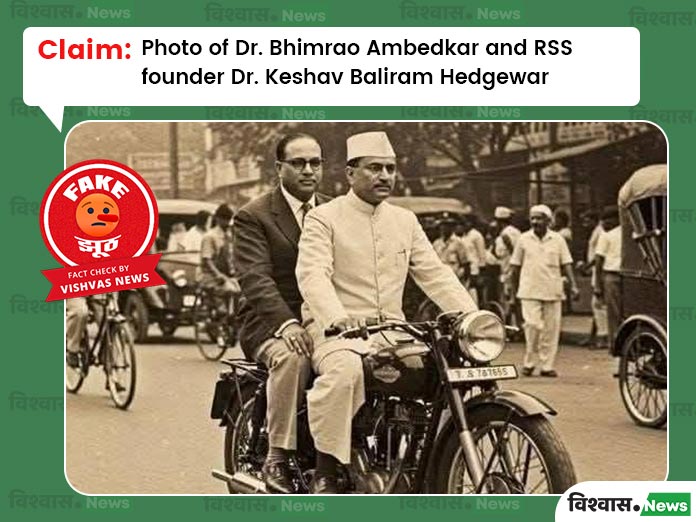
An image circulating widely on social media that appears to show Rashtriya Swayamsevak Sangh (RSS) founder K.B. Hedgewar riding a motorcycle with Dr. B.R. Ambedkar as a passenger has been confirmed as artificially generated, according to a thorough investigation by Vishvas News.
The viral image, which many social media users had assumed was an authentic historical photograph, was flagged for verification after being submitted to Vishvas News’ fact-checking tipline. The organization’s investigation revealed multiple inconsistencies that pointed to the image’s fabricated nature.
Researchers first established a historical timeline that made the encounter impossible. K.B. Hedgewar died on June 21, 1940, in Nagpur, while motorcycles only became widely available in India in the mid-1950s. The first significant motorcycle model in India, the Bullet 350, was initially imported by Madras Motors in 1949, with domestic production beginning in 1955 – well after Hedgewar’s death.
A search through government archives yielded no record or documentation of such a meeting between the two prominent historical figures on a motorcycle, further raising suspicions about the image’s authenticity.
Close visual examination of the photograph revealed several telltale signs of AI generation. The background appears unnaturally blurry, and some individuals in the scene have partially formed or distorted faces – a common artifact in AI-generated imagery. The motorcycle’s registration number, shown as “78787655,” is historically inaccurate, as early Indian vehicle number plates used alphanumeric provincial codes rather than long numeric sequences.
To confirm these suspicions, Vishvas News employed professional AI detection tools. Analysis with Hive Moderation, a specialized platform designed to identify artificially generated images, returned a 99% probability that the image was created using artificial intelligence. A second tool, “Was Is AI,” produced similar results, suggesting the image was not authentic.
AI expert Azhar Machwe, consulted by Vishvas News, reviewed the findings and definitively confirmed the image’s artificial origin.
This incident highlights the growing challenge of distinguishing between authentic historical documentation and sophisticated AI-generated content. As generative AI technology becomes more accessible and produces increasingly realistic images, the potential for historical misinformation grows significantly.
The circulation of such fabricated historical imagery can lead to misconceptions about relationships between significant figures in India’s political and social history. K.B. Hedgewar, who founded the RSS in 1925, and Dr. B.R. Ambedkar, the chief architect of India’s constitution and prominent Dalit rights advocate, represent different ideological perspectives in Indian political history.
Vishvas News has labeled the viral claim as “False” in its fact-check report, emphasizing the importance of verifying historical imagery, especially when it depicts unlikely scenarios or meetings between prominent figures.
The incident serves as a reminder for social media users to maintain healthy skepticism toward unusual or surprising historical images, particularly as AI technology makes the creation of convincing fake imagery increasingly accessible to the general public.
Fact Checker
Verify the accuracy of this article using The Disinformation Commission analysis and real-time sources.

9 Comments
Interesting to see this AI-generated image debunked. It’s important to verify the authenticity of historical photos before sharing them online, even if they seem plausible.
Thanks for the detailed fact-checking on this image. It’s concerning to see the spread of misinformation, even if unintentional. We need to be vigilant about verifying sources, especially for historical content.
Absolutely. Fact-checking is crucial to combat the rise of deepfakes and other manipulated media. Good on the Vishvas News team for their thorough investigation.
This is a good reminder of the potential pitfalls of AI-generated imagery. While the technology is advancing rapidly, we must be cautious about accepting visual ‘evidence’ at face value.
Fascinating how quickly this AI-generated image spread, despite the historical implausibility. Highlights the need for digital literacy and source verification, even for seemingly innocuous content.
The timeline inconsistencies highlighted in the investigation make it clear this was a fabricated image. Kudos to the fact-checkers for digging into the details.
The rapid spread of this debunked image shows the power of social media to amplify misinformation. Fact-checking efforts are essential to maintain trust in online content.
Agreed. The public has a responsibility to be more discerning consumers of digital media, but platforms and authorities also need to do more to curb the spread of manipulated content.
As AI-powered image generation becomes more sophisticated, it’s critical that we develop robust methods for identifying manipulated or synthetic media. This case study is a valuable lesson.