


Listen to the article
Iran Protest Flashlight Video Revealed as AI-Generated Footage
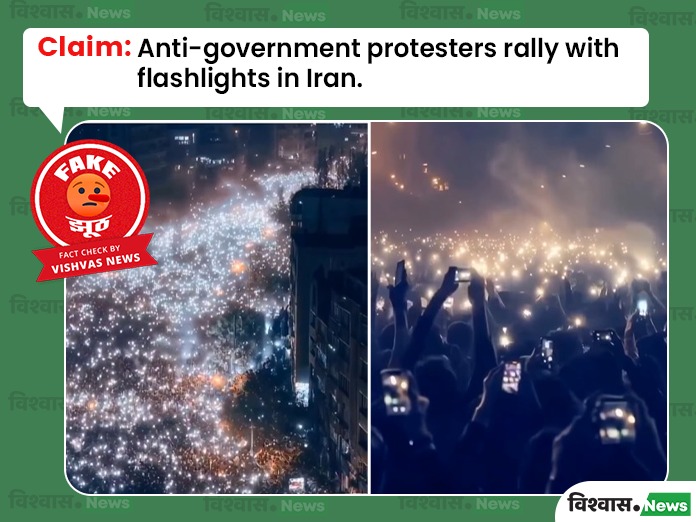
A video circulating widely on social media claiming to show Iranian protesters using mobile phone flashlights during recent anti-government demonstrations has been confirmed as AI-generated, according to fact-checking organization Vishvas News.
The fabricated footage, which depicts crowds of people illuminating darkened streets with their phone flashlights, has spread across multiple platforms with the hashtag “All Eyes on Iran.” Social media accounts sharing the video falsely claimed it showed events from January 10, 2026, in Tehran, where protesters supposedly used their phone lights after the government cut street lighting to obscure their numbers.
“This viral video captures a moment that never actually happened,” said a spokesperson from Vishvas News’ Deepfake Analysis Unit. “It’s a sophisticated example of how AI-generated content can be weaponized to spread misinformation about real-world events.”
The investigation traced the video to Instagram user elnaz555, who had clearly labeled it as an AI creation inspired by the ongoing protests. “Recently, a video surfaced showing a large crowd on the dark streets of Tehran… That moment inspired me to recreate that scene through art using AI,” the user wrote.
Multiple specialized AI detection tools confirmed the footage’s artificial nature. The University of Buffalo’s DeepFake-O-Meter indicated nearly 100% probability of AI manipulation across several detection algorithms. Similarly, TruthScan’s analysis returned a 100% probability score for AI generation, while tools like IsitAI and ImageWhisperer corroborated these findings.
The fabricated video emerges against the backdrop of genuine civil unrest in Iran, where according to Reuters, more than 500 people have reportedly been killed in anti-government protests. BBC reporting indicates demonstrations have spread across 80 districts in 24 of Iran’s 31 provinces as of early January 2026.
This incident highlights the growing challenge of distinguishing authentic footage from AI-generated content during critical events. As protests continue across Iran, the spread of such synthetic media threatens to complicate understanding of actual developments on the ground.
“What makes this particularly concerning is the specificity of the false narrative,” noted media analyst Sarah Khoury, who was not involved in the fact-check. “The fabricated video doesn’t just show generic protests—it tells a specific story about government actions and public resistance that never occurred, potentially influencing international perceptions of the conflict.”
Digital rights advocates point to this case as evidence for the urgent need for better media literacy and improved detection tools as AI-generated content becomes increasingly sophisticated and difficult to distinguish from genuine footage.
For individuals encountering protest footage from Iran or other regions experiencing civil unrest, experts recommend consulting multiple reliable news sources and checking whether content has been verified by established fact-checking organizations before sharing.
Fact Checker
Verify the accuracy of this article using The Disinformation Commission analysis and real-time sources.

12 Comments
Interesting to see how AI-generated content can be used to spread misinformation, even about important real-world events. It’s concerning how easily something like this could be shared and presented as authentic footage. Fact-checking is crucial to identify manipulated media.
You’re right, it’s a prime example of how AI can be misused for disinformation. Fact-checkers play a vital role in exposing these fabricated videos and maintaining public trust.
This is a troubling development, as AI-generated content can be increasingly difficult to distinguish from the real thing. Robust fact-checking processes are essential to counter the spread of misinformation, especially around sensitive political events.
Agreed. The ability of AI to create such convincing synthetic media is a double-edged sword. Responsible development and deployment of these technologies is crucial to prevent their malicious use.
It’s concerning to see how AI-generated content can be weaponized to distort the truth about protests and other real-world events. This highlights the growing need for media literacy and robust fact-checking to identify manipulated footage, even when it appears authentic.
You make a good point. As AI capabilities advance, the public must remain vigilant and critical when consuming online content, especially around sensitive topics. Fact-checking organizations play a vital role in maintaining the integrity of information.
This is a prime example of how AI-generated content can be used to mislead the public. It’s crucial that we develop better tools and processes to detect and counter the spread of fabricated media, especially when it relates to important real-world events.
Absolutely. The ability to create such convincing synthetic footage is concerning, and it highlights the need for increased media literacy and robust fact-checking to ensure the public has access to accurate information.
The use of AI-generated content to spread misinformation about the Iran protests is deeply troubling. It demonstrates the potential for these technologies to be exploited to distort the truth and sow confusion. Fact-checking and public awareness are crucial to address this growing challenge.
You’re right, this incident underscores the importance of maintaining a critical eye when consuming online media, especially around sensitive political events. Fact-checkers play a vital role in exposing manipulated content and preserving the integrity of information.
This is a concerning development, as it shows how AI-generated content can be used to spread misinformation and distort the narrative around real-world protests and events. It’s a reminder of the importance of media literacy and robust fact-checking to ensure the public has access to accurate information.
Exactly. As AI technologies become more advanced, the potential for misuse in the spread of disinformation also grows. Vigilance and critical thinking are essential to identify and counter these manipulated media efforts.