


Listen to the article
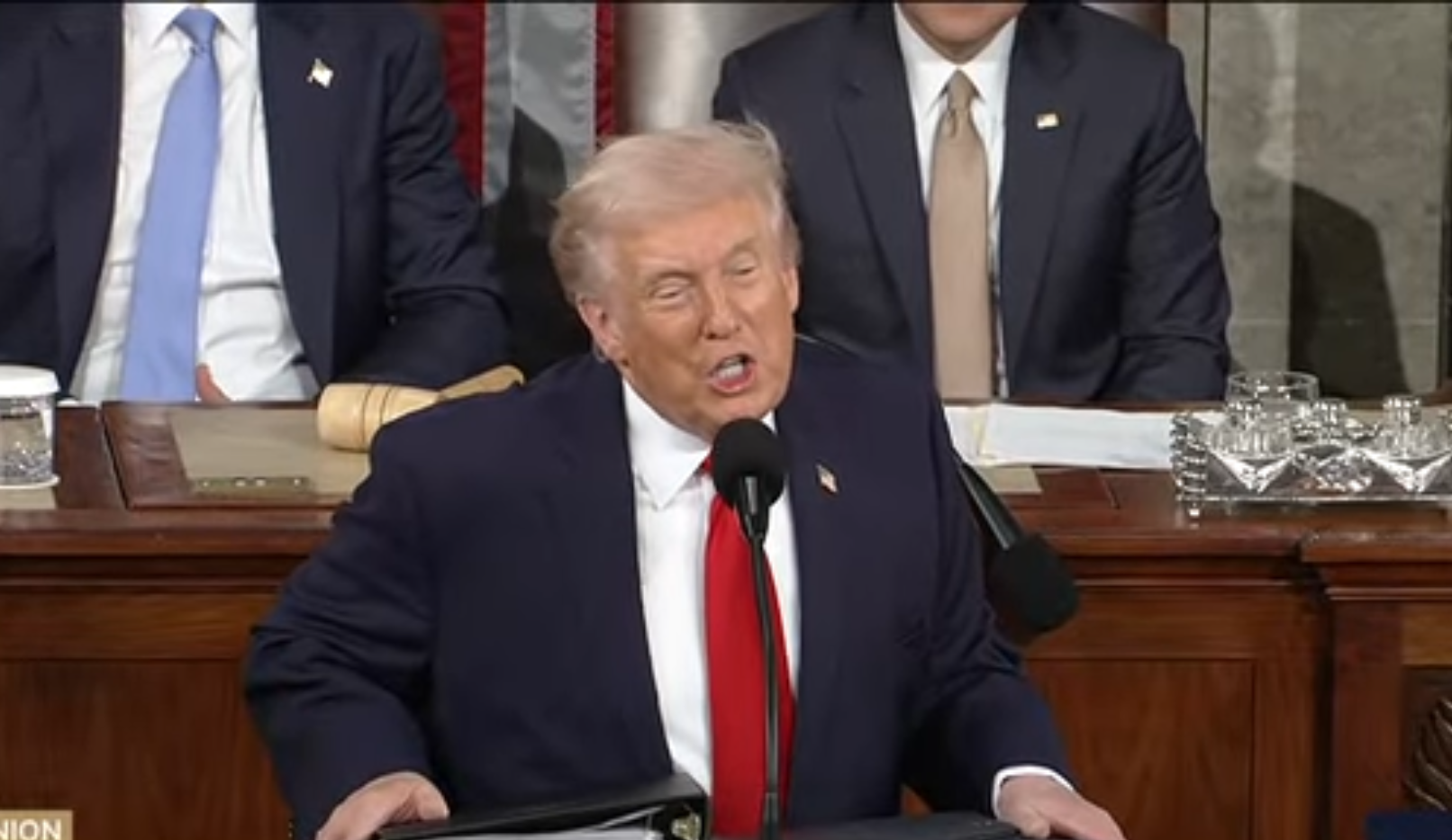
In a historic State of the Union address that stretched nearly one hour and 48 minutes—the longest on record—President Donald Trump delivered a speech laden with claims of economic triumph, stringent immigration policies, and heightened patriotic rhetoric.
Trump devoted significant portions of his address to immigration and border security, claiming the border is now completely secure with “zero illegal immigrants” entering the country in the past nine months—a statement fact-checkers have flagged as misleading. He repeatedly criticized the Biden administration for what he characterized as “open-border” policies that allowed immigrants to pour “in by the millions from prisons and mental institutions,” another unsubstantiated claim.
The president spotlighted several families he described as “angel moms and families,” including the case of 7-year-old Dalilah Coleman, who was injured in an accident involving an undocumented truck driver. Trump used Coleman’s story to advocate for the “Dalilah Law,” which would prohibit undocumented immigrants from obtaining commercial driver’s licenses—something already prohibited under current regulations. In a moment that raised eyebrows, Trump asked the young girl, who is still relearning to walk after her injuries, to “please stand up.”
“We’re getting them the hell out of here fast. We don’t want them,” Trump declared regarding undocumented immigrants, while calling for the abolition of sanctuary cities. He asserted his administration “will always allow people to come in legally,” despite implementing policies that have made legal immigration more difficult.
On the economy, which polls indicated was Americans’ primary concern, Trump touted what he described as a “stunning economic turnaround.” He highlighted decreasing inflation rates, lower gas prices, increased child tax credits, his “No Tax On Tips” pledge, and the creation of “Trump accounts” for American children.
Analysts noted several inaccuracies in his economic assertions. While Trump pledged to “always protect Social Security, Medicare, Medicaid,” his administration made cuts to these programs early in his term. He claimed to have brought in $18 trillion in foreign investments—a figure experts consider greatly inflated. His statement that the cost of living is “plummeting downward” contradicts economic data showing steady increases.
The president repeatedly credited his tariff policies for economic successes and expressed disappointment over a recent Supreme Court ruling that blocked some of those tariffs. In a bold prediction, Trump suggested tariffs would eventually replace income tax in America.
Foreign policy featured prominently throughout the address, with Trump discussing his approach to Iran, hostage negotiations between Hamas and Israel, and labeling drug cartels as Foreign Terrorist Organizations. He asserted that the Russia-Ukraine conflict “would have never happened if I were president” and referred to Venezuela, whose government his administration recently upended, as “our new friend and partner.”
The speech was frequently punctuated by chants of “USA, USA” and standing ovations from Republican lawmakers. In an unusual move, Trump invited the gold-medal winning U.S. men’s Olympic hockey team into the chamber and awarded goalkeeper Connor Hellebuyck the Presidential Medal of Freedom. The women’s hockey team, which also won gold but declined to attend following recent controversy, received only a brief mention.
The evening was not without discord. Approximately 50 Democratic lawmakers skipped the address entirely, while others staged protests during the speech. Rep. Ilhan Omar (D-Minnesota) interrupted Trump by shouting, “You have killed Americans!” Rep. Rashida Tlaib (D-Michigan) wore a pin with an anti-ICE slogan, and Rep. Al Green (D-Texas) was removed for displaying a sign reading “Black People Aren’t Apes!”—referring to a controversial AI-generated video Trump had posted on social media.
Throughout his address, Trump made numerous direct attacks on Democratic lawmakers in attendance, at times addressing them directly with comments like “you caused that problem” and “these people are crazy.” He referred to the Biden administration as “quite honestly, a disaster” and remarked that his current term “should be my third term, but strange things happen.”
Following the address, Virginia Governor Abigail Spanberger delivered the Democratic response, disputing Trump’s economic claims and condemning his immigration policies in a 13-minute rebuttal.
Fact Checker
Verify the accuracy of this article using The Disinformation Commission analysis and real-time sources.

8 Comments
With such a lengthy and wide-ranging speech, it will be important for the fact-check to delve into the nuances and provide context around the various claims made by the President. Transparency and accuracy are critical.
Interesting analysis of the President’s long State of the Union speech. Fact-checking claims around immigration and border security will be important to ensure the public has accurate information.
Agreed, the immigration and border security claims require close scrutiny. It’s crucial that policy decisions are based on verifiable facts, not unsubstantiated statements.
The mining, metals, and energy sectors will be watching this speech closely, given the potential policy implications. I hope the analysis provides a balanced, evidence-based assessment of the relevant claims and proposals.
Agreed. These industries have a major stake in the policy decisions that could stem from this address, so an impartial, data-driven review is essential.
As the largest State of the Union on record, this speech clearly had a lot of ground to cover. I’m curious to see how the various claims and proposals hold up under closer inspection by fact-checkers and policy experts.
The President’s use of specific cases like the Dalilah Coleman incident to advocate for policy changes is a common rhetorical tactic, though the factual basis should be examined. Nuance and objectivity are needed on these complex issues.
Good point. Anecdotal examples can be powerful but don’t necessarily reflect broader trends. Rigorous data analysis is required to assess the merits of proposed policies.