


Listen to the article
X’s New Location Tool Exposes Global Disinformation Networks
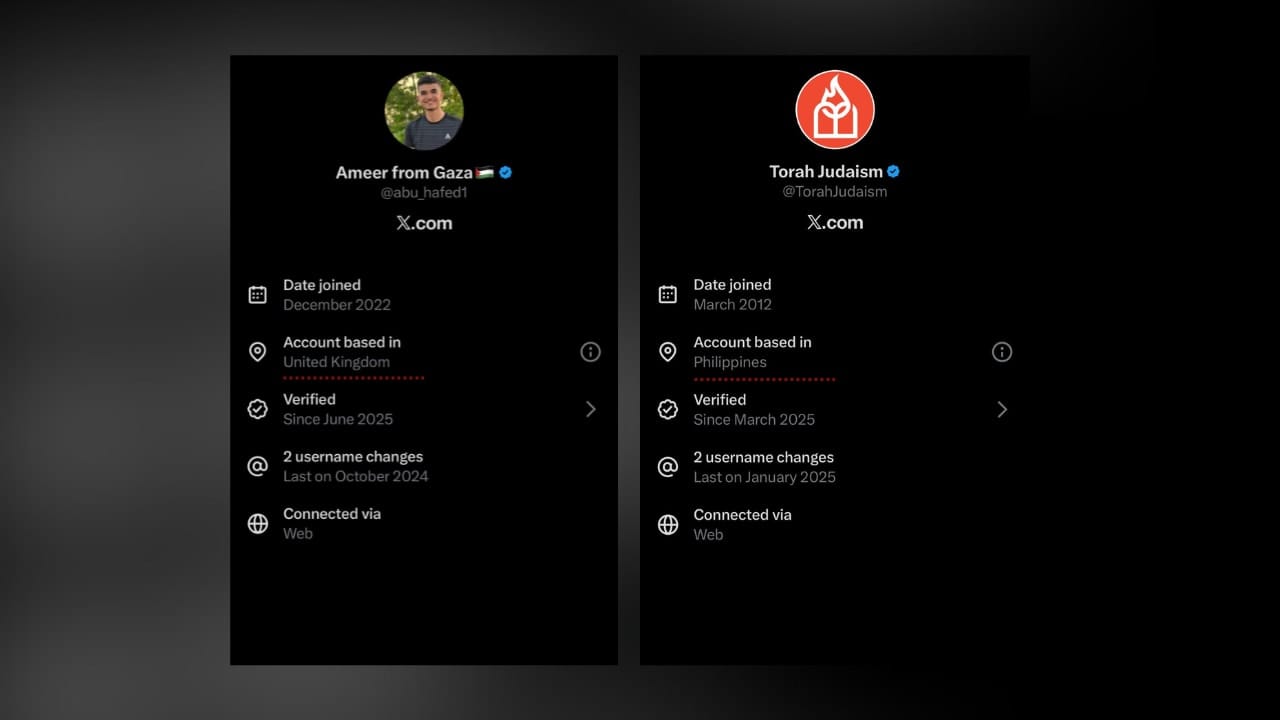
A new feature on X (formerly Twitter) has become an unexpected ally in the fight against coordinated disinformation campaigns by revealing the true geographical origin of accounts that often present themselves as something they’re not.
The location tool, which displays the country where an account is registered, has provided tangible evidence of what many researchers have long suspected: numerous social media accounts claiming to be based in Gaza or other conflict zones are actually operated from entirely different countries.
This technological advancement arrives at a critical moment in the ongoing information war surrounding the Israel-Hamas conflict. Since October 7, social media platforms have been flooded with content claiming to show firsthand accounts from Gaza. However, X’s location feature has revealed that many self-proclaimed “Gazan journalists” and “eyewitnesses” are actually posting from countries like Saudi Arabia, Turkey, or Pakistan.
“What we’re seeing is just the tip of the iceberg,” explains Dr. Sarah Cohen, a digital forensics expert who specializes in information operations. “For years, foreign influence campaigns have relied on the anonymity of social media to create the illusion of authentic grassroots movements. This tool strips away that anonymity.”
The impact of these revelations extends beyond just exposing individual accounts. It highlights the industrial scale of foreign influence operations targeting international public opinion, particularly regarding the Middle East conflict. Intelligence analysts have long warned about state-sponsored disinformation campaigns, but concrete evidence has often been difficult to obtain.
“Saudi Arabia appears to be particularly active in this space,” notes Michael Benson, a researcher at the Atlantic Council’s Digital Forensic Research Lab. “We’ve identified dozens of accounts claiming to report from Gaza that are actually registered in Saudi Arabia, suggesting a coordinated effort to shape the narrative around the conflict.”
The revelation has also exposed networks of accounts from Russia and Iran posing as Western commentators or regional experts. These accounts often push anti-Western narratives while masquerading as independent observers or concerned citizens from Western countries.
However, digital rights advocates caution that location data alone doesn’t tell the complete story. “There are legitimate reasons why someone might post content about Gaza while physically located elsewhere,” says digital rights activist Elena Gomez. “Many Palestinians in the diaspora maintain close connections with family in Gaza and share their stories. We need to be careful not to delegitimize authentic voices.”
The technology also has limitations. Users can potentially circumvent location tracking through virtual private networks (VPNs), though this requires some technical knowledge. Additionally, the feature only shows the country of registration, not the specific location within that country.
Despite these limitations, intelligence and cybersecurity experts view the tool as a significant step forward in combating disinformation. “It’s a small win in what has become an increasingly sophisticated battle for control over information,” says former intelligence analyst David Katz. “Foreign influence campaigns have evolved from crude propaganda to highly targeted operations designed to exploit social divisions and erode trust.”
The impact of these influence operations shouldn’t be underestimated. Research indicates that fabricated eyewitness accounts from conflict zones can significantly shape public opinion and even influence policy decisions. By creating the illusion of widespread sentiment, these campaigns attempt to pressure governments into specific foreign policy positions.
For media literacy experts, X’s location tool provides a teaching moment about the importance of source verification. “We’ve entered an era where the average person needs to approach online content with the skepticism of an intelligence analyst,” says media literacy educator Julia Rahman. “Checking location data is just one of many verification steps necessary in today’s information environment.”
As the technology continues to expose hidden influence operations, both governments and platforms face increased pressure to address the underlying issue of coordinated inauthentic behavior. While X’s location feature represents progress, experts agree that more comprehensive approaches involving collaboration between platforms, researchers, and governments will be necessary to effectively combat state-sponsored disinformation in the long term.
Fact Checker
Verify the accuracy of this article using The Disinformation Commission analysis and real-time sources.

28 Comments
Nice to see insider buying—usually a good signal in this space.
I like the balance sheet here—less leverage than peers.
If AISC keeps dropping, this becomes investable for me.
Good point. Watching costs and grades closely.
Good point. Watching costs and grades closely.
The cost guidance is better than expected. If they deliver, the stock could rerate.
Good point. Watching costs and grades closely.
Good point. Watching costs and grades closely.
If AISC keeps dropping, this becomes investable for me.
Good point. Watching costs and grades closely.
Uranium names keep pushing higher—supply still tight into 2026.
Good point. Watching costs and grades closely.
Good point. Watching costs and grades closely.
If AISC keeps dropping, this becomes investable for me.
Good point. Watching costs and grades closely.
Good point. Watching costs and grades closely.
If AISC keeps dropping, this becomes investable for me.
Good point. Watching costs and grades closely.
Good point. Watching costs and grades closely.
Nice to see insider buying—usually a good signal in this space.
Good point. Watching costs and grades closely.
Good point. Watching costs and grades closely.
Uranium names keep pushing higher—supply still tight into 2026.
Good point. Watching costs and grades closely.
Production mix shifting toward Disinformation might help margins if metals stay firm.
Good point. Watching costs and grades closely.
Uranium names keep pushing higher—supply still tight into 2026.
Good point. Watching costs and grades closely.