


Listen to the article
In a landmark legal case that may reshape how political dissent is treated in America, eight protesters were found guilty of domestic terrorism charges last week in Texas, marking the first time such convictions have been linked to antifascism, commonly known as “antifa.”
The case stemmed from a July 2025 protest at an Immigration and Customs Enforcement (ICE) detention facility near Fort Worth, where demonstrators had gathered to show solidarity with detainees. While many protesters had firearms—legal in Texas, an open carry state—most left their weapons in their vehicles before participating in what they intended to be a peaceful demonstration.
According to court records, the situation escalated when at least one individual allegedly opened fire, wounding a police officer. While prosecutors characterized the incident as a coordinated attack by “antifa operatives,” only one defendant was convicted of attempted murder, with the others found guilty under broader terrorism statutes.
Legal experts have voiced concern about the precedent this case sets. The convictions represent the first time in U.S. history that individuals have been found guilty of terrorism charges specifically connected to antifascism, and the first time the government has explicitly prosecuted people for alleged membership in what prosecutors described as an “Antifa cell.”
What makes the case particularly notable is that these charges didn’t require prosecutors to link defendants to any specific organization. Unlike foreign terrorism cases, the U.S. government maintains no official list of domestic terrorist groups, as such designations have traditionally been considered constitutionally problematic under First Amendment protections.
Nevertheless, the Trump administration designated antifa as a domestic terrorist organization in September, setting the stage for these prosecutions. Civil liberties attorneys warn the verdict could establish a dangerous precedent for criminalizing constitutionally protected protests.
Beyond its legal implications, the case exemplifies a sophisticated information warfare campaign that has effectively manufactured an enemy out of American citizens. While antifascism has existed for decades in the U.S. and longer in Europe, it only gained prominence following the 2016 election.
The narrative surrounding antifascism intensified after the deadly 2017 Unite the Right rally in Charlottesville, when the administration began promoting the concept of a violent “alt-left” allegedly equivalent to right-wing extremists—despite data consistently showing violent extremism in America remains predominantly a right-wing phenomenon.
Over subsequent years, this portrayal developed into what critics describe as a coordinated disinformation campaign involving government officials, think tanks, social media influencers, and right-wing media outlets. The campaign operated on dual tracks: associating antifascism with violence and anti-American sentiment, while simultaneously expanding the definition of antifascism to encompass virtually any liberal or left-leaning activist movement.
Media coverage played a crucial role in this effort. When property damage occurred at protests, certain news outlets would feature footage of the destruction for days, while social media accounts circulated images—some authentic, others manipulated—attempting to link incidents to immigrants, socialists, feminists, or transgender individuals.
The disinformation ecosystem even included the creation of fake social media accounts posing as antifascists planning violence, according to investigations. Court documents have also revealed instances of extremists dressing in black to impersonate antifa activists and incite violence.
These tactics have triggered real-world consequences, with viral rumors about antifa “invasions” prompting armed citizens to “defend” their communities against nonexistent threats. In several instances, local law enforcement agencies diverted resources to address these manufactured threats.
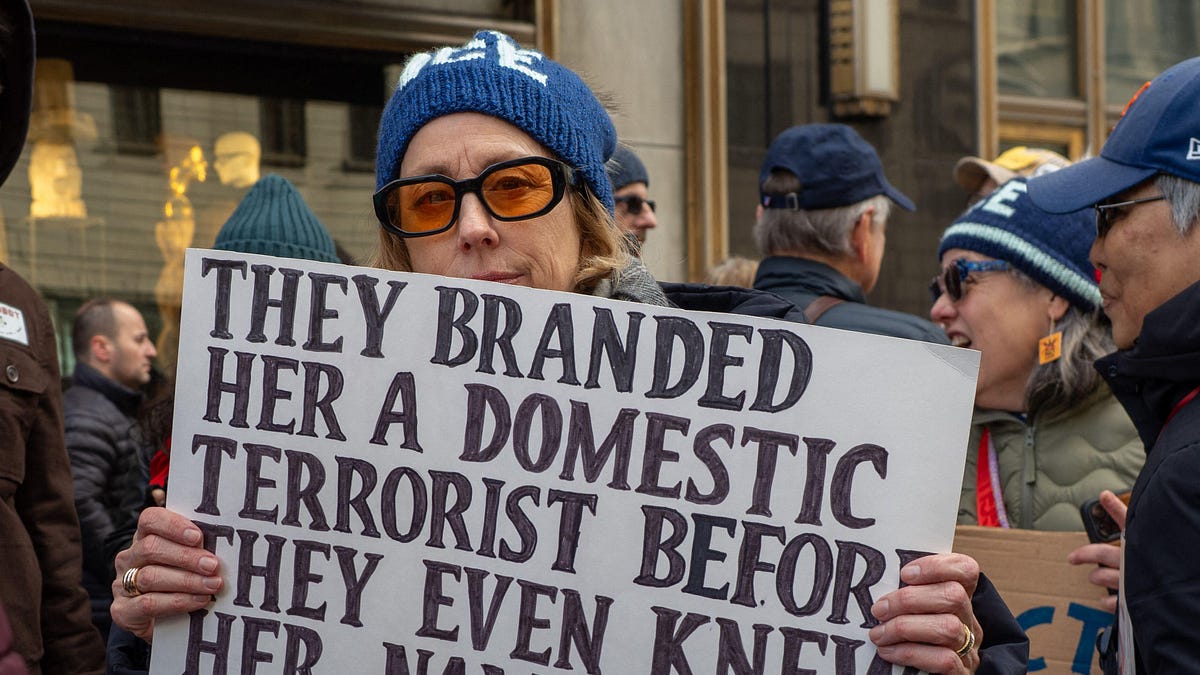
The administration now appears to be applying this strategy more broadly. Critics point to the cases of Renee Nicole Good and Alex Pretti, American citizens killed by federal law enforcement officers during peaceful protests against ICE earlier this year. Both were immediately labeled “domestic terrorists” by administration officials despite engaging in no activities resembling terrorism.
This creates what civil liberties advocates call a self-reinforcing loop: the application of the “domestic terrorist” label becomes its own justification, requiring no evidence while providing cover for increasingly severe responses to political dissent.
“This is the power of disinformation,” says one legal scholar who requested anonymity for safety concerns. “Rather than creating something new, it works by reshaping existing realities—redefining words, reframing lawful protest as threats, and ultimately transforming citizens into enemies.”
Fact Checker
Verify the accuracy of this article using The Disinformation Commission analysis and real-time sources.

7 Comments
This case raises serious questions about the state of free speech and assembly in the US. Using heavy-handed tactics to quash protest movements is a troubling development.
While the actions of the protesters may have been unwise, convicting them of domestic terrorism seems like an extreme overreaction. This case deserves careful scrutiny.
Labeling anti-fascist protesters as ‘terrorists’ is a concerning attempt to stifle dissent. We need to be vigilant about preserving civil liberties, even in times of political turmoil.
The details of this case are murky, but weaponizing anti-terrorism statutes against protesters is a dangerous precedent. We need to safeguard the right to peaceful assembly.
I agree, this sets a worrying precedent. The line between legitimate protest and terrorism is being blurred in a way that undermines democratic norms.
This is a troubling development that highlights the growing divide in American politics. Using anti-terrorism laws to crack down on political dissent is a concerning erosion of civil liberties.
I’m curious to see how this case plays out on appeal. The terrorism charges seem like an overreach given the unclear circumstances.